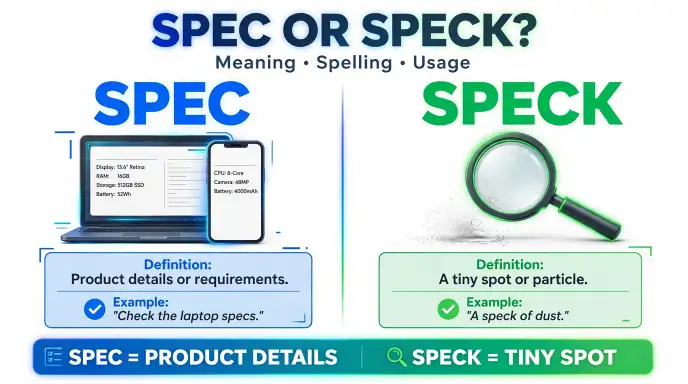
The words spec and speck are both correct, but they have different meanings. Spec is usually short for specification, which means the details or requirements of something. Speck means a tiny spot, mark, or particle.
People often search for “spec or speck” because the words sound alike. However, choosing the wrong word can change the meaning of a sentence. For example, a laptop’s specs describe its features, while a speck of dust is a tiny piece of dirt.
Understanding the difference helps you write clearly in emails, product descriptions, schoolwork, and everyday conversations. It is especially useful when discussing technology, cars, construction, or other products with technical requirements.
In this guide, you will learn the meaning and origin of both words, explore British and American usage, and discover common spelling mistakes. You will also find practical examples, writing tips, and answers to frequently asked questions. By the end, you will know which word to use in different situations.
Featured Snippet: What Is the Difference Between Spec and Speck?
Spec means a specification, detail, or requirement, often related to a product or project. Speck means a tiny spot, mark, or particle. For example, you check a computer’s specs before buying it, but you wipe a speck of dust from its screen. Both spellings are correct in British and American English.
Spec or Speck: Quick Answer
Use spec when you mean a specification or requirement. Use speck when you mean something tiny, such as a spot of dust or a small mark.
Examples:
- Spec: The phone has impressive specs.
- Speck: A speck of dirt covered the screen.
- Spec: The builder checked the project specs.
- Speck: There is not a speck of paint on the floor.
Remember this simple rule: specs describe details, while specks are tiny spots.
What Does Spec or Speck Mean?
Although these words sound alike, they serve different purposes in English.
What Does Spec Mean?
Spec is an informal noun that usually stands for specification. A specification gives details about how something should look, work, or be made.
People often use this word when talking about computers, phones, cars, buildings, and other products. It is a shorter way to refer to technical details or requirements.
Examples:
- The laptop has good specs for its price.
- Please check the product spec before ordering.
- The designer followed the client’s specs.
The word can also work as a verb. To spec something means to plan or define it according to certain requirements.
Example: The company will spec the computer for graphic design.
What Does Speck Mean?
A speck is a very small spot, mark, or particle. It may be so tiny that you need to look closely to see it.
You can use this word to describe dust, dirt, paint, food, or small marks on a surface. It can also describe something that looks tiny from far away.
Examples:
- A speck of dust landed on the screen.
- She noticed a speck of paint on her shirt.
- The island looked like a tiny speck in the sea.
The word can also describe a very small amount of something.
Example: There was not a speck of sugar left in the bowl.
What Is the Difference Between Specs and Specks?
Specs is the plural of spec. It often refers to product features or requirements. In informal British English, it can also mean eyeglasses.
Specks is the plural of speck. It refers to several tiny spots or particles.
| Word | Meaning | Example |
| Spec | One specification or requirement | Read the spec carefully. |
| Specs | Specifications or informal term for glasses | Check the phone specs. |
| Speck | One tiny spot or particle | A speck of dust appeared. |
| Specks | Several tiny spots or particles | Specks covered the glass. |
The Origin of Spec and Speck
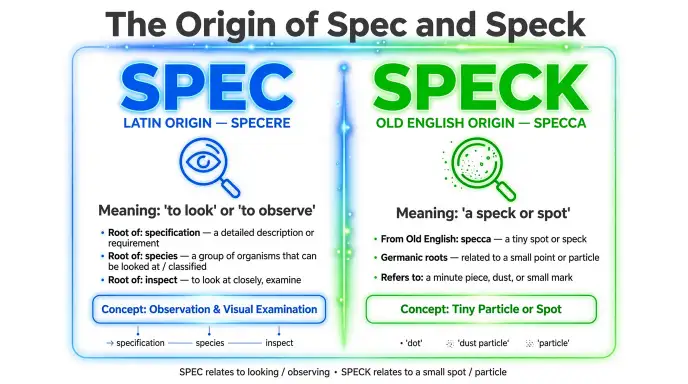
The two words have different histories, even though they sound alike today.
Where Did Spec Come From?
Spec developed as a shortened form of specification. It became useful in technical and business settings, where people often needed a quick way to discuss product details and project requirements.
The word is now common in technology, engineering, construction, product design, and shopping.
For example, when someone asks about a phone’s specs, they usually want details such as storage capacity, screen size, battery life, and processor speed.
The phrase on spec has a separate use. It can mean doing work without a firm agreement or payment guarantee, in the hope that someone will accept or buy it.
Example: She wrote an article on spec and hoped a magazine would publish it.
Where Did Speck Come From?
Speck has much older roots. It comes from the Old English word specca, which referred to a small spot or mark. The word continued through Middle English and retained its basic meaning.
Its deeper origin is uncertain, so it is best not to claim a more specific root without reliable evidence.
Today, speck remains a common word in everyday speech and descriptive writing. People use it to describe tiny particles, small stains, and distant objects that appear very small.
Why Are Spec and Speck Confused?
The words are easy to mix up because they sound alike and differ by only one letter.
Their meanings, however, are not interchangeable:
- Spec relates to details, features, or requirements.
- Speck relates to tiny spots, marks, or particles.
The extra k in speck can help you remember the word for a tiny spot.
British English vs American English
Both spec and speck are standard words in British and American English. Their spellings do not change between these varieties.
| British English | American English | Example |
| Spec | Spec | Check the product spec. |
| Specs | Specs | The computer specs look good. |
| Speck | Speck | A speck of dust fell. |
| Specks | Specks | Small specks covered the surface. |
Are There Any Regional Differences?
The main difference is how people use certain expressions.
In British English, specs is a familiar informal term for eyeglasses. For example, “I cannot read the sign without my specs.”
In American English, people usually say glasses in everyday conversation. However, both varieties use spec and specs when discussing product specifications.
What Do Style Guides Recommend?
For formal documents, specification may be clearer than spec, especially when readers may not know the abbreviation.
In product reviews, technical discussions, and informal business messages, spec or specs is often suitable. Choose wording that fits the audience and the type of document.
Neither spec nor speck is an incorrect regional spelling of the other. They are separate words with different meanings.
Which Version Should You Use?
The correct choice depends on what you want to say, not where you live.
United States
Use spec or specs when referring to product features. Use speck or specks for tiny marks or particles.
Example: The phone specs are impressive, but there is a speck of dust on the screen.
United Kingdom
Follow the same spelling rules. You can also use specs as an informal term for eyeglasses.
Example: I checked the computer specs before buying new specs for my eyes.
Canada
Both words have the same meanings as in other English-speaking countries. Use specs for product details and specks for tiny particles.
Australia
The standard spellings are also spec and speck. Choose the word that matches the intended meaning.
International Writing
For an international audience, use clear wording. If readers may not understand spec, write specification instead.
Academic Writing
Use specification when you need a formal tone or must explain a technical requirement. Use speck when describing a small mark or particle.
Business Writing
Spec is useful in product descriptions, project plans, and technical emails. Speck is useful when reporting a small stain or defect.
For example, “The product meets the agreed specs” and “A speck of paint remains on the surface” are both correct.
Common Mistakes with Spec or Speck
Writers often confuse these words when typing quickly or relying on pronunciation alone.
1. Using Speck for Product Details
Incorrect: This laptop has excellent specks.
Correct: This laptop has excellent specs.
Why: Specs refers to the laptop’s features, such as memory, storage, and processor speed.
2. Using Spec for a Tiny Mark
Incorrect: There is a spec of dirt on the window.
Correct: There is a speck of dirt on the window.
Why: A speck is a tiny spot or particle.
3. Confusing Specs and Specks
Incorrect: The screen has several specs of dust.
Correct: The screen has several specks of dust.
Why: Use specks for tiny particles. Use specs for specifications or, informally, eyeglasses.
4. Assuming Spec Is Always Technical
The word spec can appear in expressions such as on spec, where it has a different meaning.
Example: The writer prepared the article on spec.
Tip: Connect spec with specification and speck with tiny spot. This simple memory trick helps you choose the right word.
Spec or Speck in Everyday Examples
These words appear in many types of writing. The context tells you which one to use.
Emails
Using spec:
“Please send me the product specs before I place the order.”
Using speck:
“I noticed a speck of dust on the sample. Could you clean it before shipping?”
Business Writing
- The team reviewed the project specs before work began.
- The quality inspector found a speck of paint on the finished product.
News Headlines
- New Smartphone Specs Reveal a Larger Battery
- Tiny Specks of Dust Found on Display Surface
Blog Posts
- “Compare Laptop Specs Before You Buy”
- “How to Remove Dust Specks from Your Screen”
Social Media
- “These phone specs are amazing!”
- “I cleaned my desk, but I still found tiny specks of dust.”
Academic Writing
- The researcher recorded the equipment specs before beginning the experiment.
- Several dark specks appeared on the surface of the sample.
In formal academic work, specifications may be clearer than specs, depending on the subject.
Daily Conversation
- “What are the specs of your new computer?”
- “Can you see that speck on your shirt?”
- “I forgot my specs at home.”
The last example uses specs to mean eyeglasses, an informal usage especially familiar in British English.
Google Trends and Modern Usage
The words spec and speck appear in different contexts, so their search popularity can be difficult to compare directly.
Why Do People Search for These Words?
Several factors may explain the confusion:
- Similar pronunciation: Both words sound alike in common English pronunciation.
- Technology and shopping: People often look up product specs before buying computers, phones, or cars.
- Spelling mistakes: Writers may type one word when they mean the other.
- English learning: Students often need help with words that sound alike but have different meanings.
Which Word Is More Common?
Usage depends on the topic. Specs is common in product reviews, technology articles, and informal discussions about eyeglasses. Specks appears in descriptions of dust, dirt, stains, and tiny particles.
Without a specific Google Trends comparison and date range, it would be misleading to claim that one word is more popular worldwide. Search results can vary by country, period, and topic.
You can compare interest in the terms using . Remember that search interest does not measure every use of a word in books, conversations, or websites.
For , focus on the meaning your readers want. Use specs for product features and specks for tiny marks. Avoid repeating both words just to increase keyword frequency.
Quick Comparison Table
| Version | Meaning | Correct? | Region | Example |
| Spec | A specification or requirement | Yes | US, UK, and other English-speaking regions | Check the project spec. |
| Specs | Specifications or informal term for eyeglasses | Yes | International; eyeglasses usage is especially familiar in the UK | The phone specs look good. |
| Speck | A tiny spot or particle | Yes | US, UK, and other English-speaking regions | A speck of dust fell. |
| Specks | Tiny spots or particles | Yes | US, UK, and other English-speaking regions | Specks covered the surface. |
Key Takeaways
- Spec is a shortened form of specification.
- Speck means a tiny spot, mark, or particle.
- Both words are correct in American and British English.
- Specs is the plural of spec and can also mean eyeglasses.
- Specks is the plural of speck.
- Use the surrounding sentence to decide which word fits.
- In formal writing, specification may be clearer than spec.
- Remember: specifications are specs, while tiny particles are specks.
Frequently Asked Questions
1. What is the difference between spec and speck?
Spec usually means a specification, requirement, or product detail. Speck means a tiny spot or particle. For example, you check a laptop’s specs before buying it, but you might wipe a speck of dust from its screen. The words sound alike, but you cannot use them interchangeably.
2. Is spec a real word?
Yes. Spec is a recognized English word and an informal abbreviation of specification. It is common in technology, engineering, construction, and product descriptions. It can also be used as a verb. In formal writing, the full word specification may be more suitable when clarity matters.
3. Is speck the same as a spot?
The words have similar meanings, but they are not always identical. A speck usually refers to a very small spot or particle. A spot can be much larger and may describe a mark, stain, or area. For example, a tiny dot of dust is a speck, while a large stain is usually called a spot.
4. Is specs short for specifications?
Yes. Specs is a common informal plural form of spec, which stands for specification. People use it to describe the features or requirements of a product. For example, “Check the camera specs” means to review details such as its resolution, lens, and other features.
5. Can specs mean glasses?
Yes. Specs is an informal term for eyeglasses, especially in British English. For example, “I need my specs to read the menu” means the speaker needs their glasses. The same word can also mean specifications, so the surrounding sentence tells you which meaning is intended.
6. What is the plural of speck?
The plural of speck is specks. Use it when describing more than one tiny spot or particle. For example, “Several specks of dust covered the table.” Do not use specs for tiny particles because that spelling usually refers to specifications or eyeglasses.
7. Are spec and speck pronounced the same?
In common English pronunciation, spec and speck sound the same. Both rhyme with words such as check and neck. Because you cannot always tell the difference by hearing the words, pay attention to the spelling and meaning when reading or writing them.
8. How can I remember when to use spec or speck?
Connect spec with specification. Both relate to details or requirements. Remember that speck has an extra k and means a tiny spot or particle. When describing a product, use specs. When describing dust, dirt, or a tiny mark, use speck or specks.
9. Should I use spec or specification in formal writing?
Use specification when you need a clear, formal tone or when readers may not know the abbreviation. Spec is often suitable for technical discussions, product reviews, and familiar business settings. The best choice depends on your audience, the type of document, and how clearly the term is understood.
10. Is spec or speck correct in American and British English?
Both are correct in American and British English, but their meanings differ. Spec refers to a specification, while speck means a tiny mark or particle. British English also commonly uses specs as an informal word for eyeglasses. These are differences in meaning and usage, not spelling rules.
Conclusion
The difference between spec and speck is simple once you understand what each word describes. Spec is usually short for specification, so it refers to the details, features, or requirements of something. Speck means a tiny spot, mark, or particle.
Both words are correct in American and British English. Your choice does not depend on regional spelling. Instead, it depends on the meaning of your sentence. You might check the specs of a new phone, follow the specs for a building project, or notice a speck of dust on a screen.
Remember that specs can also mean eyeglasses in informal British English. If you are writing for work or school, choose the word that gives your reader the clearest meaning. When the abbreviation might cause confusion, write specification instead.
The easiest way to remember the difference is to connect spec with specifications and speck with tiny spots. Use this rule in your writing, and you will be much less likely to mix them up. Share this guide with anyone who finds these similar-sounding words confusing.
Improve Your Grammar!

I’m Ethan Carter, a grammar-focused writer and English language enthusiast at SpellGrammar. I enjoy explaining confusing words, spelling differences, and grammar rules in clear, simple language. My goal is to help readers write with greater accuracy and confidence in everyday and professional English.







