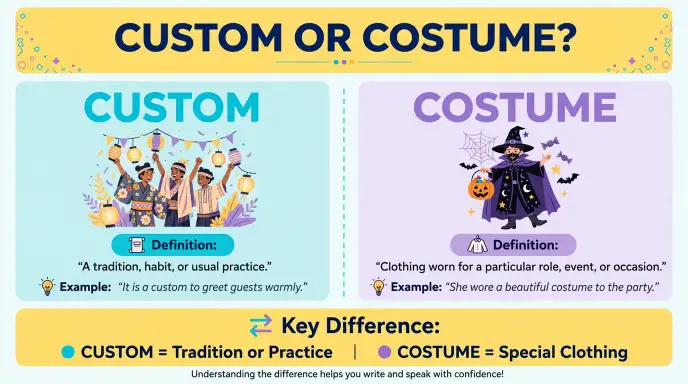
Custom and costume are both correct English words, but they have different meanings and uses. A custom is a usual way of doing something or a tradition, while a costume is a set of clothes worn for a special purpose, such as a party, performance, or cultural event.
People often search for “custom or costume” because the words look similar and share some letters. However, they cannot be used in place of each other. Choosing the wrong word can change the meaning of a sentence and make your writing unclear.
For example, a family may follow a traditional custom during a wedding, while a guest may wear a special costume for a themed party. One word describes a practice or tradition, and the other describes clothing.
Understanding this difference can help students, English learners, writers, and editors avoid common word-choice mistakes. In this guide, you will learn the meaning and origin of both words, how to use them correctly, and how to choose the right word in everyday situations. You will also find clear examples, spelling tips, and answers to common questions.
Custom or Costume: Quick Answer
Custom means a tradition, habit, or usual practice. Costume means clothing worn for a particular occasion, role, or performance.
Examples:
- Custom: It is a local custom to greet guests warmly.
- Costume: She wore a fairy costume to the party.
- Custom: Exchanging gifts is a holiday custom in many families.
Remember this simple rule: a custom is something people do, while a costume is something people wear.
Definition and Meaning of Custom or Costume
Although custom and costume look similar, they describe different things. Learning their meanings will help you use each word with confidence.
What Does Custom Mean?
A custom is a common practice, tradition, or habit followed by a person, family, group, or community.
It can describe a social rule that people follow over time. Customs may be linked to weddings, holidays, greetings, food, or religious and cultural events.
Examples:
- It is a local custom to remove your shoes before entering the house.
- Giving gifts is a common birthday custom.
- The village has a custom of holding a yearly festival.
The word custom can also describe something made or changed for a particular person or purpose when used as an adjective.
Examples:
- She ordered a custom desk for her office.
- The company offers custom designs.
- He bought a custom-made suit.
In these examples, custom means specially made or tailored to meet particular needs.
What Does Costume Mean?
A costume is a set of clothes worn to represent a character, fit a theme, or suit a special event.
Costumes are common in plays, films, dance performances, Halloween celebrations, and themed parties. The word can also describe traditional clothing linked to a culture or historical period.
Examples:
- The actor wore a royal costume in the play.
- My son chose a dinosaur costume for Halloween.
- The dancers wore traditional costumes.
A costume is usually more specific than ordinary everyday clothing. It may help someone represent a character, period, role, or cultural tradition.
What Is the Main Difference Between Custom and Costume?
The main difference is their meaning and purpose.
| Word | Meaning | Example |
| Custom | A tradition or usual practice | It is a wedding custom to give gifts. |
| Custom | Made for a particular person or need | She ordered a custom dress. |
| Costume | Clothing worn for a role or event | He wore a pirate costume. |
Notice that custom has more than one use. It can describe a tradition or something specially made. Costume refers to clothing, especially clothing associated with a particular role, occasion, or style.
The Origin of Custom or Costume
The words custom and costume have related histories, but their meanings developed in different ways.
Origin of Custom
The English word custom came through Old French from Latin consuetudo, which referred to a habit, practice, or established way of doing something.
Over time, the word came to describe traditions and practices that people follow regularly. It also developed the adjective use found in expressions such as custom design and custom-made furniture.
Today, custom can refer to a cultural tradition, a repeated practice, or a product made to suit a particular need.
Origin of Costume
The word costume entered English through French costume, which came from Italian costume. The Italian word referred to custom, habit, or established practice and was related to Latin consuetudo.
In English, costume became strongly associated with clothing that reflects a particular period, character, culture, or occasion.
For example, a costume designer creates clothing for actors, while a historical costume may show how people dressed in an earlier period.
Why Do People Confuse These Words?
Both words share similar letters and have a historical connection to the idea of established practices or ways of life. Their modern meanings, however, are different.
The easiest way to remember the difference is to focus on what each word describes:
- Custom: What people do or something specially made.
- Costume: What people wear for a particular role or occasion.
Their spelling is not a British-versus-American difference. Both words are standard in the main varieties of English.
British English vs American English Spelling
There is no spelling difference between custom and costume in British and American English. Both words use the same spelling in the United States, the United Kingdom, Canada, and Australia.
The difference lies in their meanings, not their regional spelling.
| Feature | British English | American English | Example |
| Tradition or practice | Custom | Custom | It is a local custom. |
| Specially made | Custom | Custom | He ordered a custom table. |
| Special clothing | Costume | Costume | She wore a costume. |
| Plural of custom | Customs | Customs | Family customs vary. |
| Plural of costume | Costumes | Costumes | The costumes look bright. |
Do British and American Writers Use These Words Differently?
Both varieties of English use the words in the same general ways.
A British writer might say, “The children wore costumes at the school event.” An American writer can use the exact same sentence.
Likewise, “It is a local custom to greet visitors” is correct in both varieties.
What About the Word Customs?
The plural customs has another common meaning. It can refer to the government service that checks goods and travelers entering or leaving a country.
For example:
- We passed through customs at the airport.
- Customs officers checked the luggage.
This meaning is separate from the use of customs to describe traditions or common practices.
Which Spelling Should You Use?
Both custom and costume are correct words. Your choice should depend on what you want to say, not where your readers live.
United States
Use custom for a tradition or something made to order. Use costume for special clothing.
- Correct: The company created a custom table.
- Correct: The child wore a superhero costume.
United Kingdom
The same rules apply in British English.
- Correct: It is a local custom to serve tea to guests.
- Correct: The actor wore a historical costume.
Canada and Australia
Writers in Canada and Australia also use both words with the same meanings. Neither word has a special regional spelling.
International Writing
For international readers, choose the word that matches your intended meaning. Avoid using costume when you mean a tradition or custom when you mean special clothing.
Academic Writing
In essays, reports, and research papers, use custom when discussing social practices or cultural traditions. Use costume when writing about clothing, theater, film, or historical dress.
For example:
“Wedding customs vary across communities, while traditional costumes may reflect regional identity.”
Business Writing
Use custom when describing a product made to meet a customer’s needs.
For example:
“Our company provides custom furniture for homes and offices.”
Use costume when the subject is theatrical clothing, event outfits, or other special dress.
Common Mistakes with Custom or Costume
These words are easy to confuse, but a few simple rules can prevent most errors.
1. Using Costume Instead of Custom
Incorrect: It is a local costume to greet guests.
Correct: It is a local custom to greet guests.
Why: Greeting guests is a social practice, not a type of clothing.
2. Using Custom Instead of Costume
Incorrect: She wore a witch custom for Halloween.
Correct: She wore a witch costume for Halloween.
Why: The sentence describes clothing worn for an event, so costume is the right word.
3. Confusing Custom-Made with Costume
Incorrect: He ordered a costume table for his living room.
Correct: He ordered a custom-made table for his living room.
Why: The table was specially made to meet his needs. It was not clothing for a role or event.
4. Forgetting the Different Meanings of Customs
The word customs can mean traditions or a government service at a border or airport.
Examples:
- Family customs can change over time.
- Travelers may need to declare goods at customs.
Use the surrounding sentence to determine which meaning is intended.
5. Assuming the Words Are Regional Variants
Incorrect assumption: Custom is British, and costume is American.
Correction: Both words are used in British and American English.
Memory tip: A custom is a practice; a costume is clothing. If you are talking about what someone wears, costume may be the word you need.
Custom or Costume in Everyday Examples
The words appear in everyday conversation, emails, business documents, news stories, and educational writing.
In Emails
Custom:
“Hello, we would like to order a custom table that fits the dimensions of our office.”
Costume:
“Hi, please remember to bring your costume for the school performance tomorrow.”
In Business Writing
Custom:
“Our team creates custom websites based on each client’s goals.”
Costume:
“The theater company needs new costumes for its upcoming production.”
In News Headlines
Examples include:
- “Local Customs Attract Visitors to the Annual Festival”
- “Costume Designers Prepare for a New Theater Production”
- “Custom Furniture Gains Attention Among Homeowners”
Each headline uses the word according to its meaning.
In Blogs
Custom:
“Many families follow special customs during holidays. These practices help preserve family traditions.”
Costume:
“Choosing a comfortable costume can make a themed party more enjoyable. Look for a design that fits well and suits the event.”
On Social Media
Custom:
“Every family has its own customs and traditions.”
Costume:
“Ready for the Halloween party in my favorite costume!”
In Academic Writing
Custom:
“Cultural customs can influence greetings, celebrations, and family relationships.”
Costume:
“Historical costumes can help researchers understand clothing styles from earlier periods.”
In Daily Conversation
- “Is it a custom in your family to exchange gifts?”
- “What costume are you wearing to the party?”
- “Can I order a custom chair for my room?”
- “The dancers wore colorful costumes.”
These examples show why context matters. The same conversation may use both words, but each one has a different job.
Custom or Costume: Google Trends and Modern Usage
The words custom and costume appear in different search contexts because people use them for different purposes.
What Do People Search for When They Type Custom?
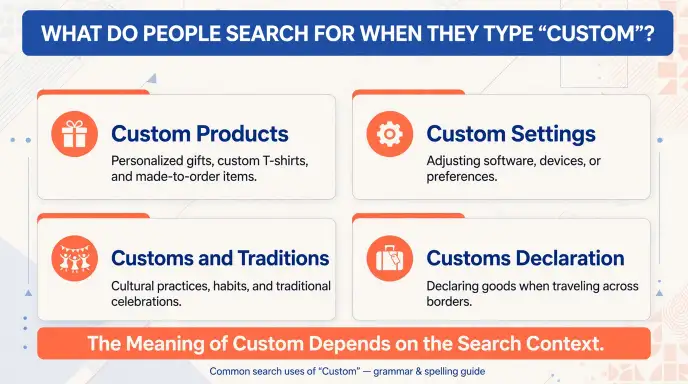
Searches for custom may relate to products made to order, design services, personal preferences, or cultural practices.
Examples include:
- Custom furniture
- Custom clothing
- Custom website design
- Wedding customs
- Cultural customs
The intended meaning depends on the words used with custom.
What Do People Search for When They Type Costume?
Searches for costume often relate to special clothing, parties, entertainment, and performances.
Examples include:
- Halloween costumes
- Costume ideas
- Movie costumes
- Costume design
- Traditional costumes
These searches usually indicate that someone wants to find, buy, make, or learn about special clothing.
Which Word Is More Popular?
There is no single useful answer without defining the search context. Custom has several meanings and appears in many industries, while costume is more closely tied to clothing and performance.
Google Trends can compare search interest by region and time period. However, search interest is not the same as total word usage, and no exact figures should be claimed without checking the relevant data.
For , use the word that matches the reader’s intent. An article about traditions should focus on custom, while a guide to Halloween outfits should use costume. A comparison article should explain both meanings clearly.
Custom vs Costume: Quick Comparison Table
| Version | Meaning | Correct? | Region | Example |
| Custom | A tradition or practice | Yes | All major English varieties | It is a local custom. |
| Custom | Made to meet specific needs | Yes | All major English varieties | She ordered a custom desk. |
| Costume | Clothing for a role or event | Yes | All major English varieties | He wore a pirate costume. |
| Customs | Traditions or border-control service | Yes | All major English varieties | We went through customs. |
| Costumes | Special outfits or clothing sets | Yes | All major English varieties | The costumes were colorful. |
Frequently Asked Questions
1. What is the difference between custom and costume?
A custom is a tradition, habit, or usual practice. It can also mean something made to meet a particular need. A costume is clothing worn for a role, performance, celebration, or special event. The words look similar, but their meanings are different.
2. Is custom or costume the correct word for clothing?
Use costume when talking about clothing worn for a character, performance, themed party, or special occasion. Use custom when you mean something specially made for a person or purpose, such as a custom suit or custom furniture.
3. Can custom mean specially made?
Yes. When used as an adjective, custom describes something designed or made to meet particular needs. For example, “They ordered a custom desk for their office.” This meaning differs from costume, which refers to a type of clothing.
4. Is costume used in British and American English?
Yes. Costume has the same spelling and general meaning in British and American English. Both varieties use it for special clothing worn in performances, themed events, and other occasions.
5. What is an example of a custom?
An example is removing your shoes before entering a home if that is the usual practice in that family or community. Other customs include exchanging gifts during celebrations, greeting people in a particular way, or following traditions at weddings.
6. What is an example of a costume?
A child wearing a dinosaur outfit for Halloween is wearing a costume. Actors also wear costumes to represent characters in plays and films. Traditional clothing worn for cultural performances may also be described as costumes.
7. What does customs mean at an airport?
At an airport, customs refers to the government process that checks goods and items travelers bring into or take out of a country. For example, “We went through customs after collecting our luggage.” This meaning differs from customs that describe traditions.
Conclusion
The difference between custom and costume is simple once you understand what each word describes. A custom is a tradition, habit, or common practice. It can also describe something specially made for a person or purpose. A costume, on the other hand, is clothing worn for a special event, role, performance, or theme.
Neither word is more correct than the other. Both are standard English words, and both have the same spelling in British and American English. The right choice depends on the meaning you want to express.
When writing about cultural practices, family traditions, or social habits, choose custom. When discussing Halloween outfits, theater clothing, or dress for a particular role, choose costume. If you are talking about a product made to fit someone’s needs, custom may be the right word.
Use the context of your sentence to guide your choice. Remember: a custom is something people do, while a costume is something people wear. Explore more English word comparisons to improve your spelling and writing skills.
Explore Grammar Guides!

I’m Ethan Carter, a grammar-focused writer and English language enthusiast at SpellGrammar. I enjoy explaining confusing words, spelling differences, and grammar rules in clear, simple language. My goal is to help readers write with greater accuracy and confidence in everyday and professional English.








1 thought on “Custom or Costume: Meaning, Differences, and Examples”