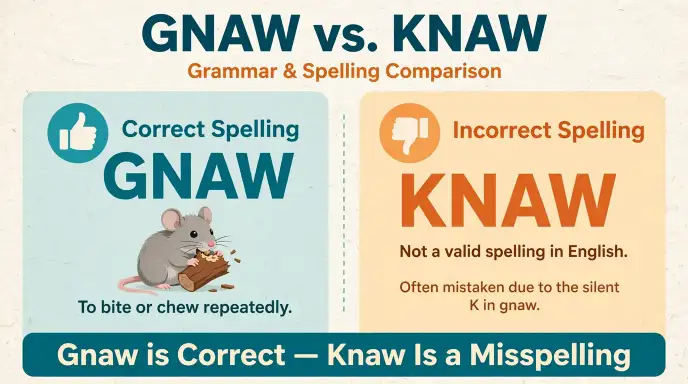
Have you ever wondered if to write gnaw or knaw? Gnaw is the correct spelling, while knaw is a common misspelling. The word gnaw means to bite or chew something repeatedly, often with the teeth. It can also describe a worry or feeling that slowly troubles someone.
People often search for “gnaw or knaw” because the word begins with a silent letter. In English, the letter g in gnaw is not pronounced, so the word sounds like “naw.” This can make the spelling difficult to remember, especially for students and people learning English.
The confusion also comes from other English words that begin with silent letters, such as know, knee, and knock. These words have different spellings but share a similar sound pattern. However, their spelling rules are not always the same.
In this guide, you will learn the meaning of gnaw, its origin, and how to use it correctly. You will also see practical examples, common spelling mistakes, and tips for remembering the difference between gnaw and knaw.
Gnaw or Knaw: The Correct Spelling Explained
Gnaw is the correct English spelling. It means to bite, chew, or wear away something gradually. Knaw is not a standard spelling of this word. For example, “The dog likes to gnaw on a bone.” The g in gnaw is silent, so the word sounds like “naw.”
Gnaw or Knaw: Quick Answer
The correct spelling is gnaw, not knaw. Use gnaw when describing an animal chewing something, a person biting at an object, or a worry that keeps troubling someone.
Examples:
- The puppy likes to gnaw on its toy.
- Rats may gnaw through wood.
- A feeling of guilt began to gnaw at him.
Remember that the g is silent. Although gnaw sounds like “naw,” you must include the letter g when writing it.
What Does Gnaw Mean?
The verb gnaw has two main uses. It can describe physical chewing, or it can describe a feeling that troubles someone over time.
1. Gnaw as Physical Chewing
To gnaw means to bite or chew something repeatedly. Animals often gnaw on bones, wood, food, or toys.
Examples:
- The rabbit began to gnaw on a piece of wood.
- A dog can gnaw on a rubber toy.
- The mouse tried to gnaw through the box.
This use often suggests repeated biting. It may also describe slowly wearing down or damaging a hard object.
2. Gnaw as a Feeling
The word can also describe a worry, fear, doubt, or feeling that continues to trouble someone.
Examples:
- Doubt began to gnaw at her confidence.
- Hunger gnawed at his stomach.
- A small fear continued to gnaw at his mind.
In these examples, no one is chewing a physical object. The word describes a feeling that keeps affecting a person.
3. Common Forms of Gnaw
The verb changes form depending on the sentence.
| Form | Example |
| Gnaw | Dogs gnaw on bones. |
| Gnaws | The puppy gnaws on its toy. |
| Gnawed | The mouse gnawed through the package. |
| Gnawing | She felt a gnawing sense of worry. |
These forms are all correct. Do not change the spelling to knaw when adding an ending.
The Origin of Gnaw
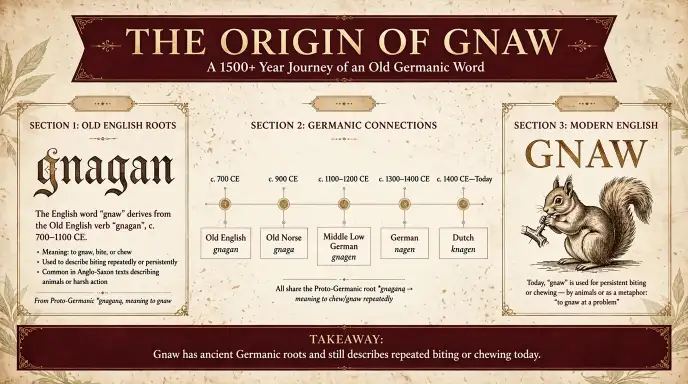
The word gnaw has a long history in the English language. It comes from Old English gnagan, which meant to gnaw or bite.
The word kept its spelling pattern over time, even as English pronunciation changed. In modern English, the initial g is silent, but it remains part of the written word.
This is one reason English spelling can seem confusing. Some words preserve letters from older forms, even when people no longer pronounce those letters.
Why Is the G Silent in Gnaw?
In older forms of English and related Germanic languages, the initial consonant group in words such as gnaw was pronounced differently from how it is pronounced today.
Over time, the sound of the initial g disappeared in standard modern English pronunciation. The spelling remained, which is why gnaw starts with a letter that you do not hear.
Other words, such as gnat and gnash, also begin with a silent g in modern English.
Why Do People Write Knaw?
The mistake usually happens because people spell words according to their sounds. Since gnaw sounds like “naw,” some writers may guess that it begins with k, especially because English has words such as know and knock.
However, gnaw and know follow different spelling patterns. Learning the correct spelling of each word is the best way to avoid confusion.
British English vs American English
There is no standard British-versus-American spelling difference between gnaw and knaw. The correct spelling is gnaw in both British and American English.
Unlike words such as colour and color, this word does not have two accepted regional spellings.
| Feature | British English | American English | Example |
| Correct spelling | Gnaw | Gnaw | The dog will gnaw on its bone. |
| Incorrect spelling | Knaw | Knaw | “The dog will knaw” is incorrect. |
| Past tense | Gnawed | Gnawed | The puppy gnawed the toy. |
| Present participle | Gnawing | Gnawing | The mouse is gnawing the wood. |
| Pronunciation | “Naw” | “Naw” | The initial g is silent. |
Do British and American Dictionaries Agree?
Yes. Standard British and American dictionaries recognize gnaw as the correct spelling. You should use it in schoolwork, professional writing, emails, and online content in either variety of English.
Regional spelling differences do exist in English, but gnaw is not one of them.
Which Version Should You Use?
Always use gnaw when you mean to bite or chew repeatedly, or when you describe a persistent feeling. The word is spelled the same way across major English varieties.
United States
American writers should use gnaw. The spelling is standard in US dictionaries and publications.
Example: “The puppy began to gnaw on its new toy.”
United Kingdom
British writers also use gnaw. Do not replace the initial g with k.
Example: “The rabbit continued to gnaw at the wooden fence.”
Canada
Canadian English uses gnaw as well. The word does not change according to Canadian spelling conventions.
Australia
Australian English follows the same spelling. Use gnaw in school assignments, business documents, and everyday writing.
International and Academic Writing
For international readers, gnaw is the correct and widely accepted choice. Students should use it in essays, exams, reports, and other academic work.
Business and Professional Writing
If you use the word figuratively, make sure its meaning is clear from the context.
For example: “The unresolved issue continued to gnaw at the team leader.”
This sentence uses gnaw to describe a persistent concern rather than physical chewing.
Common Mistakes
Writers can avoid many spelling errors by learning the correct form and understanding how it works in a sentence.
1. Writing Knaw Instead of Gnaw
Incorrect: The dog likes to knaw on its bone.
Correct: The dog likes to gnaw on its bone.
Why: Knaw is not the standard spelling of the verb. The correct word begins with a silent g.
2. Confusing Gnaw with Know
Incorrect: The mouse began to know through the wood.
Correct: The mouse began to gnaw through the wood.
Why: Know means to understand or be aware of something. Gnaw means to bite or wear something away.
3. Misspelling Gnawed
Incorrect: The puppy knawed the toy.
Correct: The puppy gnawed the toy.
Why: The past-tense form keeps the correct spelling of the base verb: gnaw becomes gnawed.
4. Using Gnaw When You Mean Peddle
Incorrect: The shopkeeper continued to gnaw goods at the market.
Correct: The shopkeeper continued to peddle goods at the market.
Why: Peddle means to sell goods. Gnaw refers to chewing or a persistent feeling.
5. Forgetting the Silent G
Incorrect: The rabbit began to naw on a carrot.
Correct: The rabbit began to gnaw on a carrot.
Why: The word may sound like “naw,” but the standard spelling includes the silent g.
Memory Tip
Think of the G in gnaw as a letter that stays in writing even though you do not say it aloud.
You can also remember this sentence:
“A dog can gnaw, but it cannot knaw.”
The sentence links the correct spelling to a familiar action.
Gnaw or Knaw in Everyday Examples
The correct spelling gnaw can appear in many types of writing. Here are examples for different situations.
In Emails
“Hi Sam, the puppy has started to gnaw on the legs of the coffee table. Could you recommend a safe chew toy?”
This example uses gnaw to describe repeated chewing.
In Business Writing
“The unresolved complaint continued to gnaw at the manager, who wanted to find a fair solution.”
Here, the word describes a concern that remains in someone’s thoughts.
In News Headlines
- “Rising Food Costs Gnaw at Household Budgets”
- “Rodents Gnaw Through Storage Materials”
- “Doubts Gnaw at the Team Before the Final”
The word can describe physical damage or an ongoing emotional concern.
In Blogs
“Puppies often gnaw on toys while exploring their surroundings. Choose suitable chew toys and keep unsafe objects out of reach.”
This example shows how the word appears in pet-care content.
On Social Media
“My puppy has discovered his favorite toy and will not stop gnawing on it!”
The word sounds natural in casual posts and captions.
In Academic Writing
“Persistent uncertainty can gnaw at a person’s confidence when a decision remains unresolved.”
This sentence uses gnaw figuratively to describe the effect of ongoing doubt.
In Daily Conversation
- “Why is the dog gnawing on that stick?”
- “A little worry kept gnawing at me.”
- “The rabbit has gnawed through the cardboard.”
Each example uses the standard spelling.
Gnaw or Knaw: Google Trends and Modern Usage
People search for “gnaw or knaw” because the two forms may sound similar when spoken. The silent g makes the correct spelling less obvious, particularly for young learners and people studying English as a second language.
The correct spelling remains gnaw in modern British, American, Canadian, and Australian English. Knaw is a spelling error when someone intends to use this verb.
Which Spelling Is More Common?
In standard written English, gnaw is the established form. Knaw may appear in spelling mistakes, informal messages, usernames, or other nonstandard contexts, but those uses do not make it a correct alternative.
What Does Google Trends Tell Us?
Google Trends can compare search interest in gnaw and knaw across countries and over selected time periods. However, search interest is not the same as dictionary acceptance or total word usage.
Without a live, clearly defined Trends comparison, it would be misleading to give exact search volumes or country rankings. The spelling rule itself is clear: use gnaw in standard English writing.
Why Does This Keyword Matter for ?
A spelling-comparison article can help readers who are unsure how to write a word they have heard. Including the correct form, a direct answer, simple examples, and a clear explanation of the silent g addresses that need.
For content, use gnaw or knaw naturally in the title or a relevant heading. Use gnaw in the examples and explanations, and avoid repeating the incorrect form unnecessarily.
Gnaw vs Knaw: Quick Comparison Table
| Version | Meaning | Correct? | Region | Example |
| Gnaw | To bite, chew, or trouble someone persistently | Yes | All major English varieties | The dog likes to gnaw on a bone. |
| Knaw | No standard meaning as a spelling variant of gnaw | No | Not a standard regional spelling | Write “gnaw,” not “knaw.” |
| Gnawed | Past tense of gnaw | Yes | All major English varieties | The puppy gnawed its toy. |
| Gnawing | Present participle or gerund of gnaw | Yes | All major English varieties | A gnawing worry kept him awake. |
Key Takeaways
- Gnaw is the correct spelling.
- Knaw is a common misspelling, not a standard alternative.
- The initial g in gnaw is silent.
- Gnaw can mean to chew or bite something repeatedly.
- It can also describe a worry or feeling that keeps troubling someone.
- British and American English use the same spelling.
- The past tense is gnawed, and the -ing form is gnawing.
- Remember the silent g to avoid this common spelling mistake.
Frequently Asked Questions
1. Is it gnaw or knaw?
The correct spelling is gnaw. It means to bite or chew something repeatedly, or to describe a feeling that continues to trouble someone. Knaw is not the standard spelling of this word. Even though the first letter in gnaw is silent, you must include it when writing the word.
2. Why is the G silent in gnaw?
The word comes from older forms of English in which the initial consonant group was pronounced differently. Over time, the g stopped being pronounced in standard modern English, but the traditional spelling remained. This is why gnaw sounds like “naw” even though it begins with the letter g.
3. What does gnaw mean?
Gnaw means to bite or chew something repeatedly, often with the teeth. A dog may gnaw on a bone, or a mouse may gnaw through a box. The word can also describe a feeling, such as guilt or doubt, that continues to trouble someone over time.
4. Is knaw ever correct?
Knaw is not a standard spelling of the verb meaning to chew or bite. You may see it in a typo, a username, or a nonstandard context, but standard English uses gnaw. For schoolwork, professional documents, and published writing, choose gnaw.
5. What is the past tense of gnaw?
The past tense of gnaw is gnawed. For example, “The puppy gnawed on its toy.” The spelling remains the same in British and American English. Do not write knawed, because that form comes from the incorrect spelling knaw.
6. Is gnaw spelled the same in British and American English?
Yes. Both British and American English use gnaw. Unlike words such as colour and color, it has no standard regional spelling difference. Writers in Canada and Australia also use gnaw.
7. What is the difference between gnaw and know?
Gnaw means to chew or bite repeatedly, while know means to understand or be aware of something. Their spellings and meanings are different, even though both begin with silent letters. For example, “The dog will gnaw the bone” and “I know the answer” use the words correctly.
8. How can I remember the spelling of gnaw?
Remember that gnaw begins with a silent g. Connect the word with a familiar example, such as a dog gnawing on a bone. Repeating the correct spelling in short sentences can also help you remember it and avoid writing knaw.
9. Can gnaw describe emotions?
Yes. Writers often use gnaw to describe a feeling that continues to trouble someone. For example, “A sense of guilt began to gnaw at him.” The sentence does not describe physical chewing. It uses the word to show how a persistent feeling affects a person.
10. What words are similar to gnaw?
Depending on the context, similar words include chew, bite, nibble, and worry. For physical actions, chew and bite may work. For feelings, trouble, torment, or bother may be more suitable. These words are related in meaning but are not always interchangeable.
Conclusion
When choosing between gnaw and knaw, always use gnaw. It is the standard English spelling in the United States, the United Kingdom, Canada, Australia, and other English-speaking regions. Knaw is a common spelling mistake, not an accepted regional alternative.
The word gnaw has two main uses. It can describe the act of chewing or biting something repeatedly, as when a dog gnaws on a bone. It can also describe a feeling that continues to trouble someone, such as doubt, hunger, or guilt.
The most confusing part is the silent g. Although you do not hear it when saying the word, you must include it when writing. The past-tense form is gnawed, and the -ing form is gnawing.
If you are writing an essay, email, blog post, or social media caption, choose gnaw every time you mean to use this verb. Check your spelling before publishing, and use examples to reinforce the correct form.
Remember: the G may be silent, but it belongs in gnaw. Explore more spelling guides to build confidence in everyday English writing.
More Grammar Resources!

I’m Ethan Carter, a grammar-focused writer and English language enthusiast at SpellGrammar. I enjoy explaining confusing words, spelling differences, and grammar rules in clear, simple language. My goal is to help readers write with greater accuracy and confidence in everyday and professional English.








1 thought on “Gnaw or Knaw: Correct Spelling and Common Mistakes”