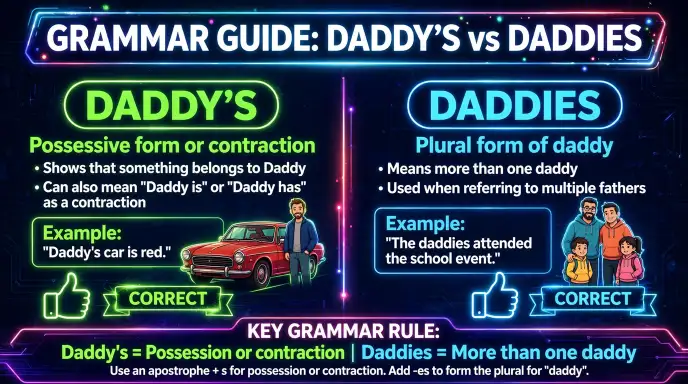
The correct choice depends on what you want to say. “Daddy’s” usually shows ownership or means “daddy is” or “daddy has” in a contraction, while “daddies” is the plural of “daddy,” meaning more than one father or dad.
These words look almost the same, so it is easy to mix them up. The apostrophe in daddy’s changes its meaning, while daddies follows a common English spelling rule for forming plurals.
For example, Daddy’s car means the car belongs to Daddy. In contrast, two daddies means two fathers. You might also see Daddy’s coming home in a sentence, where the apostrophe replaces missing letters in Daddy is.
This guide explains the meaning, spelling, grammar rules, and everyday use of daddy’s or daddies. You will learn how to choose the right form in emails, stories, social media posts, and formal writing.
Featured Snippet: Daddy’s or Daddies?
Daddy’s and daddies have different meanings. Use daddy’s to show that something belongs to Daddy or as a contraction of Daddy is or Daddy has. Use daddies when talking about two or more people called Daddy. For example, “Daddy’s shoes” shows ownership, while “The daddies arrived” refers to several fathers.
Daddy’s or Daddies: Quick Answer
Both spellings are correct, but you cannot use them in the same way.
- Daddy’s: Shows ownership or forms a contraction.
- Daddies: The plural of daddy, meaning more than one daddy.
Here are three simple examples:
- Ownership: Daddy’s phone is on the table.
- Plural: The two daddies waited outside the school.
- Contraction: Daddy’s coming home soon. This means “Daddy is coming home soon.”
Easy rule: Use an apostrophe in daddy’s for ownership or a contraction. Use daddies without an apostrophe when you mean more than one daddy.
What Does Daddy’s or Daddies Mean?
To choose the correct spelling, look at the role the word plays in the sentence. The apostrophe is the key difference.
What Does Daddy’s Mean?
Daddy’s is the possessive form of daddy. It shows that something belongs to, relates to, or is associated with Daddy.
Examples:
- Daddy’s jacket is hanging by the door.
- I found Daddy’s keys.
- Daddy’s favorite meal is pasta.
In each sentence, daddy’s connects Daddy to something associated with him.
The same spelling can also be a contraction. A contraction joins words and replaces missing letters with an apostrophe.
Examples:
- Daddy’s tired. = Daddy is tired.
- Daddy’s finished his work. = Daddy has finished his work.
The surrounding words tell you which meaning applies.
What Does Daddies Mean?
Daddies is the plural of daddy. It refers to two or more people who are called Daddy or described as daddies.
Examples:
- The daddies helped the children build a sandcastle.
- Three daddies attended the school event.
- The story features two daddies raising a child.
There is no apostrophe because the word simply names more than one person.
Daddy’s vs. Daddies at a Glance
| Word | Meaning | Example |
| Daddy | One father or dad | Daddy is at home. |
| Daddy’s | Ownership or contraction | Daddy’s coat is blue. |
| Daddies | More than one daddy | The daddies are talking. |
| Daddies’ | Ownership by multiple daddies | The daddies’ cars are parked outside. |
Notice the last form, daddies’. It uses an apostrophe after the plural ending to show that something belongs to several daddies.
The Origin of Daddy’s and Daddies
The difference between daddy’s and daddies comes from two familiar English grammar rules: forming plurals and showing possession.
Where Does the Word Daddy Come From?
Daddy is an affectionate word for a father. It developed from dad, a familiar term for a father, with the ending -y adding a familiar or affectionate tone.
Words such as mommy, mummy, and daddy are common in family speech, children’s language, and informal writing. Their exact use can vary by family and region.
Why Does Daddy Become Daddies?
In English, many nouns that end in a consonant followed by y form their plurals by changing the y to ies.
For example:
- Baby → babies
- City → cities
- Party → parties
- Daddy → daddies
This rule explains why daddys is not the standard plural spelling.
Why Does Daddy’s Keep the Y?
The possessive form does not use the plural spelling rule. Instead, you add an apostrophe and s to the singular noun.
- Daddy → Daddy’s
- Mommy → Mommy’s
- Baby → Baby’s
Therefore, Daddy’s toy means a toy belonging to Daddy, while daddies means more than one daddy.
The two forms follow different grammar rules, which is why their endings are not interchangeable.
British English vs American English
The spelling difference between daddy’s and daddies is the same in British and American English. Both varieties use the apostrophe for possession and contractions, and both use -ies to form the plural of daddy.
| British English | American English | Example |
| Daddy’s | Daddy’s | Daddy’s coat is here. |
| Daddies | Daddies | The daddies arrived early. |
| Daddies’ | Daddies’ | The daddies’ meeting starts at noon. |
Are There Regional Spelling Differences?
No major spelling difference exists between British and American English for these forms. The choice depends on grammar, not geography.
However, families may prefer different terms for fathers, such as Dad, Daddy, Papa, or Father. These are choices of vocabulary and tone rather than different rules for daddy’s and daddies.
What About Style Guides?
Standard English grammar and mainstream dictionaries support these forms:
- Use Daddy’s for singular possession or a contraction.
- Use daddies for the plural.
- Use daddies’ for possession by multiple daddies.
Follow your publication’s style guide for capitalization. For instance, a family may write Daddy as a name or title, while a general reference to a father may use lowercase daddy.
Which Version Should You Use?
The right form depends on the meaning you want to express, not the country where you are writing.
United States
Use daddy’s for ownership or contractions and daddies for the plural.
- Daddy’s truck is outside.
- The daddies volunteered at school.
United Kingdom
The same rules apply in British English.
- Daddy’s tea is ready.
- The daddies watched the match.
Canada
Canadian English follows the same standard spelling rules for these words.
- Daddy’s book is missing.
- Several daddies joined the event.
Australia
Australian English also uses daddy’s for possession or contractions and daddies for the plural.
- Daddy’s hat is on the chair.
- The daddies arrived together.
International Writing
For readers around the world, choose the spelling based on the sentence’s meaning. If the audience may not use daddy in everyday speech, father or dad may be clearer.
Academic Writing
In academic work, use father or fathers when a neutral or formal tone is needed. If a quotation, research subject, or text uses daddy, preserve the original wording and apply the appropriate grammar.
Business Writing
Use father or parent in formal business communication when it sounds more professional. If you need the word daddy, still follow the standard rules:
- Correct: Daddy’s appointment is at 3 p.m.
- Correct: The daddies’ group will meet tomorrow.
Common Mistakes with Daddy’s and Daddies
The most common mistake is adding an apostrophe when you only want to make the word plural.
Mistake 1: Using Daddy’s for More Than One Daddy
- Incorrect: The two daddy’s attended the event.
- Correct: The two daddies attended the event.
Why? A regular plural does not need an apostrophe. Change the final y to ies.
Mistake 2: Using Daddies to Show Ownership
- Incorrect: The daddies car is new.
- Correct: Daddy’s car is new.
Why? The first sentence refers to more than one daddy but does not show ownership correctly. If one daddy owns the car, use Daddy’s car.
If several daddies own cars together, write:
– Correct: The daddies’ cars are new.
Mistake 3: Writing Daddys
- Incorrect: The daddys are waiting.
- Correct: The daddies are waiting.
Why? A noun ending in a consonant followed by y usually changes to ies in the plural.
Mistake 4: Confusing a Contraction with Possession
- Daddy’s sleeping.
- Daddy’s blanket is warm.
Both sentences are correct, but daddy’s means something different in each one.
In the first sentence, it means Daddy is sleeping. In the second, it shows that the blanket belongs to Daddy.
A Simple Memory Tip
Remember these three patterns:
- Daddy’s = belongs to Daddy, or Daddy is/has.
- Daddies = more than one daddy.
- Daddies’ = something belongs to more than one daddy.
If you can replace Daddy’s with Daddy is or Daddy has, it is a contraction. If you are counting people, use daddies.
Daddy’s or Daddies in Everyday Examples
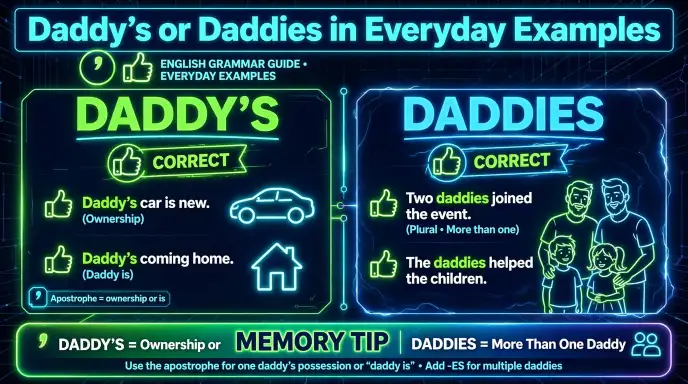
Seeing both forms in context makes the spelling rule easier to remember.
1. Emails
Possession:
Hi, the children have packed Daddy’s lunch for tomorrow.
Plural:
Hello, several daddies have volunteered to help with the school trip.
2. Business Writing
Possession:
Daddy’s appointment has been moved to Thursday.
Plural:
The daddies’ support group will meet in the community room.
The second example uses daddies’ because the group belongs to or is associated with multiple daddies.
3. News Headlines
Possession:
Daddy’s New Book Becomes a Family Favorite
Plural:
Local Daddies Join Community Fundraiser
Headlines often leave out small words, but the spelling still needs to reflect the intended meaning.
4. Blogs
Possession:
Daddy’s homemade pancakes are a weekend tradition.
Plural:
Five daddies share their favorite family activities.
5. Social Media
Possession:
Daddy’s little helper had a busy day!
Plural:
These daddies made the school celebration extra special.
6. Academic Writing
Possession:
The story explores Daddy’s role in the child’s life.
Plural:
The study included interviews with fathers who identified as daddies.
In formal research, explain the term if it is important to your study. Avoid replacing a participant’s chosen words without a clear reason.
7. Daily Conversation
Possession:
Is that Daddy’s cup?
Plural:
The daddies are waiting by the gate.
Contraction:
Daddy’s coming home soon.
In the last sentence, Daddy’s means Daddy is. This is common in everyday speech and informal writing.
Google Trends and Modern Usage
People may search for daddy’s or daddies because the words sound alike and differ by only one apostrophe and a letter. The main question is usually if to use an apostrophe or change y to ies.
Why Do People Search for These Spellings?
Common reasons include:
- Checking the plural of daddy.
- Learning when to use an apostrophe.
- Writing captions, family messages, or stories.
- Understanding the difference between Daddy’s and daddies’.
- Learning English as a second language.
Which Form Is More Popular?
The two forms serve different purposes, so their search and writing frequency cannot be compared fairly without examining context. Daddy’s can appear in possessive phrases and contractions, while daddies refers to multiple people.
No exact Google Trends figures are included here. Without checking a defined date range, region, and search term, it would be misleading to claim that one form is more popular or to give a numerical difference.
How Can You Check Current Search Interest?
Google Trends can help compare search interest over time. For a useful comparison:
- Enter daddy’s and daddies as separate search terms.
- Select the country or region you want to study.
- Choose a consistent period, such as the past 12 months.
- Review the trend lines and related queries.
- Remember that Trends shows relative search interest, not the total number of searches or proof that a spelling is grammatically correct.
Regardless of search popularity, standard grammar gives each form a clear role.
Quick Comparison Table
| Version | Meaning | Correct? | Region | Example |
| Daddy | One father or dad | Yes | All English varieties | Daddy is home. |
| Daddy’s | Singular possession | Yes | All English varieties | Daddy’s bag is here. |
| Daddy’s | Contraction of Daddy is or Daddy has | Yes | All English varieties | Daddy’s arrived. |
| Daddies | More than one daddy | Yes | All English varieties | The daddies arrived. |
| Daddies’ | Possession by multiple daddies | Yes | All English varieties | The daddies’ room is open. |
| Daddys | Intended plural of daddy | No, in standard English | All English varieties | Write daddies instead. |
| Daddy,s | Incorrect apostrophe placement | No | All English varieties | Write Daddy’s for possession. |
Key Takeaways
- Daddy’s can show ownership, as in Daddy’s hat.
- Daddy’s can also mean Daddy is or Daddy has.
- Daddies is the standard plural of daddy.
- Daddies’ shows possession by two or more daddies.
- Do not use an apostrophe just to make a word plural.
- The spelling rules are the same in British, American, Canadian, and Australian English.
- Use the sentence’s meaning to decide which form fits.
FAQs About Daddy’s or Daddies
1. Is it daddy’s or daddies?
Both spellings are correct, but they have different meanings. Daddy’s shows ownership or acts as a contraction of Daddy is or Daddy has. Daddies is the plural of daddy and refers to more than one person called Daddy. Choose the spelling that matches your sentence.
2. What is the plural of daddy?
The plural of daddy is daddies. English usually changes a noun’s final y to ies when a consonant comes before the y. The same pattern appears in words such as baby and city. For example, “Three daddies attended the school event” uses the correct plural form.
3. Does daddy’s need an apostrophe?
Yes, daddy’s needs an apostrophe when it shows ownership or forms a contraction. For example, “Daddy’s shoes are missing” shows ownership, while “Daddy’s coming home” means “Daddy is coming home.” The apostrophe helps distinguish these meanings from daddies, which simply refers to multiple people.
4. Is daddys ever correct?
In standard English, daddys is not the correct plural of daddy. The accepted plural spelling is daddies. You may encounter Daddys in a brand name, username, or other deliberately styled name, but that does not make it the standard plural form in ordinary writing.
5. What is the difference between daddies and daddies’?
Daddies means more than one daddy, while daddies’ shows that something belongs to or is associated with multiple daddies. For example, “The daddies arrived” describes several people. “The daddies’ cars were parked outside” indicates that the cars belong to those people.
6. Can daddy’s mean daddy is?
Yes. Daddy’s can be a contraction of Daddy is or Daddy has. For example, “Daddy’s tired” means “Daddy is tired,” while “Daddy’s finished his work” can mean “Daddy has finished his work.” Read the whole sentence to identify the intended meaning.
7. Is daddy’s the same in British and American English?
Yes. British and American English use the same standard spellings: daddy’s for possession or contractions and daddies for the plural. There is no regional spelling change between these forms. The word a family chooses for a father may vary, but the grammar rules remain the same.
8. How do you write about two daddies?
Use two daddies when referring to two people. For example, “Two daddies attended the parent meeting.” If you want to show that something belongs to both of them, use the plural possessive form: “The two daddies’ children played together.” The apostrophe goes after the final s.
9. Is it Daddy’s Day or Daddies Day?
The correct form depends on the intended meaning and the event’s official name. Daddy’s Day can suggest a day associated with one daddy, while Daddies’ Day suggests a day associated with multiple daddies. If you are referring to Father’s Day, that is the standard name of the holiday.
10. How can I remember when to use daddy’s or daddies?
Use daddies when counting more than one person, and use daddy’s for ownership or a contraction. Try replacing daddy’s with “Daddy is” or “Daddy has.” If the sentence still makes sense, it may be a contraction. If you mean several people, choose daddies instead.
Conclusion
The difference between daddy’s or daddies comes down to meaning and grammar. Daddy’s shows that something belongs to Daddy or works as a contraction of Daddy is or Daddy has. Daddies is the plural form used when talking about more than one daddy. For ownership shared by several daddies, use daddies’.
These spellings follow the same rules in British, American, Canadian, and Australian English. You do not need to memorize separate regional versions. Instead, look at the sentence and decide if you mean one person’s possession, a contraction, or multiple people.
For example, write “Daddy’s book” when the book belongs to Daddy, “Daddy’s sleeping” when you mean Daddy is sleeping, and “The daddies arrived” when several people arrived.
Explore Grammar Guides!

Hi, I’m Olivia Bennett, an English grammar and spelling content writer. I enjoy exploring confusing words, spelling differences, and everyday language questions. My goal is to share clear, simple, and helpful explanations that make English easier to understand.








1 thought on “Daddy’s or Daddies: Simple Grammar Rules and Examples”