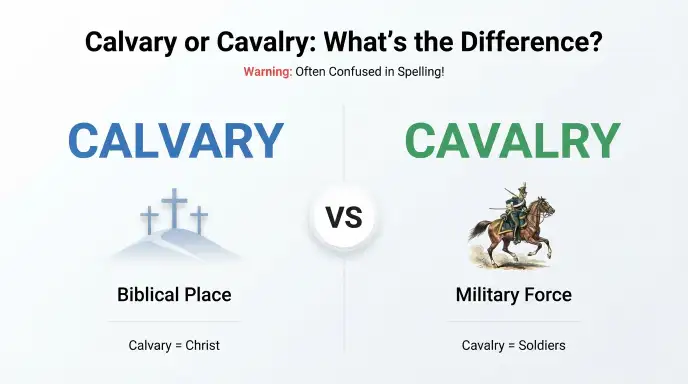
Calvary and cavalry are different words with different meanings. Calvary refers to the hill where Jesus Christ was crucified, while cavalry refers to a military group that historically fought on horseback and now can include armored or other mobile forces.
The two words look and sound very similar, so it is easy to mix them up. This is especially true when people hear them in conversation rather than see them in writing. A sentence such as “the cavalry arrived” has nothing to do with religion, while “the road to Calvary” has nothing to do with soldiers.
The confusion also comes from their shared-looking beginning, calv- / cav-, and their similar pronunciation. However, their histories are different. Calvary comes from a Latin word connected with “skull” and the biblical place of the Crucifixion. Cavalry came into English through French and Italian words connected with horsemen.
This guide explains the meaning, origin, pronunciation, regional usage, common mistakes, and practical examples of calvary or cavalry so you can choose the right word with confidence.
Calvary or Cavalry: Quick Answer
Use Calvary when you mean the biblical place associated with the crucifixion of Jesus Christ.
Use cavalry when you mean soldiers who fight as a mounted or mobile military force.
Quick examples
- The pilgrims traveled to Calvary.
- The cavalry moved toward the battlefield.
- The painting depicts Christ at Calvary.
- The cavalry unit arrived before the infantry.
A simple memory trick is:
Calvary = Christ
Cavalry = soldiers
The two words are not alternative spellings. They have different meanings and different origins. Cambridge defines Calvary as the hill outside Jerusalem where Jesus was crucified, while cavalry refers to an army group that historically fought on horseback and can now operate using tanks or other military vehicles.
Featured Snippet: Calvary or Cavalry?
Calvary is a religious and biblical term for the hill outside Jerusalem where Jesus Christ was crucified. Cavalry is a military term for soldiers who historically fought on horseback and now may operate using armored vehicles or other mobile equipment. The words sound similar, but they are not interchangeable.
What Does Calvary or Cavalry Mean?
Although calvary and cavalry look almost alike, they describe completely different ideas.
What Does Calvary Mean?
Calvary is the traditional English name for the place outside Jerusalem associated with the crucifixion of Jesus Christ.
It is usually capitalized when it refers to the biblical place:
The story describes Jesus’ journey to Calvary.
The word can also have a lowercase form, calvary, meaning a representation of the Crucifixion, such as a sculpture or painting. Cambridge lists both meanings.
In religious writing, you may see phrases such as:
- the road to Calvary
- Christ’s journey to Calvary
- the cross at Calvary
- the Crucifixion at Calvary
What Does Cavalry Mean?
Cavalry refers to a military force traditionally made up of soldiers who fought on horseback.
The meaning has expanded with military technology. Modern dictionaries also use cavalry for military groups that operate from armored vehicles or other mobile platforms.
Examples include:
- cavalry unit
- cavalry regiment
- cavalry officer
- cavalry charge
- armored cavalry
- light cavalry
- heavy cavalry
For example:
The cavalry advanced across the field.
This sentence refers to soldiers, not a religious location.
Why Do People Confuse Them?
The words have similar sounds and nearly identical letter patterns.
Compare:
Calvary
Cavalry
Only one letter separates the first two syllables, but the meanings are far apart.
That makes this pair a common spelling and vocabulary trap.
The Origin of Calvary or Cavalry
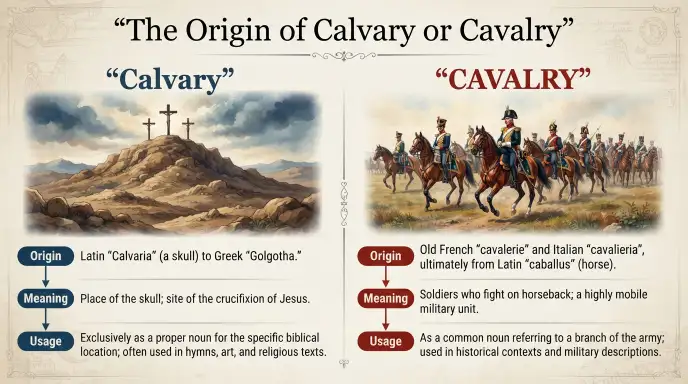
The words have different histories, even though they look similar today.
Origin of Calvary
Calvary entered English in the late 14th century. It came from Latin calvaria, meaning “skull.” The Latin term was used to translate the biblical name associated with Golgotha, traditionally understood as the “place of the skull.”
The connection with a skull is also reflected in the traditional name Golgotha, which comes through Greek and Latin from an Aramaic term associated with a skull.
Over time, Calvary became the established English name for the place of the Crucifixion.
It also developed a broader artistic meaning. A calvary can refer to a sculpture or painting that represents the Crucifixion.
Origin of Cavalry
Cavalry has a very different history.
It entered English in the 1590s from French cavalerie, which came from Italian cavalleria, meaning mounted militia. The Italian word is related to cavaliere, meaning a mounted soldier.
The deeper history connects with Late Latin caballarius, meaning “horseman,” and the Vulgar Latin word caballus, meaning a horse.
This family of words also produced related terms such as cavalier.
So the origins give us a useful distinction:
- Calvary → skull → biblical Crucifixion
- Cavalry → horseman → military force
Their similar appearance is therefore a coincidence of modern English spelling, not evidence that they mean the same thing.
British English vs American English
Unlike pairs such as colour/color or centre/center, calvary and cavalry do not represent a British-versus-American spelling difference.
The same spellings are used in both major varieties of English.
| Word | British English | American English | Example |
| Calvary | Same spelling | Same spelling | The story refers to Calvary. |
| calvary | Same spelling | Same spelling | The church displays a calvary. |
| cavalry | Same spelling | Same spelling | The cavalry moved forward. |
| cavalryman | Same spelling | Same spelling | He served as a cavalryman. |
Cambridge gives the same core spellings and meanings across its British and American dictionary entries. It also notes that modern cavalry can refer to military forces using tanks or other vehicles, not only horses.
Regional Differences
There is no need to switch from calvary to cavalry because of your audience’s country.
Instead, choose the word based on meaning.
For example:
- US writing: The cavalry arrived.
- UK writing: The cavalry arrived.
- Canadian writing: The cavalry arrived.
- Australian writing: The cavalry arrived.
The spelling remains the same.
Style Guides and Publishing
Academic publishers, newspapers, websites, and businesses should use the word that matches the intended meaning.
A style guide may affect capitalization or treatment of military terms, but it does not turn calvary into an alternate spelling of cavalry.
When writing about the biblical place, capitalize Calvary.
When referring to a military force, use lowercase cavalry unless it forms part of a proper name.
Which Version Should You Use?
The correct choice depends on what you are talking about.
United States
Use Calvary for the biblical place and cavalry for the military force.
The soldiers belonged to the cavalry.
The sermon focused on Calvary.
United Kingdom
The same distinction applies.
British English does not use calvary as a spelling of the military word.
Canada
Canadian English also uses the two words according to their meanings.
Choose cavalry for military contexts and Calvary for the biblical or religious context.
Australia
Australian English follows the same basic distinction.
Context determines the correct word, not the country.
International Writing
For an international audience, avoid relying only on pronunciation.
Use the spelling that clearly communicates the intended meaning.
This is especially useful for ESL learners, because calvary and cavalry can sound close when spoken quickly.
Academic Writing
Accuracy matters most in academic work.
Use:
- Calvary for biblical history, theology, religion, art, and related subjects.
- cavalry for military history and military studies.
Business Writing
Most business writing will rarely need Calvary. If a historical or religious reference appears, use the proper spelling.
If discussing military history, use cavalry.
Common Mistakes
Mistake 1: Using “Calvary” for Soldiers
Incorrect:
The calvary arrived at the battlefield.
Correct:
The cavalry arrived at the battlefield.
Explanation: The military word is cavalry.
Memory tip: Think cavalry = cavalryman = soldier.
Mistake 2: Using “Cavalry” for the Biblical Place
Incorrect:
Jesus was crucified at Cavalry.
Correct:
Jesus was crucified at Calvary.
Explanation: The biblical place is Calvary.
Memory tip: Think Calvary = Christ.
Mistake 3: Treating Them as British and American Spellings
Incorrect idea:
Calvary is British, while cavalry is American.
Correct idea:
They are different words used for different meanings in both British and American English.
Mistake 4: Forgetting the Capital Letter
Incorrect:
The pilgrims visited calvary.
Correct:
The pilgrims visited Calvary.
When the word refers to the biblical place, Calvary is a proper name.
Mistake 5: Assuming Cavalry Always Means Horses
Historically, cavalry was strongly associated with horses. Modern military terminology can also use cavalry for units operating with armored vehicles or other mobile equipment.
So this sentence can be correct:
The armored cavalry moved toward the objective.
Everyday Examples
The best way to remember these words is to see them in different types of writing.
Emails
The museum’s new exhibit includes a painting of Calvary.
This is a religious or artistic reference.
Business Writing
The report discusses the history of the cavalry unit.
Here, cavalry refers to a military organization.
News Headlines
Historic Cavalry Regiment Marks Anniversary
The headline uses cavalry because it concerns a military regiment.
Another example:
Church Opens New Calvary Exhibition
Here, Calvary relates to a religious subject.
Blogs
Many visitors want to learn about the history of Calvary and its place in Christian tradition.
Social Media
Reading about the cavalry’s role in the battle today.
Or:
Visiting an exhibition focused on Calvary.
Academic Writing
Medieval cavalry played an important role in many European military campaigns.
Or:
The artwork presents a traditional interpretation of Calvary.
Daily Conversation
“Who arrived first?”
“The cavalry.”
In another context:
“What does Calvary mean?”
“It refers to the place associated with the Crucifixion.”
Google Trends & Modern Usage
People often search calvary or cavalry because the two words are easy to confuse when heard aloud.
Their similar pronunciation creates a spelling problem, especially for students, ESL learners, writers, and anyone editing historical or religious material.
Search interest can also be driven by different topics.
Calvary Search Contexts
Interest in Calvary is often connected with topics such as:
- Christianity
- the Bible
- the Crucifixion
- churches
- religious art
- theology
- biblical history
Searches for Cavalry
Searches for cavalry are more likely to relate to:
- military history
- horses
- soldiers
- battles
- cavalry units
- armored forces
- historical armies
Modern dictionary usage confirms that cavalry can describe military forces using armored vehicles, while the historical horse-riding meaning remains important.
Regional Popularity
There is no meaningful British-versus-American spelling split for these words. Both English varieties use Calvary and cavalry according to meaning.
Exact Google Trends numbers can change based on the selected date range, country, and search category. For that reason, it is better not to assign fixed popularity figures without a specific Trends dataset.
The main modern usage pattern is clear: Calvary belongs mainly to religious and biblical contexts, while cavalry belongs to military contexts.
Quick Comparison Table
| Version | Meaning | Correct? | Region | Example |
| Calvary | Biblical place of the Crucifixion | Yes | International English | They traveled to Calvary. |
| calvary | Representation of the Crucifixion | Yes | International English | The church displayed a calvary. |
| cavalry | Military force, historically mounted | Yes | International English | The cavalry advanced. |
| cavalry | Modern mobile or armored military force | Yes | International English | The armored cavalry moved forward. |
| calvary for soldiers | Incorrect | No | All regions | ❌ The calvary arrived. |
| cavalry for the biblical place | Incorrect | No | All regions | ❌ He went to Cavalry. |
Key Takeaways
- Calvary and cavalry are different words.
- Calvary refers to the biblical place associated with the Crucifixion.
- Calvary can also mean an artistic representation of the Crucifixion.
- Cavalry refers to a military force.
- Historically, cavalry soldiers fought on horseback.
- Modern cavalry can include armored or other mobile military forces.
- The distinction is the same in British and American English.
- Remember: Calvary = Christ; cavalry = soldiers.
FAQs About Calvary or Cavalry
What is the difference between Calvary and cavalry?
Calvary is the biblical place associated with the crucifixion of Jesus Christ. Cavalry is a military term for soldiers who historically fought on horseback and now may operate using armored or other mobile equipment.
Is Calvary a place or a person?
Calvary is a place name. It traditionally refers to the hill outside Jerusalem where Jesus Christ was crucified. It can also refer to an artistic representation of the Crucifixion, such as a sculpture or painting.
Is cavalry always on horseback?
No. Historically, cavalry was strongly associated with mounted soldiers. Modern military terminology can also use cavalry for forces operating from tanks, armored vehicles, helicopters, or other mobile platforms.
Is Calvary a British spelling?
No. Calvary is not a British spelling of cavalry. They are separate words, and both are used in British and American English. The correct word depends on the meaning you intend.
Why are Calvary and cavalry confused?
They are often confused because they look and sound very similar. Their meanings, however, are unrelated in modern English. A useful memory aid is Calvary = Christ and cavalry = soldiers.
How do you spell cavalry correctly?
The military word is spelled c-a-v-a-l-r-y: cavalry. It refers to a military force that historically fought on horseback and can now refer to mobile or armored forces.
Should Calvary always be capitalized?
When Calvary refers to the biblical place, it is normally capitalized because it is a proper name. The lowercase noun calvary can refer to a representation of the Crucifixion.
Can cavalry refer to modern soldiers?
Yes. The meaning has expanded beyond horse-mounted soldiers. Modern dictionaries include military forces that operate from tanks or other armored and mobile equipment.
Is “the calvary is coming” correct?
No, if you mean a military force. The correct sentence is “The cavalry is coming.” If you mean the biblical place, Calvary has an entirely different meaning.
What is the easiest way to remember Calvary vs cavalry?
Use this simple memory trick: Calvary = Christ and cavalry = soldiers. The first connects with the Crucifixion, while the second connects with military forces and cavalrymen.
Conclusion
Calvary and cavalry may look almost identical, but they have completely different meanings. Calvary is the name traditionally given to the hill outside Jerusalem associated with the crucifixion of Jesus Christ. It can also refer to a sculpture or painting showing the Crucifixion. Cavalry, on the other hand, is a military term. It historically described soldiers who fought on horseback and can now include mobile or armored military forces.
The words are not British and American spelling variants. Writers in both varieties of English use the same spellings. The key is to understand the context before choosing a word.
For religious, biblical, or Christian writing, choose Calvary. For military history, battles, soldiers, or armored forces, choose cavalry.
Discover More About Confused Words!

Hi, I’m Olivia Bennett, an English grammar and spelling content writer. I enjoy exploring confusing words, spelling differences, and everyday language questions. My goal is to share clear, simple, and helpful explanations that make English easier to understand.








2 thoughts on “Calvary or Cavalry: A Simple Guide to the Difference”