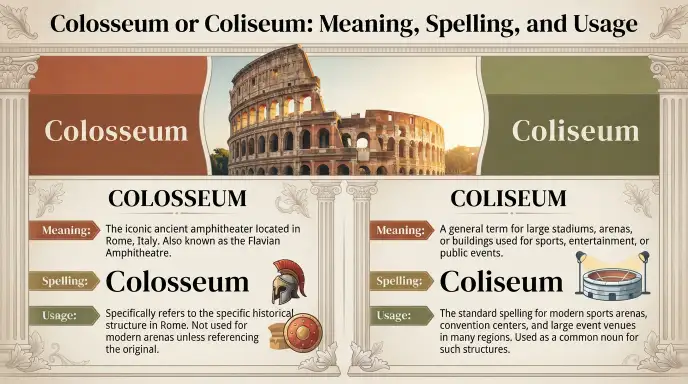
Colosseum is the standard spelling for the famous ancient amphitheater in Rome, while coliseum is commonly used for a large stadium, arena, or public entertainment building. Both forms are recognized English words, so the correct choice depends on what you mean.
The confusion between Colosseum or Coliseum often comes from their similar pronunciation and shared history. Writers may wonder if one spelling belongs to British English and the other to American English. In reality, the difference is more about meaning, naming, and usage than a simple British-versus-American spelling rule.
When referring specifically to the ancient Roman landmark, use the Colosseum with a capital C. When referring to a general arena or large public venue, coliseum is often the natural choice. Oxford defines coliseum as a large building used for sports, entertainment, or exhibitions, while Cambridge recognizes colosseum as a term for a large amphitheater and specifically names the Roman structure as the Colosseum.
Understanding this distinction makes your writing more accurate, especially in travel articles, history assignments, news reports, and formal writing.
Colosseum or Coliseum – Quick Answer
Use Colosseum when you mean the famous ancient Roman amphitheater in Rome.
Use coliseum when you mean a large arena, stadium, or entertainment building in general.
Examples
- We visited the Colosseum in Rome.
- The concert was held at the local coliseum.
- The Colosseum is one of Rome’s most famous landmarks.
- Thousands of fans entered the city coliseum.
The distinction is not absolute in every dictionary or historical source. Both spellings have been used for the Roman amphitheater, but modern English commonly uses Colosseum for the specific monument and coliseum for the general noun.
Definition and Meaning of Colosseum or Coliseum
Colosseum
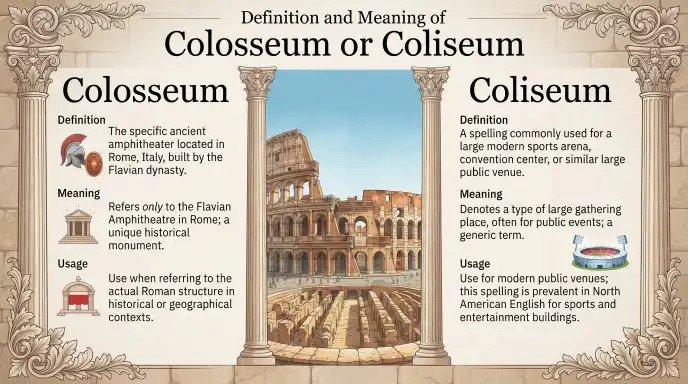
Colosseum usually refers to the ancient amphitheater in Rome, Italy.
It was built during the Roman period and became a major site for public spectacles. Because it is a specific historical landmark, the word is normally capitalized:
The Colosseum attracts visitors from around the world.
The lowercase form colosseum can also appear as a general noun for a large amphitheater.
Coliseum
Coliseum is commonly used as a general noun for a large building designed for sports, entertainment, exhibitions, or public events.
For example:
The basketball game was held at the city coliseum.
Oxford’s American English dictionary defines coliseum as a large building used for sports events, entertainment, exhibitions, and similar activities.
Simple Meaning
The easiest way to remember the difference is:
| Word | Common meaning |
| Colosseum | The ancient Roman landmark in Rome |
| coliseum | A large arena or public entertainment building |
| Coliseum | Part of a proper name for some buildings or venues |
However, context matters. Some buildings have Coliseum as part of their official name, so capitalization should follow the proper name.
The Origin of Colosseum or Coliseum
The two spellings have a shared historical background.
The name is connected with the Latin word colosseus, meaning something enormous or gigantic. The word is related to colossus, a word for a gigantic statue or figure. The Roman amphitheater became associated with the enormous statue of Nero that once stood nearby.
Over time, different forms of the name appeared in English and other languages. Historical spellings developed into the modern forms Colosseum and Coliseum.
The spelling difference therefore does not come from a simple rule such as:
British English = Colosseum
American English = Coliseum
That explanation is too simple.
Modern dictionaries show that both forms occur in English. Cambridge lists colosseum as a noun for a large amphitheater and separately identifies the Colosseum as the famous structure in Rome.
Oxford also lists coliseum as a North American English noun for a large building used for sports, entertainment, and exhibitions.
British English vs American English Spelling
The difference between Colosseum and Coliseum is not a strict British-versus-American spelling rule.
American English commonly uses coliseum as a general noun for a large arena or venue. At the same time, American English uses Colosseum for the famous Roman landmark.
British English also uses Colosseum, especially for the Roman monument, while coliseum can appear as a general noun.
Comparison Table
| Context | British English | American English |
| Roman landmark | the Colosseum | the Colosseum |
| General large arena | coliseum / colosseum | coliseum |
| Proper venue name | Follow official name | Follow official name |
| Historical writing | Colosseum is common | Colosseum is common |
| Sports or entertainment venue | coliseum may be used | coliseum is common |
Oxford specifically labels coliseum as North American English when defining the general type of building.
So, rather than memorizing a country-based spelling rule, identify the context first.
Which Spelling Should You Use?
Your choice should depend mainly on what you are describing.
For the Roman Landmark
Use:
Colosseum
Example:
We spent the afternoon exploring the Colosseum.
This is the clearest choice when writing about the famous structure in Rome.
For a General Arena
Use:
coliseum
Example:
The event will take place at the local coliseum.
This makes it clear that you mean a large public venue rather than the Roman monument.
For a Specific Building Name
Check the building’s official name.
For example, a venue may officially use Coliseum as part of its name. In that situation, preserve the official spelling.
For International Readers
If your audience is international, Colosseum is the safest choice when discussing Rome. For a general arena, coliseum is clear and widely understood.
Common Mistakes with Colosseum or Coliseum
1. Using Coliseum for the Roman Landmark
Incorrect or less preferred:
We visited the Coliseum in Rome.
Preferred:
We visited the Colosseum in Rome.
The capitalized form Colosseum clearly identifies the famous Roman structure.
2. Treating the Words as Completely Different Things
The words are historically related and can overlap in meaning.
It is better to understand their common modern uses rather than assume they are unrelated words.
3. Assuming One Is Always American
It is not accurate to say that Coliseum is always American and Colosseum is always British.
Both forms occur across English varieties, although their modern uses differ.
4. Forgetting Capitalization
When naming the famous Roman monument, write:
the Colosseum
Do not normally write:
the colosseum
when you are using it as the proper name of the landmark.
5. Changing an Official Venue Name
If a building officially uses Coliseum, do not change it to Colosseum simply because you prefer the latter spelling.
Proper names should retain their established spelling.
Colosseum or Coliseum in Everyday Examples
Seeing both words in real sentences makes the distinction easier to remember.
In an Email
Our group will meet outside the Colosseum at 9 a.m.
Here, Colosseum refers to the Roman landmark.
In News Writing
Thousands of fans gathered at the city coliseum for the championship.
Here, coliseum means a large sports venue.
On Social Media
Finally seeing the Colosseum in person!
The capitalized spelling identifies the famous monument.
In Formal Writing
The Colosseum remains an important symbol of ancient Roman architecture.
The specific historical site is being discussed.
In a Sports Article
The team announced that its next game would be held at the new coliseum.
Here, coliseum describes a modern sports venue.
In a History Assignment
The Colosseum was an important site for public spectacles in ancient Rome.
The proper name is capitalized.
Colosseum or Coliseum – Google Trends & Usage Data
Google Trends can help show how search interest changes between Colosseum and Coliseum, but its numbers need careful interpretation.
Google explains that Trends measures relative search interest, not absolute search volume. A value represents a term’s popularity compared with the highest point in the selected time, place, and search set.
This matters for Colosseum or Coliseum because people may search the two spellings for different reasons.
Searches for “Colosseum”
Searches for Colosseum are strongly connected with:
- Rome
- Italy
- ancient history
- tourism
- architecture
- travel
- Roman history
The capitalized form is especially relevant when people are searching for information about the famous Roman landmark.
Searches for “Coliseum”
Searches for Coliseum can have a broader range of meanings.
They may relate to:
- sports venues
- concert halls
- exhibition buildings
- local arenas
- specific building names
- the Roman monument
This wider meaning can affect regional search patterns.
Country and Regional Differences
Search behavior can vary by country, language, topic, and the names of local venues. A search for Coliseum in the United States, for example, may be connected to a specific arena or building rather than the ancient monument.
Google also notes that regional Trends data shows relative popularity by location, so a term having stronger interest in one area does not necessarily mean it has a higher absolute number of searches there.
For, this means you should not choose a spelling only because it appears popular in a particular region. Search intent and context matter too.
Colosseum vs Coliseum: Comparison Table
| Feature | Colosseum | Coliseum |
| Main modern use | Famous Roman landmark | General large arena or venue |
| Location association | Rome, Italy | Many locations |
| Capitalization | Usually capitalized for Rome | Lowercase as a common noun |
| Sports venues | Less common as a generic term | Common |
| Historical writing | Very common for Rome | Also historically used |
| Travel writing | Preferred for Rome | Can cause ambiguity |
| American English | Used for Roman landmark | Common for general venues |
| British English | Common for Roman landmark | Also possible as a general noun |
| Proper names | Used for the Roman site | Used by some venues |
FAQs About Colosseum or Coliseum
1. Is Colosseum or Coliseum correct?
Both spellings are recognized, but Colosseum is the usual spelling for the famous Roman landmark. Coliseum is commonly used for a general large arena.
2. Should I write Colosseum with a capital C?
Yes, when you mean the famous ancient monument in Rome, write the Colosseum.
3. Is Coliseum an American spelling?
Coliseum is commonly used in American English for a large arena or public venue. However, it is not simply an American-only spelling.
4. Is Colosseum only used in British English?
No. Colosseum is widely used in American English too, especially for the Roman landmark.
5. What is the difference between Colosseum and Coliseum?
Colosseum usually identifies the Roman monument, while coliseum commonly means a large arena or entertainment building.
6. Which spelling should I use for Rome?
Use the Colosseum when referring to the ancient amphitheater in Rome.
7. Can Coliseum refer to the Roman Colosseum?
Yes. Historical and dictionary sources show that coliseum has been used for the Roman amphitheater, although Colosseum is the standard modern choice for the landmark.
Conclusion
Choosing between Colosseum or Coliseum becomes easy once you identify the meaning. Colosseum is the preferred modern spelling for the famous ancient amphitheater in Rome, especially when it is used as a proper name. Coliseum is commonly used as a general noun for a large arena, stadium, or entertainment venue.
The difference should not be treated as a simple British-versus-American spelling rule. Both forms appear across varieties of English, and specific buildings may use either spelling as part of their official name. Oxford identifies coliseum as a North American English term for a large building used for sports, entertainment, or exhibitions, while Cambridge recognizes colosseum as a term for a large amphitheater and specifically identifies the Roman landmark as the Colosseum.
For clear professional writing, use the Colosseum for Rome and coliseum for a general arena unless a venue’s official name says otherwise. This simple distinction keeps your spelling accurate, your meaning clear, and your writing natural for international readers.
Discover More About Vocabulary!

Hi, I’m Olivia Bennett, an English grammar and spelling content writer. I enjoy exploring confusing words, spelling differences, and everyday language questions. My goal is to share clear, simple, and helpful explanations that make English easier to understand.








2 thoughts on “Colosseum or Coliseum: Meaning, Spelling, and Usage”