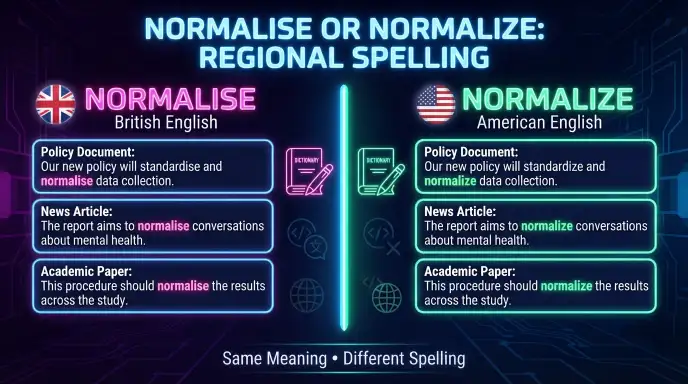
Normalise and normalize are both correct spellings, but “normalise” is mainly used in British English, while “normalize” is the standard American English spelling. Both words have the same meaning, pronunciation, and grammatical use.
This spelling difference often causes confusion because many English words ending in ize can appear with ise in British writing. For example, writers may see organise and organize, realise and realize, or recognise and recognize. The same pattern appears with normalise and normalize.
The verb means to make something normal, usual, standard, or consistent. It can also mean to adjust data or values so they can be compared more easily.
The choice between the two forms depends mainly on your preferred English variety and the style guide you follow. British English commonly accepts normalise, while American English uses normalize. Some British publishers also prefer ize spellings, so the issue is not always as simple as geography alone.
This guide explains the meaning, origin, spelling rules, regional usage, common mistakes, everyday examples, and practical advice for choosing the right form.
Normalise or Normalize: Featured Snippet Answer
Both spellings have the same meaning. Normalise is commonly used in British English, while normalize is the standard form in American English. Both mean to make something normal, standard, or consistent. British style can also use normalize, depending on the dictionary or style guide being followed.
Normalise or Normalize: Quick Answer
Both normalise and normalize are correct.
- Normalise: Common British English spelling
- Normalize: Standard American English spelling
- Meaning: To make something normal, standard, or consistent
- Pronunciation: Essentially the same
Example 1
British English:
The company wants to normalise the process.
American English:
The company wants to normalize the process.
Example 2
British English:
The software can normalise the data.
American English:
The software can normalize the data.
Example 3
The team is trying to normalise the new procedure.
Or:
The team is trying to normalize the new procedure.
The meaning does not change.
What Does Normalise or Normalize Mean?
Normalise and normalize are verbs.
They can have several related meanings depending on the context.
1. To Make Something Normal
The word can mean to make something seem usual, ordinary, or acceptable.
The campaign aims to normalise conversations about mental health.
In American English:
The campaign aims to normalize conversations about mental health.
2. To Make Something Standard
The verb can also mean to bring something into a standard or expected condition.
The company wants to normalise its reporting process.
This meaning is common in business and technical writing.
3. To Make Things Consistent
In mathematics, computing, and data science, normalize can have a more technical meaning.
For example:
The program normalizes the data before analysis.
Here, the word refers to changing data into a consistent or standard form.
4. To Restore Normal Conditions
The word may also describe returning a situation to a usual state.
Officials worked to normalise services after the disruption.
The American spelling would be:
Officials worked to normalize services after the disruption.
The Origin of Normalise or Normalize
The words normalise and normalize come from the same linguistic source.
The base word normal comes from Latin normalis, meaning related to a rule, pattern, or standard. English later developed the verb forms normalise and normalize from the idea of making something conform to a standard or normal condition.
The spelling difference developed from broader English spelling traditions.
Why Does British English Use Normalise?
British English commonly uses ise in many words:
- normalise
- organise
- realise
- recognise
- apologise
However, British English also uses ize in many formal and academic contexts.
For example:
- organize
- realize
- recognize
- apologize
- normalize
This means that normalise is not the only accepted form in British English.
Some British dictionaries and style guides prefer or accept ize spellings because they reflect historical word formation.
Why Does American English Use Normalize?
American English generally prefers ize endings.
Examples include:
- normalize
- organize
- realize
- recognize
- apologize
This convention is strongly established in modern American English.
The key point is that the difference is about spelling convention, not meaning.
British English vs American English
The clearest difference is the ending.
| British English | American English | Example |
| normalise | normalize | They want to normalise/normalize the process. |
| organise | organize | We need to organise/organize the files. |
| realise | realize | She began to realise/realize the problem. |
| recognise | recognize | I did not recognise/recognize him. |
| apologise | apologize | He decided to apologise/apologize. |
British English
Normalise is widely used in British English and is common in newspapers, websites, and everyday writing.
However, British English does not always require ise. Many British style guides accept or prefer ize.
American English
Normalize is the standard American spelling.
It is the form you will normally see in US dictionaries, business writing, academic work, software documentation, and newspapers.
Canadian English
Canadian English uses a mixture of British and American conventions.
Both normalise and normalize may appear, although normalize is widely used, especially in technical and scientific writing.
Always follow the publication or institution’s preferred style.
Australian English
Australian English often follows British spelling patterns, so normalise can be common.
However, normalize also appears, especially in technical, scientific, and international contexts.
Which Version Should You Use?
Your audience should guide your choice.
United States
Use:
normalize
Example:
The system automatically normalizes the data.
This is the natural choice for standard American English.
United Kingdom
You can use:
normalise
Example:
The government aims to normalise the situation.
However, normalize is also accepted by many British dictionaries and style guides.
If your publication follows Oxford style ize spelling, use normalize consistently.
Canada
Check the style guide used by your organization, school, journal, or publication.
Normalize is common, especially in technical writing.
Australia
Normalise is a common choice in Australian English, but style guides may differ.
International Writing
For a global audience, consistency matters most.
If your website uses American English, choose normalize.
If it follows British English conventions, normalise may be suitable.
Academic Writing
Follow the style guide required by your institution or journal.
Do not switch between normalise and normalize without a clear reason.
Business Writing
Match the spelling to your target market.
A US company would usually use normalize, while a UK publication may use normalise or normalize, depending on its house style.
Common Mistakes
Mistake 1: Saying Normalise Is Always Wrong
Incorrect:
Normalise is a misspelling.
Correct:
Normalise is a standard British English spelling.
The word is not wrong simply because American English uses normalize.
Mistake 2: Saying Normalize Is Only American
Incorrect:
Normalize cannot be used in British English.
Correct:
Normalize is also used in British English, especially by style guides that prefer the ize form.
This is an important distinction.
Mistake 3: Mixing Forms
A writer may use:
We organise the data and normalize the results.
This is not automatically grammatically wrong, but it creates an inconsistent spelling style if both forms are intended to follow the same convention.
A consistent version would be:
We organise the data and normalise the results.
Or:
We organize the data and normalize the results.
Mistake 4: Confusing Normalise With Normalize in Technical Writing
In programming and data science, normalize is extremely common.
For example:
Normalize the values before training the model.
Technical documentation often follows American English conventions even when it is read worldwide.
Memory Tip
Think:
ise = common British form
ize = standard American form
But remember that British English can also use ize.
Normalise or Normalize in Everyday Examples
Emails
British English:
We can normalise the process next month.
American English:
We can normalize the process next month.
Business Writing
The company plans to normalise its internal procedures.
American version:
The company plans to normalize its internal procedures.
News Headlines
Efforts continue to normalise relations.
American style:
Efforts continue to normalize relations.
Blogs
It can take time to normalise a new routine.
American version:
It can take time to normalize a new routine.
Social Media
We should normalise asking questions when something is unclear.
Or:
We should normalize asking questions when something is unclear.
Academic Writing
The researchers normalised the results before comparing the groups.
American academic style:
The researchers normalized the results before comparing the groups.
Data Science
The model normalizes numerical data before processing it.
This technical use is especially common with normalize.
Daily Conversation
It took a while for things to normalise.
American English:
It took a while for things to normalize.
The meaning stays the same.
Normalise or Normalize: Google Trends & Modern Usage
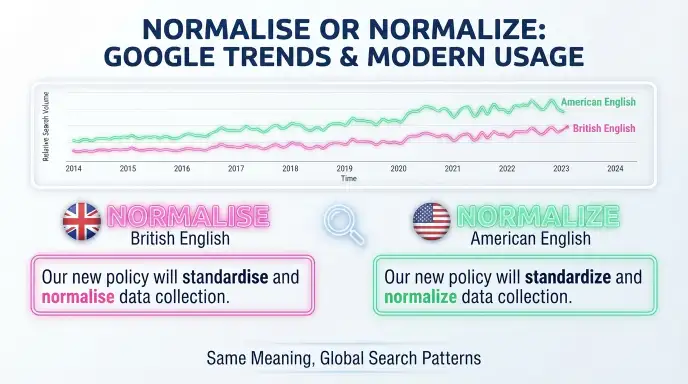
People commonly search normalise or normalize because English spelling varies across countries and style systems.
The question is especially common among:
- Students
- Bloggers
- Editors
- ESL learners
- Researchers
- Business writers
- Technical writers
General usage patterns show that normalize is strongly associated with American English, while normalise is strongly associated with British English.
At the same time, British English is more flexible than many writers assume. Several British dictionaries and publishers use or accept ize spellings.
This is why a British writer may see both forms in reputable sources.
Technical fields also tend to favor normalize, particularly in programming, statistics, mathematics, databases, and data science.
Google Trends can show search interest for specific spellings, countries, and time periods, but it does not provide a complete measure of how frequently a word appears in all published English.
For practical writing, your best guide is the English variety and style guide you are following.
Quick Comparison Table
| Version | Meaning | Correct? | Region | Example |
| Normalise | Make normal or standard | Yes | British English | We need to normalise the process. |
| Normalize | Make normal or standard | Yes | American English | We need to normalize the process. |
| Normalised | Past tense or participle | Yes | British English | The data was normalised. |
| Normalized | Past tense or participle | Yes | American English | The data was normalized. |
| Normalising | Present participle | Yes | British English | The system is normalising the data. |
| Normalizing | Present participle | Yes | American English | The system is normalizing the data. |
Key Takeaways
- Normalise and normalize have the same meaning.
- Normalise is common in British English.
- Normalize is standard in American English.
- British English can also use normalize.
- Many British style guides prefer ize spellings.
- Technical and scientific writing often uses normalize.
- Choose one spelling system and use it consistently.
- Always follow your publication, school, or organization’s style guide.
FAQs
Is normalise or normalize correct?
Both are correct. Normalise is commonly associated with British English, while normalize is the standard American form. British English can also use normalize, especially under style guides that prefer ize spellings. The meaning and pronunciation are essentially the same.
Is normalise British or American?
Normalise is mainly associated with British English. It is also found in other varieties influenced by British spelling. American English normally uses normalize with a z.
Is normalize correct in British English?
Yes. Normalize is accepted and used in British English. Some British dictionaries and style guides prefer ize spellings because of their historical connection to word formation. Therefore, normalize should not automatically be treated as an American only spelling.
Is normalise more correct than normalize?
Neither spelling is universally more correct. The preferred form depends on the English variety and style guide. British writing may use normalise or normalize, while American writing normally uses normalize.
What does normalise mean?
Normalise means to make something normal, usual, standard, or consistent. In technical contexts, it can also mean adjusting data or values so they follow a standard scale or format.
What does normalize mean in data science?
In data science, normalize generally means transforming data into a consistent or standardized form. The exact method depends on the task.
Should I use normalise or normalize in the UK?
Both can be used, but normalise is a familiar British spelling. If your organization or publication follows an ize style, use normalize instead.
Is normalize American English?
Yes. Normalize is the standard American English spelling. American English generally uses ize endings in words such as normalize, organize, realize, and recognize.
Is normalise used in Australia?
Yes. Normalise is commonly used in Australian English because Australian spelling often follows British conventions. However, normalize also appears, particularly in technical and international writing.
Conclusion
Normalise and normalize are both correct spellings of varietie he same verb. The main difference is the spelling convention used by different English varieties. Normalise is common in British English, while normalize is the standard form in American English.
The choice becomes slightly more complex because British English also accepts ize spellings. Some dictionaries, publishers, and academic style guides prefer normalize even in British writing. This means that geography alone does not always determine the answer.
For US audiences, normalize is the clear choice. For UK and some Commonwealth audiences, normalise is common, but normalize may also be appropriate under a particular style guide. Technical and scientific writing frequently uses normalize, especially when discussing data, statistics, databases, or programming.
The safest approach is to identify your audience and follow one spelling system throughout your work. If a publisher, university, employer, or journal has a style guide, follow it first.
Discover More About Correct Spelling!

I’m Ethan Carter, a grammar-focused writer and English language enthusiast at SpellGrammar. I enjoy explaining confusing words, spelling differences, and grammar rules in clear, simple language. My goal is to help readers write with greater accuracy and confidence in everyday and professional English.








2 thoughts on “Normalise or Normalize: Meaning and Usage”