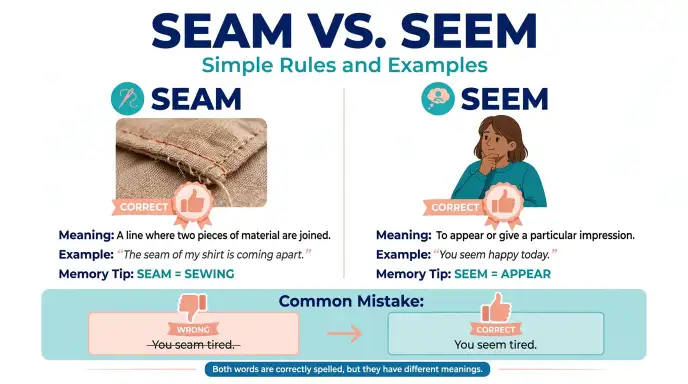
Have you ever wondered if to write seam or seem? Both words are correct, but they have different meanings. A seam refers to a line where two pieces of fabric or material join, while seem means to appear or give a particular impression.
People often confuse these words because they sound alike in many English accents. However, their meanings, spellings, and grammatical uses are different. Choosing the wrong word can change the meaning of a sentence, especially in school assignments, emails, business writing, and everyday conversations.
For example, a tailor may sew a seam into a shirt, but a person may seem happy after receiving good news. These words are easy to remember once you connect each one with its purpose.
This guide explains their definitions, origins, grammatical roles, and common mistakes. You will also find practical examples and simple tips to help you choose the correct word in your writing.
Seam or Seem – Quick Answer
Both spellings are correct, but the right choice depends on your intended meaning.
- Seam: A line where two pieces of fabric or material meet.
- Seem: A verb meaning to appear or give an impression.
Examples:
- The seam on my jacket needs repair.
- You seem worried about the exam.
- The tailor fixed the seam in her dress.
- They seem ready for the meeting.
A simple memory trick is to connect seam with sewing and seem with appearing to be something.
Neither word is more correct than the other. Each serves a different purpose in English.
Definition and Meaning
Although these terms sound similar, they perform different functions in a sentence. Understanding their definitions will help you select the appropriate spelling.
What Does Seam Mean?
A seam is a line where two pieces of fabric, leather, or another material are joined. In clothing, it usually forms when a person or machine stitches separate pieces together.
The word can also describe a joining line in other materials or a visible division between two surfaces.
Examples include:
- The seam of his trousers came apart.
- She used a sewing machine to create a neat seam.
- A crack appeared along the seam between the panels.
This word is usually a noun, and its plural form is seams.
It also appears in expressions such as seam allowance, which refers to extra fabric left beside a stitched line for sewing.
What Does Seem Mean?
Seem is a verb meaning to appear, look, or give a particular impression. It describes how someone or something appears rather than necessarily stating a proven fact.
Examples include:
- You seem happy today.
- The task seems difficult.
- She seemed surprised by the news.
- They seem to understand the instructions.
The verb changes according to the subject and tense.
| Form | Example |
|---|---|
| Seem | They seem ready. |
| Seems | He seems confident. |
| Seemed | She seemed upset. |
| Seeming | His seeming confidence surprised us. |
The verb often appears before an adjective or in the structure seem to be.
For example, “The room seems quiet” describes an impression. It does not necessarily prove that the room is completely silent.
How Do These Words Differ in a Sentence?
The easiest way to distinguish them is to examine the context.
Use seam when the sentence concerns sewing, clothing, or a joining line. Choose seem when describing an appearance, feeling, or impression.
Compare these examples:
- The seam looks uneven. This refers to a line in the material.
- The dress seems expensive. This describes an impression about the dress.
- The seam split during washing. This describes a problem with the stitching.
- The washing machine seems broken. This expresses a belief about its condition.
The surrounding words usually make the intended meaning clear.
The Origin of Seam or Seem
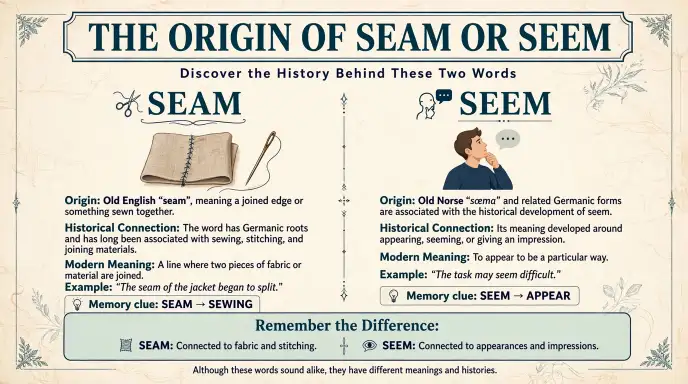
These words have separate histories, even though they sound alike today.
The Origin of Seam
The word seam comes from Old English seam, referring to a seam or a line formed by joining material. It is related to older Germanic words associated with sewing and joining.
Its meaning developed around the idea of a connection between two pieces. Today, it commonly describes stitched lines in clothing, but it can also refer to joining lines in other objects.
For example, a seam may appear where two metal panels meet or where sections of a manufactured product connect.
The Origin of Seem
The verb seem has roots associated with Old Norse sœma and related historical forms. Its development in English reflects older ideas of being fitting or appearing a certain way.
Over time, its modern meaning became associated with giving an impression or appearing to have a particular quality.
For example, “The solution seems simple” means that the solution appears simple to the speaker. It does not guarantee that solving the problem will actually be easy.
Why Are They Spelled Differently?
English spelling reflects the histories of words, not just their pronunciation. These terms developed from different linguistic roots and retained separate spellings.
Their similar sounds can cause confusion, but their meanings remain distinct. Remembering the connection between sewing and appearance can help prevent mistakes.
British English vs. American English
British and American English use the same spellings and meanings for both words. There is no standard regional spelling difference between them.
| Word | British English | American English | Example |
|---|---|---|---|
| Seam | Seam | Seam | The seam needs repair. |
| Seem | Seem | Seem | You seem tired. |
| Seams | Seams | Seams | The seams are strong. |
| Seems | Seems | Seems | She seems happy. |
| Seemed | Seemed | Seemed | He seemed surprised. |
Do British and American Writers Use Different Spellings?
No. Writers in both countries use seam for a joining line and seem for an appearance or impression.
Some English words have different regional spellings, such as colour and color. However, that distinction does not apply here.
What About Pronunciation?
In many English accents, the two words are pronounced alike. They are examples of homophones, which are words that sound the same but have different meanings or spellings.
This similarity explains why people may confuse them when writing from memory or typing quickly.
Which Spelling Should You Use?
Your choice should depend on the meaning of your sentence, not your country.
United States
Use seam for a stitched or joined line and seem for an appearance or impression.
Example: “The jacket’s seam is loose, and the jacket seems too large.”
United Kingdom
British writers follow the same rule. Both spellings are standard in everyday and formal writing.
Example: “The seam needs fixing, but the coat seems comfortable.”
Canada
Canadian English also uses the same spellings and meanings.
Example: “The seam is straight, and the dress seems well made.”
Australia
Australian English follows the same distinction.
Example: “The seam has opened, and the repair seems simple.”
International Writing
For international audiences, choose the word that matches your intended meaning. Neither spelling needs to change based on regional preferences.
Academic Writing
In essays and research papers, use seem when describing an interpretation or cautious conclusion.
For example: “The results seem to support the hypothesis.”
Choose seam when discussing clothing, textiles, engineering, geology, or another subject involving joining lines.
Business Writing
Use seem to describe an impression politely, as in “The figures seem inconsistent.”
Choose seam when discussing fabric, manufacturing, or product quality, as in “The seam requires further inspection.”
Common Mistakes
These terms are easy to mix up because they sound alike. The following examples show how to avoid common errors.
1. Using Seam Instead of Seem
Incorrect: You seam upset today.
Correct: You seem upset today.
Why? The sentence describes someone’s apparent feelings, so it needs the verb seem.
2. Using Seem Instead of Seam
Incorrect: The seem of the shirt is coming apart.
Correct: The seam of the shirt is coming apart.
Why? The sentence refers to the stitched line in the shirt, so the noun seam is correct.
3. Confusing Seem With See
Incorrect: I seem the bird outside.
Correct: I see the bird outside.
Why? See means to notice something with your eyes. Seem means to appear or give an impression.
4. Forgetting Subject-Verb Agreement
Incorrect: She seem happy.
Correct: She seems happy.
Why? In the present simple tense, the verb takes -s with he, she, and it.
5. Using Seem When Talking About Sewing
Incorrect: Please repair the seem on my trousers.
Correct: Please repair the seam on my trousers.
Why? A tailor repairs a joining line, not an impression.
Memory Tip
Remember these two connections:
- Seam = Sewing: Both relate to fabric and joining.
- Seem = Appears: Use it when describing how something looks or feels.
If you can replace the word with appears, you probably need seem. If you are talking about a stitched line, choose seam.
Everyday Examples
Seeing these words in different settings helps you understand how to use them naturally.
In Emails
- Seam: “Could you please check the seam on the sample jacket before shipping?”
- Seem: “The revised figures seem correct, but I will review them once more.”
For workplace communication
- Seam: “The production team found a defect along the seam of the fabric.”
- Seem: “The proposed changes seem suitable for the next phase.”
In News Headlines
- Seam: “Factory Recalls Jackets After Seams Begin to Split.”
- Seem: “New Figures Seem to Show a Change in Consumer Habits.”
These examples illustrate how the noun may appear in manufacturing news, while the verb can express an interpretation of evidence.
In Blogs
- Seam: “A strong seam can help a handmade bag last longer.”
- Seem: “These simple decorating ideas seem perfect for small rooms.”
On Social Media
- Seam: “The seam on my new jeans ripped after one wash.”
- Seem: “You seem so happy in these photos!”
In Academic Writing
- Seam: “The researcher examined the seam between the two material layers.”
- Seem: “The findings seem consistent with earlier studies.”
Academic writers often use seem to express a cautious conclusion when the available evidence does not provide complete proof.
In Daily Conversation
- Seam: “Can you sew this seam before tomorrow?”
- Seem: “You seem quiet today. Is everything okay?”
The intended meaning determines which spelling belongs in each sentence.
Google Trends and Modern Usage
People may search for these words because they sound alike and differ by only one letter. This makes them easy to confuse when writing quickly, using speech-to-text tools, or learning English.
Why Do People Search for These Words?
Common reasons include:
- Checking the correct spelling for a sentence.
- Learning the difference between homophones.
- Improving grammar for school or work.
- Editing emails, essays, and online content.
- Understanding how the verb works in a sentence.
Which Word Is More Common?
Both words are established in modern English, but they appear in different contexts.
Seam is common in sewing, clothing, textiles, manufacturing, and descriptions of joining lines. It can also be used in geology, such as when discussing a coal seam.
Seem is used broadly in everyday conversation and writing because people often describe how situations, people, and objects appear.
However, the words cannot be compared fairly without considering their different meanings. Search volume may also include unrelated uses and phrases.
Do Search Trends Differ by Country?
British, American, Canadian, and Australian writers use both words with the same spelling. Search interest may vary by region, season, or subject, but that does not change the spelling rule.
Exact search volumes and country rankings require current data from Google Trends or a keyword research tool. Without checking those figures, it would be misleading to claim that one country searches for either word more often.
The most useful lesson is to focus on meaning rather than popularity.
Quick Comparison Table
| Word or Form | Meaning | Correct? | Example |
|---|---|---|---|
| Seam | A line where materials are joined | Yes | The seam is loose. |
| Seem | To appear or give an impression | Yes | You seem worried. |
| Seams | Plural of seam | Yes | The seams need repair. |
| Seems | Present-tense form used with a singular subject | Yes | She seems calm. |
| Seemed | Past tense of seem | Yes | He seemed tired. |
Key Takeaways
- A seam is a line where two pieces of material are joined.
- Seem means to appear or give an impression.
- Both spellings are correct, but they are not interchangeable.
- British and American English use the same spellings.
- The noun is commonly associated with sewing, textiles, and joining lines.
- The verb describes appearances or impressions.
- Remember the simple connection: sewing versus appearing.
Frequently Asked Questions
1. Is It Seam or Seem?
Both spellings are correct, but they have different meanings. A seam is a joining line in fabric or another material, while seem means to appear or give an impression. For example, “The seam is loose” refers to clothing, whereas “You seem tired” describes an impression.
2. What Is the Difference Between the Two Words?
One is a noun describing a joining line; the other is a verb describing how something appears. A tailor repairs a seam, but a person may seem worried or happy. Their meanings and grammatical roles are different despite their similar sounds.
3. Are Seam and Seem Homophones?
Yes. In many English accents, they sound the same but have different spellings and meanings. Words with this relationship are called homophones. Because pronunciation may not reveal the correct spelling, understanding the sentence’s meaning is the best way to choose.
4. How Do You Remember the Difference?
Use the memory tip seam = sewing. Both relate to fabric and joining. Remember that seem means appear, as in “You seem happy.” Choose the first for a stitched line and the second for an impression.
5. Is Seam or Seem Correct in British English?
Both are correct in British English and have the same meanings as in American English. Use the noun for a joining line and the verb for an appearance or impression. There is no British spelling rule that changes one into the other.
6. Is Seam or Seem Correct in American English?
American English uses both spellings. “The seam on my jeans is torn” is correct, as is “The jeans seem uncomfortable.” Your intended meaning determines the right choice; neither word is a regional variant of the other.
7. Can Seem Be Used as a Noun?
In ordinary modern English, seem is primarily a verb. It appears in sentences such as “They seem ready” and “The plan seems reasonable.” The noun seam, by contrast, refers to a joining line, so the words should not be substituted for one another.
8. What Is the Past Tense of Seem?
The past tense is seemed. For example, “She seemed pleased with the result.” The spelling remains the same in British and American English. By contrast, seamed is a form of the separate word seam, as in “The fabric was carefully seamed.”
9. What Is the Plural of Seam?
The plural is seams. For example, “The seams on the trousers are strong.” The verb seem does not have a plural form in the same way a noun does, although it changes to seems with a singular subject such as she or it.
10. Can Both Words Be Used in the Same Sentence?
Yes. For example, “The seam on the dress seems uneven.” Here, the noun identifies the stitched line, while the verb describes how that line appears. This sentence is a useful way to remember their different functions.
Conclusion
The difference between these words becomes simple once you understand their meanings. One describes the line where pieces of fabric or other materials are joined; the other means to appear or give an impression.
Both spellings are correct in British, American, Canadian, and Australian English. The choice does not depend on location or a regional spelling rule. Instead, it depends on what your sentence describes.
If you are unsure which spelling to use, read the sentence and ask if you mean a joining line or something that appears a certain way. This simple check can prevent errors in schoolwork, professional documents, emails, and everyday writing.
More Helpful Grammar!

Hi, I’m Olivia Bennett, an English grammar and spelling content writer. I enjoy exploring confusing words, spelling differences, and everyday language questions. My goal is to share clear, simple, and helpful explanations that make English easier to understand.






1 thought on “Seam or Seem: Meaning, Differences, and Examples”