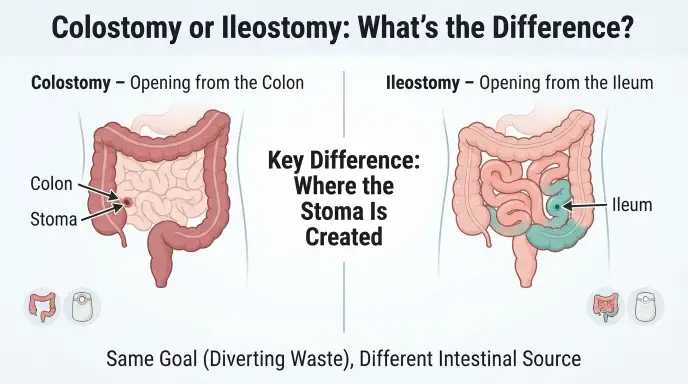
Colostomy and ileostomy are different types of bowel ostomy surgery: a colostomy uses the colon, while an ileostomy uses the ileum, the final part of the small intestine.
People often search for “colostomy or ileostomy” because the two medical terms sound similar and both involve creating a stoma. However, they are not the same procedure. The main difference is the part of the intestine connected to the stoma.
In a colostomy, part of the large intestine, called the colon, is brought through an opening in the abdomen. In an ileostomy, the end of the small intestine, called the ileum, is brought through the abdominal wall.
Knowing this difference can make medical information much easier to understand. It can also help patients and families understand terms used by doctors, surgeons, nurses, and healthcare websites.
The choice between a colostomy and ileostomy depends on the person’s condition, the part of the bowel affected, and the type of surgery required. Either procedure may be temporary or permanent.
Colostomy or Ileostomy : Featured Snippet Answer
A colostomy connects the colon (large intestine) to a stoma, while an ileostomy connects the ileum (end of the small intestine) to a stoma. Both are types of ostomy surgery, but they involve different parts of the bowel.
Colostomy or Ileostomy : Quick Answer
The easiest way to remember the difference is:
- Colostomy = colon → stoma
- Ileostomy = ileum → stoma
Both procedures create a stoma, which is an opening on the abdomen through which bowel contents leave the body.
A colostomy uses part of the colon, which belongs to the large intestine. An ileostomy uses the ileum, which is the final section of the small intestine.
The terms are closely related, but they should not be used interchangeably. They describe different locations in the digestive system.
| Term | Bowel section | Simple meaning |
| Colostomy | Colon | Colon is connected to a stoma |
| Ileostomy | Ileum | Ileum is connected to a stoma |
| Ostomy | General term | Surgically created opening |
The type of ostomy a person needs depends on the underlying medical condition and the surgical plan.
Definition and Meaning of Colostomy or Ileostomy
What Is a Colostomy?
A colostomy is a surgical procedure that creates an opening between the colon and the outside of the body through the abdominal wall.
The opening is called a stoma. Bowel contents pass through the stoma and are usually collected in an ostomy pouch.
A colostomy may be used when part of the colon needs to be removed, bypassed, or given time to heal. It can be temporary or permanent, depending on the person’s condition and treatment plan.
In simple terms:
Colostomy = a stoma made from the colon.
What Is an Ileostomy?
An ileostomy is a surgical procedure that brings the end of the ileum through an opening in the abdominal wall to create a stoma.
The ileum is the final part of the small intestine. Bowel contents pass through the stoma and are collected in an ostomy pouch.
An ileostomy may be created when the colon or rectum needs to be removed, bypassed, or allowed to heal.
In simple terms:
Ileostomy = a stoma made from the ileum.
What Does Ostomy Mean?
Ostomy is a general medical term for a surgically created opening between an internal organ and the outside of the body.
When the opening involves the bowel, it allows intestinal contents to leave the body through a stoma.
Both colostomy and ileostomy are types of bowel ostomy.
The Main Difference
The most important difference is the part of the intestine used to create the stoma.
Colostomy:
The colon, which is part of the large intestine, is connected to the stoma.
Ileostomy:
The ileum, which is part of the small intestine, is connected to the stoma.
This anatomical difference is also why doctors use two different names.
Easy Memory Trick
You can remember the terms by focusing on the first part of each word:
- Colo → Colon
- Ileo → Ileum
So:
Colostomy = colon
Ileostomy = ileum
This simple connection makes the difference much easier to remember.
The Origin of Colostomy or Ileostomy
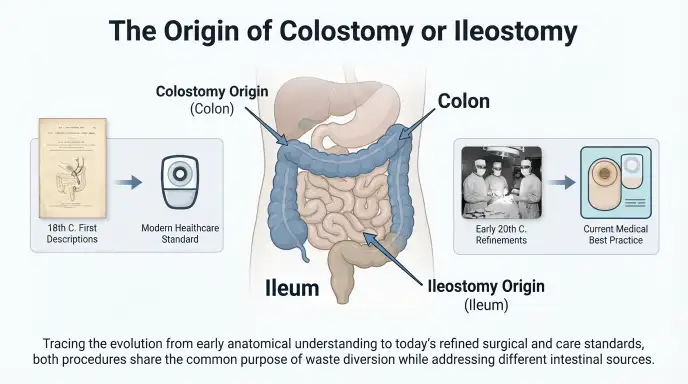
The words colostomy and ileostomy are medical terms formed from the names of parts of the intestine and the suffix stomy.
The ending stomy comes from a Greek root related to the idea of a mouth or opening. In medical language, it is used for procedures that create an opening from an internal organ to the outside of the body.
Origin of Colostomy
Colostomy is formed from colon + stomy.
The word colon refers to the main part of the large intestine. The name therefore describes a surgical opening involving the colon.
Origin of Ileostomy
Ileostomy is formed from ileum + stomy.
The ileum is the final section of the small intestine. The name describes a surgical opening involving this part of the bowel.
Why Do the Words Sound Similar?
The two words sound similar because they share the ending stomy. Both procedures create a stoma, so they belong to the same general group of surgical procedures.
The important difference is at the beginning:
- Colo refers to the colon
- Ileo refers to the ileum
This naming pattern makes the medical terms more descriptive and helps identify which part of the bowel is involved.
British English vs American English Spelling
Unlike many English spelling questions, colostomy and ileostomy do not normally have different British and American spellings.
The standard forms are the same in both varieties of English.
| Word | British English | American English |
| Colostomy | colostomy | colostomy |
| Ileostomy | ileostomy | ileostomy |
| Ostomy | ostomy | ostomy |
| Stoma | stoma | stoma |
So, if you are writing for readers in the UK, US, Canada, Australia, or another English speaking region, the spelling generally stays the same.
The main challenge is not spelling. It is using the correct term for the correct part of the bowel.
Colostomy vs Ileostomy
A quick comparison makes the distinction clear:
| Feature | Colostomy | Ileostomy |
| Intestine involved | Colon | Ileum |
| Part of digestive system | Large intestine | Small intestine |
| Stoma created | Yes | Yes |
| External pouch commonly used | Yes | Yes |
| Standard UK spelling | Colostomy | Ileostomy |
| Standard US spelling | Colostomy | Ileostomy |
Which Spelling Should You Use?
There is no major UK versus US spelling choice for these two medical terms.
Use colostomy when you mean a stoma created from the colon.
Use ileostomy when you mean a stoma created from the ileum.
For American English
American medical writing uses:
- Colostomy
- Ileostomy
These spellings are standard and should not be changed.
For British English
British medical writing also uses:
- Colostomy
- Ileostomy
For example, NHS medical information uses both terms when explaining different types of bowel surgery.
For Global Audiences
If you write for an international audience, use the standard spellings and explain the difference in simple language.
For example:
An ileostomy uses the ileum, which is the final part of the small intestine.
This is clearer than assuming readers already understand the medical terminology.
Common Mistakes with Colostomy or Ileostomy
Because the words look and sound similar, several mistakes are common.
1. Using the Terms as Synonyms
A colostomy and an ileostomy are not the same procedure.
Incorrect:
“Colostomy and ileostomy are simply two names for the same surgery.”
Correct:
“A colostomy uses the colon, while an ileostomy uses the ileum.”
2. Confusing the Ileum With the Colon
The ileum and colon are different parts of the digestive system.
Ileum: part of the small intestine.
Colon: part of the large intestine.
Remember:
Ileostomy → ileum → small intestine
Colostomy → colon → large intestine
3. Assuming the Spelling Changes by Country
Some English words have different British and American spellings, but these medical terms generally do not.
Correct in both:
- Colostomy
- Ileostomy
4. Using “Ostomy” When You Need a Specific Term
Ostomy is a broad term. It does not tell the reader if the stoma involves the colon or ileum.
For greater accuracy, choose colostomy or ileostomy when you know which type you mean.
5. Assuming Every Ostomy Is Permanent
An ostomy may be temporary or permanent. The decision depends on the person’s medical condition and surgical treatment.
Therefore, it is incorrect to assume that having a colostomy or ileostomy automatically means it will be permanent.
Colostomy or Ileostomy: Key Difference So Far
The simplest way to understand the two terms is to focus on anatomy rather than spelling.
Colostomy refers to the colon.
Ileostomy refers to the ileum.
Both create a stoma, but the section of bowel connected to that stoma is different.
This distinction is important when reading medical records, surgery information, patient guides, or healthcare articles. Using the correct term makes medical communication clearer and avoids confusion.
Colostomy or Ileostomy in Everyday Examples
Although colostomy and ileostomy are medical terms, you may see them in many types of everyday health writing. They appear in patient guides, emails, medical reports, news articles, support groups, and social media discussions.
In Emails
My doctor explained that I may need an ileostomy after the procedure.
In News Articles
The patient later underwent surgery and received a temporary colostomy.
In Social Media
I learned the difference between a colostomy and ileostomy while preparing for surgery.
In Patient Education
An ileostomy brings the end of the small intestine through the abdominal wall to form a stoma.
In Formal Writing
The type of ostomy depends on the patient’s condition and the part of the bowel affected.
These examples show that you should use “colostomy” and “ileostomy” according to their medical meanings; they are not alternative spellings of the same word.
Colostomy or Ileostomy : Google Trends & Usage Data
People usually search for “colostomy” and “ileostomy” when researching medical treatment, bowel surgery, recovery, ostomy care, or patient education.
People in different countries may show different levels of interest depending on the medical topic they search for. Someone researching surgery involving the colon may search for colostomy, while someone researching surgery involving the small intestine may search for ileostomy.
Google Trends can help show how often people search for these terms relative to each other in a selected country and time period. However, search interest does not show how common a procedure is.Health campaigns, news coverage, patient communities, and changes in public awareness can affect search volume.
For this reason, researchers should use search trends to understand search behavior rather than determine which procedure is more common or medically appropriate.
The most important distinction remains anatomical:
Colostomy → colon
Ileostomy → ileum
Colostomy vs Ileostomy : Quick Comparison Table
| Feature | Colostomy | Ileostomy |
| Main bowel section | Colon | Ileum |
| Intestine | Large intestine | Small intestine |
| Creates a stoma | Yes | Yes |
| Uses an ostomy pouch | Commonly | Commonly |
| Can be temporary | Yes | Yes |
| Can be permanent | Yes | Yes |
| UK spelling | Colostomy | Ileostomy |
| US spelling | Colostomy | Ileostomy |
| Main word clue | Colo | Ileo |
The easiest way to remember the difference is that colostomy contains “colo,” referring to the colon, while ileostomy contains “ileo,” referring to the ileum.
Frequently Asked Questions
1. What is the main difference between a colostomy and an ileostomy?
A colostomy uses the colon, while an ileostomy uses the ileum, which is the final part of the small intestine.
2. Is an ileostomy the same as a colostomy?
No. Both are types of ostomy surgery, but they involve different parts of the digestive system.
3. Is the ileum part of the small intestine?
Yes. The ileum is the final section of the small intestine, while the colon belongs to the large intestine.
4. Are colostomy and ileostomy spelled differently in the UK and US?
Generally, no. Colostomy and ileostomy have the same standard spelling in British and American English.
5. Can a colostomy or ileostomy be temporary?
Yes. Either type may be temporary or permanent, depending on the person’s condition and surgical plan.
6. What does “ostomy” mean?
Healthcare professionals use the term “ostomy” for a surgically created opening that lets contents from an internal organ leave the body.
7. Which is better, colostomy or ileostomy?
Neither is universally better. The appropriate type depends on the medical condition, affected bowel, and surgical plan.
Key Takeaways
- Colostomy involves the colon.
- Ileostomy involves the ileum.
- The ileum is part of the small intestine.
- The colon is part of the large intestine.
- Both procedures create a stoma.
- Both terms have the same standard spelling in British and American English.
- Ostomy is the broader term.
- A colostomy or ileostomy may be temporary or permanent.
- The correct procedure depends on the individual’s medical situation.
Conclusion
Understanding colostomy or ileostomy is much easier when you focus on the part of the bowel involved. A colostomy uses the colon, which is part of the large intestine. An ileostomy uses the ileum, which is the final section of the small intestine. Both procedures create a stoma that allows bowel contents to leave the body through the abdomen.
The spelling does not normally change between British and American English. This means you can use colostomy and ileostomy for both UK and US audiences. The real difference is their meaning, not their spelling.
If you are writing about these procedures, use colostomy when referring to the colon and ileostomy when referring to the ileum. When writing for a general audience, briefly explain each medical term to make the information easier to understand.
For personal medical questions, the appropriate type of ostomy depends on the individual’s condition and treatment plan.A qualified healthcare professional can explain the reason for recommending a particular procedure.
Learn More Spelling!

Hi, I’m Olivia Bennett, an English grammar and spelling content writer. I enjoy exploring confusing words, spelling differences, and everyday language questions. My goal is to share clear, simple, and helpful explanations that make English easier to understand.








2 thoughts on “Colostomy vs Ileostomy: Meaning and Differences”