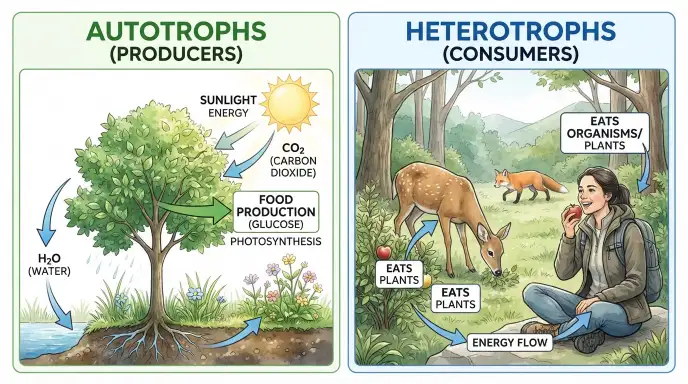
Autotrophs produce organic compounds from inorganic carbon sources, while heterotrophs obtain organic nutrients from other organisms or organic matter. This is the main difference between an autotroph or heterotroph.
Students often search for this comparison because the two terms are common in biology but can be difficult to remember. Both describe how organisms obtain the materials they need for growth, yet they use different nutritional strategies.
An autotroph can make organic compounds from inorganic carbon, often using energy from sunlight or chemical reactions. Green plants are familiar examples because they use photosynthesis to make sugars. A heterotroph, such as a human, animal, or fungus, gets organic nutrients from external sources.
The distinction is more detailed than simply saying that plants make food and animals eat it. Some microorganisms are autotrophs, while others are heterotrophs. Their energy sources can also vary.
In this guide, you will learn the meaning of autotroph or heterotroph, the origin of both terms, their biological differences, and simple examples that make the concepts easier to understand.
Autotroph or Heterotroph : Quick Answer
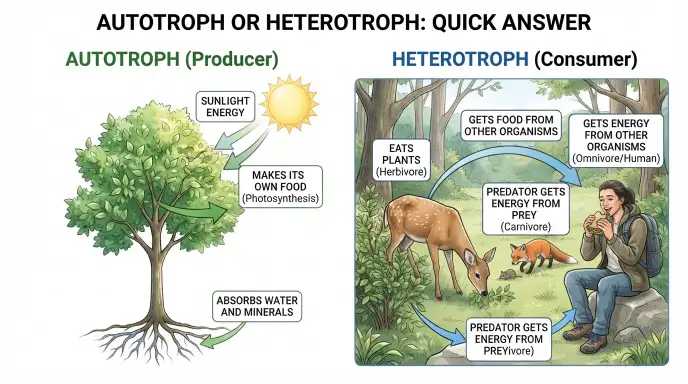
An autotroph produces organic compounds from inorganic carbon sources, while a heterotroph obtains organic carbon from external sources.
The easiest way to remember the difference is:
- Autotroph = self-nourishing
- Heterotroph = other-nourishing
- Plants are common autotrophs.
- Humans and animals are common heterotrophs.
- Fungi are generally heterotrophs.
- Some microorganisms can be autotrophic or heterotrophic.
Simple Examples
Example 1: Green Plant
A green plant uses light energy, carbon dioxide, and water to produce organic compounds through photosynthesis. It is a photoautotroph.
Example 2: Human
Humans obtain organic nutrients by eating food. This makes humans heterotrophs.
Example 3: Fungus
Fungi obtain nutrients from organic material in their surroundings. They are heterotrophs.
The key question is:
Where does the organism get its organic carbon?
If it builds organic compounds from inorganic carbon, it is using an autotrophic strategy. If it obtains organic carbon from external organic matter, it is using a heterotrophic strategy.
What Does Autotroph or Heterotroph Mean?
What Is an Autotroph?
An autotroph is an organism that produces organic compounds from inorganic carbon sources, usually carbon dioxide.
Many autotrophs use sunlight as their energy source. These are called photoautotrophs. Green plants, many algae, and some bacteria are examples.
During photosynthesis, plants use light energy to help convert carbon dioxide and water into organic compounds such as sugars.
Some autotrophs use chemical reactions instead of sunlight to obtain energy. These organisms are commonly called chemoautotrophs, although more specific scientific terms can be used for particular groups.
What Is a Heterotroph?
A heterotroph is an organism that obtains organic carbon from external sources.
Animals are common examples. Humans get carbon, energy, and nutrients by consuming food.
Fungi are also heterotrophs. They commonly release enzymes into their surroundings and absorb nutrients after organic material has been broken down.
Autotroph vs Heterotroph
| Feature | Autotroph | Heterotroph |
| Basic meaning | Produces organic compounds from inorganic carbon | Obtains organic carbon from external sources |
| Carbon source | Usually inorganic carbon such as CO₂ | Organic compounds |
| Energy source | Light or chemical reactions | Varies by organism |
| Common example | Green plant | Human |
| Common strategy | Photosynthesis or other autotrophic metabolism | Ingestion, absorption, or other heterotrophic nutrition |
The difference is more precise than simply saying autotrophs make food and heterotrophs eat food. In biology, the classification focuses mainly on how organisms obtain carbon and energy.
The Origin of Autotroph and Heterotroph
The terms autotroph and heterotroph are built from Greek roots related to self, other, and nourishment.
Auto- means self, while hetero- means other or different. The ending -troph relates to nourishment or feeding.
This gives you a simple memory trick:
- Auto + troph = self-nourishing
- Hetero + troph = other-nourishing
The terms became useful in biology because scientists needed ways to describe different nutritional strategies.
They do not refer only to particular groups of organisms. For example, not every autotroph is a plant, and not every heterotroph is an animal.
Modern biology can describe these strategies in greater detail by considering both the organism’s carbon source and energy source. This is why terms such as photoautotroph, chemoautotroph, and heterotroph are used in scientific writing.
British English vs American English
There is no significant British-American spelling difference between autotroph and heterotroph. Both terms use the same spelling in scientific, academic, and educational writing.
| British English | American English | Example |
| autotroph | autotroph | A green plant is a common autotroph. |
| heterotroph | heterotroph | Humans are heterotrophs. |
| autotrophic | autotrophic | Plants use an autotrophic nutritional strategy. |
| heterotrophic | heterotrophic | Animals have heterotrophic nutrition. |
| photoautotroph | photoautotroph | Many green plants are photoautotrophs. |
Regional Usage
Unlike spelling differences such as colour/color or organise/organize, these biology terms normally keep the same spelling across English-speaking regions.
You can use autotroph and heterotroph in:
- US English
- UK English
- Canadian English
- Australian English
- International scientific writing
Academic Writing
In academic biology, define each term when it first appears.
For example:
Autotrophs produce organic compounds from inorganic carbon sources, while heterotrophs obtain organic carbon from external sources.
This keeps the writing accurate while making the concept easier for students and general readers to understand.
Which Version Should You Use?
There is no spelling choice between autotroph and heterotroph. Both are correct scientific terms, but they describe different nutritional strategies.
United States
Use autotroph when an organism produces organic compounds from inorganic carbon.
Use heterotroph when an organism obtains organic carbon from other organisms or organic matter.
United Kingdom
British English uses the same spellings. Autotroph and heterotroph are standard terms in biology textbooks and academic writing.
Canada
Canadian scientific writing also uses autotroph and heterotroph with the same spelling as American and British English.
Australia
Australian biology resources use the same standard terminology. There is no regional spelling change between the two words.
International Writing
For an international audience, explain the terms in simple language the first time you use them.
For example:
An autotroph makes organic compounds from inorganic carbon, while a heterotroph obtains organic carbon from external sources.
Academic Writing
Use the most specific term that matches the organism or process.
For example, photoautotroph is more specific when an organism uses light as its energy source. When discussing an organism that obtains organic nutrients from its environment, heterotroph may be appropriate.
Business and General Writing
These terms are mainly used in scientific and educational contexts. If your audience is not familiar with biology, give a short definition instead of using the terms without explanation.
Common Mistakes with Autotroph or Heterotroph
Mistake 1: Saying All Plants Are Heterotrophs
Incorrect:
Plants are heterotrophs because they get water and minerals from the soil.
Correct:
Most green plants are photoautotrophs because they can produce organic compounds through photosynthesis.
Explanation:
Getting water and minerals from the environment does not make a plant a heterotroph. The plant can produce organic compounds using carbon dioxide and light energy.
Memory Tip:
Auto = self. Think of an autotroph as an organism that can build organic food from inorganic carbon.
Mistake 2: Saying Autotrophs Need Nothing From the Environment
Incorrect:
Autotrophs do not need materials from their environment.
Correct:
Autotrophs obtain materials and energy from their environment to produce organic compounds.
Explanation:
Autotrophs still need resources such as carbon dioxide, water, minerals, light, or suitable chemical energy sources.
Memory Tip:
“Self-nourishing” does not mean “completely independent.”
Mistake 3: Calling Every Bacterium an Autotroph
Incorrect:
All bacteria are autotrophs.
Correct:
Bacteria include both autotrophic and heterotrophic organisms.
Explanation:
Bacteria have many different nutritional strategies. Some can produce organic compounds from inorganic carbon, while others depend on organic material.
Memory Tip:
Never classify an organism based only on its broad group. Look at its nutritional strategy.
Mistake 4: Assuming Only Animals Are Heterotrophs
Incorrect:
Animals are the only heterotrophs.
Correct:
Animals, fungi, and many microorganisms are heterotrophs.
Explanation:
Heterotrophy occurs in many different types of organisms.
Memory Tip:
Think hetero = other, not “animal.”
Mistake 5: Using Autotroph and Heterotroph as Synonyms
Incorrect:
Autotroph and heterotroph mean the same thing.
Correct:
Autotroph and heterotroph describe different ways of obtaining carbon and energy.
Explanation:
An autotrophic strategy uses inorganic carbon as the carbon source, while a heterotrophic strategy obtains organic carbon from external sources.
Memory Tip:
Auto = self, hetero = other.
Autotroph or Heterotroph in Everyday Examples
The terms autotroph and heterotroph are most common in biology, but you may see them in school assignments, articles, reports, and everyday science discussions.
Emails
Please add an explanation of autotrophs and heterotrophs to the biology presentation.
Business Writing
The environmental report examines interactions between autotrophic and heterotrophic organisms.
News Headlines
Scientists Examine the Role of Autotrophs in Aquatic Ecosystems
Blogs
Plants are common examples of autotrophs because they can use photosynthesis to produce organic compounds.
Social Media
Biology tip: Plants are commonly photoautotrophs, while humans are heterotrophs.
Academic Writing
Autotrophs obtain carbon from inorganic sources, whereas heterotrophs obtain organic carbon from external sources.
Daily Conversation
Is a mushroom an autotroph or a heterotroph?
A simple answer is:
A mushroom is a heterotroph because fungi obtain organic nutrients from their surroundings.
Google Trends & Modern Usage
The search phrase autotroph or heterotroph has a clear educational and comparison-based search intent.
Students commonly search these terms while studying:
- Photosynthesis
- Cellular respiration
- Ecology
- Food chains
- Food webs
- Carbon cycles
- Microbiology
- Organism classification
- Autotrophic nutrition
- Heterotrophic nutrition
Common related searches include autotroph vs heterotroph, difference between autotroph and heterotroph, examples of autotrophs, examples of heterotrophs, and are humans autotrophs or heterotrophs.
Exact search-volume statistics should not be invented without current keyword research data. Google Trends can show relative interest over time and between regions, but relative interest is not the same as an exact number of searches.
The continued appearance of these terms in educational searches reflects their importance in basic biology. They are also connected to larger topics such as ecosystems, energy flow, food webs, photosynthesis, and carbon cycling.
Searchers may also confuse the terms because simple school explanations often reduce them to “plants make food” and “animals eat food.” That shortcut is useful for beginners, but the scientific distinction is based on how organisms obtain carbon and energy.
Quick Comparison Table
| Version | Meaning | Correct? | Region | Example |
| Autotroph | Produces organic compounds from inorganic carbon sources | Yes | Worldwide | A green plant is a common autotroph. |
| Heterotroph | Obtains organic carbon from external sources | Yes | Worldwide | A human is a heterotroph. |
| Photoautotroph | Uses light energy and inorganic carbon | Yes | Worldwide | Many green plants are photoautotrophs. |
| Chemoautotroph | Uses chemical energy and inorganic carbon | Yes | Worldwide | Some microorganisms use inorganic chemicals for energy. |
| Autotrophic | Related to autotrophic nutrition | Yes | Worldwide | Photosynthesis supports autotrophic growth in many plants. |
| Heterotrophic | Related to heterotrophic nutrition | Yes | Worldwide | Animals have heterotrophic nutrition. |
Key Takeaways
- Autotrophs produce organic compounds from inorganic carbon sources.
- Heterotrophs obtain organic carbon from external organic sources.
- Green plants are common examples of photoautotrophs.
- Humans and animals are common heterotrophs.
- Fungi are generally heterotrophic organisms.
- Some microorganisms can be autotrophic, while others are heterotrophic.
- Autotroph and heterotroph have the same spelling in British and American English.
- The easiest memory trick is auto = self and hetero = other.
FAQs About Autotroph or Heterotroph
1. What is the main difference between an autotroph and a heterotroph?
An autotroph produces organic compounds from inorganic carbon sources, such as carbon dioxide.
A heterotroph obtains organic carbon and nutrients from other organisms or organic matter.
2. Is a plant an autotroph or a heterotroph?
Most green plants are photoautotrophs because they use light energy to produce organic compounds through photosynthesis.
They still need water, minerals, and carbon dioxide from their environment.
3. Are humans autotrophs or heterotrophs?
Humans are heterotrophs because we obtain organic nutrients and energy by consuming food.
Our bodies cannot produce organic food from carbon dioxide and water using sunlight.
4. Are animals autotrophs or heterotrophs?
Animals are heterotrophs because they obtain organic nutrients by consuming other organisms or organic material.
They do not use photosynthesis to produce their own organic food.
5. Are fungi autotrophs or heterotrophs?
Fungi are generally heterotrophs because they obtain nutrients from organic matter in their surroundings.
They commonly break down organic material and absorb the available nutrients.
6. Can bacteria be autotrophs or heterotrophs?
Yes. Bacteria have many different nutritional strategies, so some are autotrophic while others are heterotrophic.
Their classification depends on how they obtain carbon and energy.
7. What is a photoautotroph?
A photoautotroph is an organism that uses light as its energy source and obtains carbon from inorganic sources.
Green plants, many algae, and some bacteria are examples of photoautotrophic organisms.
8. What does heterotrophic mean?
Heterotrophic describes an organism or nutritional process that depends on organic carbon from external sources.
Animals and fungi are common examples of organisms with heterotrophic nutrition.
9. What does autotrophic mean?
Autotrophic describes an organism or process that produces organic compounds from inorganic carbon sources.
Energy for this process can come from sunlight or chemical reactions, depending on the organism.
10. What is an easy way to remember autotroph and heterotroph?
Remember auto = self and hetero = other.
An autotroph builds organic compounds from inorganic carbon, while a heterotroph gets organic carbon from external sources.
Conclusion
The difference between autotroph or heterotroph becomes easier when you focus on how an organism obtains carbon and energy. An autotroph produces organic compounds from inorganic carbon sources, while a heterotroph obtains organic carbon from external organic sources.
Green plants are common examples of photoautotrophs because they use light energy during photosynthesis. Humans, animals, and fungi are common examples of heterotrophs. Many microorganisms also have these nutritional strategies, showing that the terms are much broader than simply “plants versus animals.”
There is also no British or American spelling difference between autotroph and heterotroph. Both terms are spelled the same way in scientific and academic English.
For students, the easiest memory trick is auto = self and hetero = other. This simple clue can help you remember which nutritional strategy each word describes.
if you are writing a biology assignment, studying for an exam, or explaining an ecosystem, use the term that accurately describes the organism’s nutritional strategy.
Discover More Spelling Tips!

Hi, I’m Olivia Bennett, an English grammar and spelling content writer. I enjoy exploring confusing words, spelling differences, and everyday language questions. My goal is to share clear, simple, and helpful explanations that make English easier to understand.







2 thoughts on “Autotroph or Heterotroph: What’s the Difference?”