Assault and battery are related legal terms, but they generally describe different types of unlawful conduct. The exact meaning depends on the laws of the country, state, or jurisdiction involved.
People often search for assault or battery because these words are commonly used together. To many people, these terms may sound like two words for the same thing in everyday conversation. In legal writing, however, the distinction can be important.
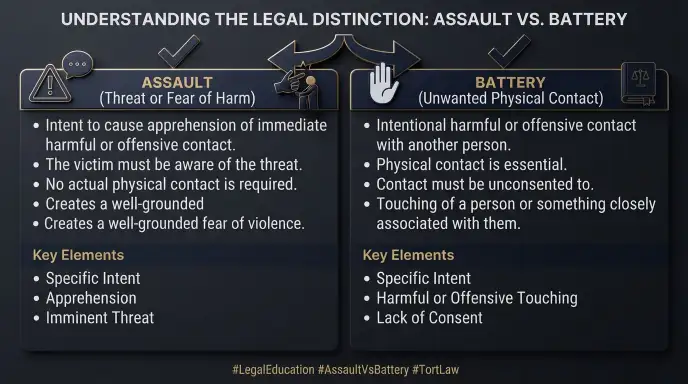
Under traditional legal definitions, assault involves intentionally causing someone to fear or expect immediate harmful or offensive contact. Battery generally involves intentional and unlawful physical contact with another person. For example, threatening to hit someone may be treated as assault, while actually hitting them may be treated as battery in a jurisdiction that recognizes the distinction.
The confusion becomes greater because legal systems do not all use these terms in exactly the same way. Some jurisdictions use assault as a broader term and do not treat battery as a separate offense.
This guide explains the meaning, history, regional usage, common mistakes, and everyday examples of assault or battery so you can understand the difference clearly.
Assault or Battery : Quick Answer
Assault and battery are not traditionally the same thing. In many legal contexts, assault concerns the threat or fear of imminent harmful contact, while battery concerns unlawful physical contact.
- Assault: May involve causing someone to fear immediate harmful or offensive contact.
- Battery: Generally involves unlawful physical contact.
- Assault and battery: A common phrase for related conduct, but its legal meaning varies by jurisdiction.
Example 1:
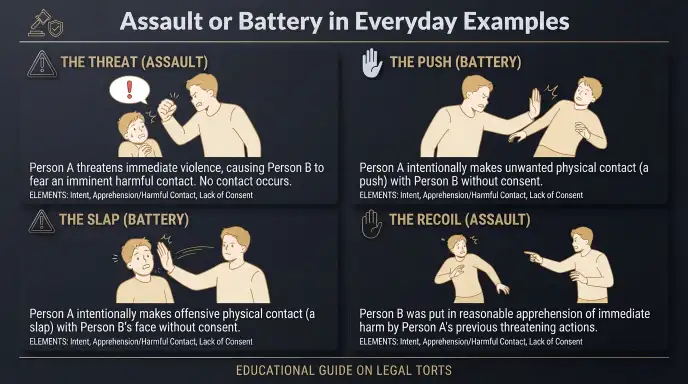
A person raises a fist and threatens to strike someone. Depending on local law, this may be assault.
Example 2:
A person intentionally punches someone. In a jurisdiction recognizing battery separately, this may be battery.
Important: Legal definitions vary, so the law of the relevant jurisdiction should always be checked.
Definition and Meaning of Assault or Battery
What Does Assault Mean?
In many traditional legal definitions, assault involves intentional conduct that causes another person to reasonably fear or expect immediate harmful or offensive physical contact.
Physical contact does not necessarily have to happen.
For example:
Someone moves toward another person with a raised fist and threatens to hit them.
Depending on the circumstances and applicable law, this could constitute assault.
What Does Battery Mean?
Battery traditionally refers to intentional and unlawful physical contact with another person. The contact may be harmful or offensive.
For example:
Someone intentionally pushes or punches another person without legal justification.
In a jurisdiction that recognizes battery as a separate offense, this physical contact may fall under battery.
Why Are Assault and Battery Used Together?
The phrase assault and battery comes from the traditional distinction between the two concepts.
A simple way to remember the traditional difference is:
Assault = fear or apprehension of immediate contact.
Battery = actual unlawful contact.
However, this is only a general guide. Modern laws can define these offenses differently.
Simple Comparison
| Term | Simple Meaning | Physical Contact |
| Assault | Threat or conduct creating fear of imminent harmful contact | Not always required |
| Battery | Intentional and unlawful physical contact | Generally required |
| Assault and battery | Related legal concepts used together | Depends on jurisdiction |
The Origin of Assault or Battery
The words assault and battery have roots in older French and English legal language.
Assault entered English through Anglo French and Old French. Its early sense was connected with attacking or making an attempt against someone. English common law later developed a more specific legal meaning.
Battery also has French roots. It developed from language associated with beating or striking and eventually became a legal term for unlawful physical contact.
The two terms became closely connected in the English common law tradition. Over time, different legal systems developed their own rules and definitions.
This history helps explain why the phrase assault and battery is still common today.
It is important to note that these are not spelling variations. Assault and battery are two separate words with different meanings.
British English vs American English Spelling
There is no British or American spelling difference between assault and battery.
Both varieties of English use the same spellings:
- assault
- battery
- assault and battery
The main difference is legal usage, not spelling. Different jurisdictions may define or classify the terms differently.
| British English | American English | Example |
| assault | assault | The person was accused of assault. |
| battery | battery | The case involved an allegation of battery. |
| assault and battery | assault and battery | The phrase is used in legal contexts. |
| physical contact | physical contact | The law may define unlawful contact differently. |
British English Usage
In modern British law, assault can have a broader meaning than the traditional American distinction suggests. For example, common assault can involve causing another person to apprehend immediate unlawful violence, while physical contact may be dealt with under offenses such as battery.
American English Usage
In the United States, many legal discussions distinguish between assault and battery. However, the exact definitions and classifications can differ from one state to another.
Because of these differences, you should not assume that an American legal definition automatically applies in British law, or vice versa.
Which Spelling Should You Use?
There is no spelling choice between assault and battery. They are different words with different meanings. The correct word depends on the situation and the legal system you are discussing.
For the United States
In the US, assault and battery may be treated as separate offenses, but the exact definitions vary by state.
Use the terms according to the law of the state involved.
For the United Kingdom
British legal usage can differ from the traditional American distinction. Assault can refer to conduct that causes someone to fear immediate unlawful violence, while physical contact may fall under battery.
For Commonwealth Countries
Countries such as Canada and Australia have their own legal rules. Do not assume that the traditional US distinction applies in every Commonwealth jurisdiction.
For International Writing
When writing for a global audience, explain the terms rather than presenting one definition as universal.
For example:
In many traditional legal definitions, assault involves apprehension of imminent contact, while battery involves unlawful physical contact.
This wording makes the regional difference clear.
For Academic Writing
Identify the jurisdiction you are discussing. Legal terms should be defined within their specific legal context.
For Business Writing
Use the terminology required by the relevant law, workplace policy, or official document. Avoid using assault and battery interchangeably when accuracy matters.
Common Mistakes with Assault or Battery
Mistake 1: Thinking Assault Always Means Being Hit
Incorrect:
Assault always means someone was physically attacked.
Correct:
Assault does not always require physical contact under traditional legal definitions.
Explanation:
Assault may involve conduct that creates a reasonable fear of immediate harmful or offensive contact.
Memory tip:
Think assault = apprehension, battery = contact in the traditional distinction.
Mistake 2: Assuming Battery Always Means Serious Injury
Incorrect:
Battery only happens when someone suffers a serious injury.
Correct:
Battery generally concerns unlawful physical contact, not necessarily serious injury.
Explanation:
The legal requirements depend on the applicable jurisdiction.
Mistake 3: Treating the Terms as Universal
Incorrect:
Assault and battery have the same legal definition everywhere.
Correct:
Their meanings vary between legal systems.
Explanation:
Different countries and states have developed different laws and classifications.
Mistake 4: Using “Assault” and “Battery” as Spelling Alternatives
Incorrect:
Assault is the British version of battery.
Correct:
Assault and battery are separate words.
Explanation:
They are not British and American spelling variants. Their difference is primarily one of meaning and legal usage.
Assault or Battery in Everyday Examples
These terms can appear in many forms of communication. The wording should be especially precise in legal contexts.
Emails
The incident has been reported as an alleged assault and is being reviewed by the appropriate authorities.
Business Writing
The company has a policy covering threats, violence, and other inappropriate physical conduct.
News Headlines
Police Investigate Assault Following Public Incident
Blogs
Assault and battery are related legal terms, but their definitions can differ by jurisdiction.
Social Media
What is the difference between assault and battery? The answer depends partly on where you live.
Formal Writing
The legal definition of assault varies between jurisdictions.
Academic Writing
The distinction between assault and battery developed within the common law legal tradition.
Daily Conversation
He was accused of assault after the incident.
In everyday speech, people may use these words loosely. In legal or professional writing, it is better to use the terminology carefully and identify the relevant jurisdiction when necessary.
Assault or Battery : Google Trends & Usage Data
The search phrase assault or battery usually shows comparison intent. People often want to understand if the terms mean the same thing and when each term should be used.
Related searches may include:
- assault vs battery
- assault or battery difference
- assault and battery meaning
- battery vs assault
- what is assault and battery
- assault and battery law
- is assault the same as battery
Interest in these terms can also increase when a high profile criminal case, court decision, or news event involves allegations of violence.
Google Trends can be useful for comparing relative search interest across countries and time periods. However, it does not provide exact search volume.
Legal terminology also varies by location. A searcher in the United States may be looking for a state specific definition, while someone in the UK may be asking about a different legal concept.
Therefore, search popularity should not be confused with legal authority. For an actual legal matter, the applicable law is more important than general online usage.
Quick Comparison Table
| Term | Meaning | Correct? | Common Context | Example |
| Assault | Conduct that may create fear of imminent harmful contact | Yes | Legal and everyday | He was accused of assault. |
| Battery | Unlawful physical contact in jurisdictions recognizing it separately | Yes | Mainly legal | The allegation involved battery. |
| Assault and battery | Traditional phrase for related conduct | Yes | Legal discussions | The phrase is common in legal writing. |
| Assault vs battery | Comparison of the two concepts | Yes | Educational content | This guide explains assault vs battery. |
Key Difference at a Glance
| Question | Assault | Battery |
| Is physical contact traditionally required? | Not always | Generally yes |
| Is it a legal term? | Yes | Yes |
| Does the definition vary? | Yes | Yes |
| Is it a spelling variant? | No | No |
| Should the jurisdiction be checked? | Yes | Yes |
Key Takeaways
- Assault and battery are separate terms, not spelling alternatives.
- Traditional definitions often distinguish apprehension of harm from actual physical contact.
- Physical contact is not always required for assault.
- Battery traditionally involves unlawful physical contact.
- Legal definitions vary between countries and states.
- British and American English use the same spellings.
- Use the terms carefully in legal and professional writing.
- Always check the relevant jurisdiction for an exact legal definition.
FAQs About Assault or Battery
1. What is the difference between assault and battery?
Assault traditionally involves creating fear of imminent harmful or offensive contact.
Battery generally involves intentional and unlawful physical contact, although definitions vary by jurisdiction.
2. Does assault require physical contact?
No. Under the traditional legal distinction, assault can occur even when no physical contact takes place.
The important issue is if the required elements of assault are present under the applicable law.
3. Does battery always cause an injury?
No. Battery generally focuses on unlawful physical contact rather than the seriousness of an injury.
A person may be accused of battery even when the contact does not cause a significant injury.
4. Are assault and battery the same thing?
No. They are related legal concepts, but they can have different meanings and legal requirements.
Some jurisdictions also use assault as a broader term and do not treat battery as a separate offense.
5. Is “assault or battery” a spelling difference?
No. Assault and battery are separate words, not British and American spelling variations.
Both words have the same spelling in British and American English.
6. Is assault different in the UK and US?
Yes. The legal definitions and offenses can differ between the UK, US states, and other jurisdictions.
The traditional assault and battery distinction is more common in some US legal discussions than in others.
7. Which word should I use: assault or battery?
Use the term that matches the situation and the applicable legal definition.
For legal writing, always check the specific jurisdiction instead of relying on a general definition.
Conclusion
Assault or battery can be confusing because these terms are closely connected but traditionally describe different types of unlawful conduct. In the traditional legal distinction, assault may involve causing someone to reasonably expect immediate harmful or offensive contact, while battery generally involves intentional and unlawful physical contact.
However, there is no single definition that applies everywhere. Laws differ between countries, states, and other jurisdictions. Some legal systems distinguish assault and battery as separate concepts, while others use assault more broadly.
It is also important to remember that assault and battery are not spelling alternatives. Both words are spelled the same way in British and American English. Their difference is mainly one of meaning and legal usage.
For general writing, understanding the traditional distinction can help you choose clearer words. For legal, academic, or professional writing, identify the relevant jurisdiction and use its definitions. This approach prevents confusion and avoids treating a general explanation as a universal legal rule.
When discussing a real legal situation, rely on the applicable law or qualified legal advice rather than assuming that the traditional definition applies.
Discover More About Spelling!

Hi, I’m Olivia Bennett, an English grammar and spelling content writer. I enjoy exploring confusing words, spelling differences, and everyday language questions. My goal is to share clear, simple, and helpful explanations that make English easier to understand.








2 thoughts on “Assault or Battery: What’s the Difference?”