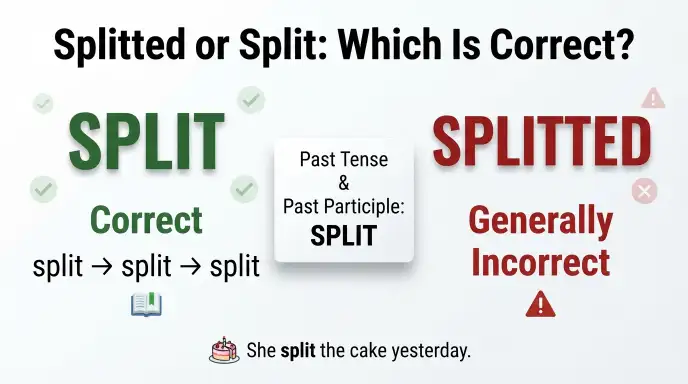
Split is the correct standard form, while splitted is generally not used in modern standard English. People often search for “splitted or split” because many English verbs form their past tense by adding -ed. However, split is an irregular verb that keeps the same form in the present, past, and past participle.
For example, you can say, “I split the cake yesterday” and “She has split the cake into six pieces.” In both cases, split is correct.
This can be confusing for students, ESL learners, writers, and anyone checking if splitted is a valid past-tense form. The good news is that the rule is simple: use split, not splitted, for the standard past tense and past participle.
This guide explains the meaning and grammar of split, its history, British and American usage, common mistakes, and practical examples.
Splitted or Split: Featured Snippet & AI Overview
Split is the standard past tense and past participle of split. Splitted is generally considered nonstandard in modern English. Use “I split the paper” rather than “I splitted the paper.” The same form is used after have, has, and had, as in “She has split the bill.”
Splitted or Split: Quick Answer
The correct standard form is split.
The verb split uses the same form for its base verb, past tense, and past participle.
- Present: I split the apple.
- Past: I split the apple yesterday.
- Past participle: I have split the apple.
Is “Splitted” Correct?
In standard modern English, splitted is generally avoided when you mean the ordinary past tense or past participle of split.
❌ She splitted the group into two teams.
✅ She split the group into two teams.
❌ The cake was splitted into six pieces.
✅ The cake was split into six pieces.
Why Is It “Split” Instead of “Splitted”?
Many regular verbs form their past tense by adding -ed:
- walk → walked
- clean → cleaned
- open → opened
Split does not follow this pattern. It is an irregular verb:
split → split → split
The form stays the same for the base verb, past tense, and past participle.
What Does Splitted or Split Mean?
Meaning of “Split”
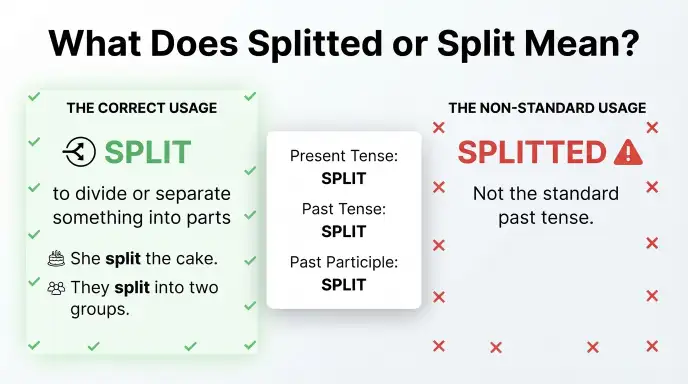
Split means to divide something into two or more parts. It can also mean to separate people, groups, objects, or amounts.
For example:
We split the pizza into eight slices.
Here, split means divided.
It can also describe something that breaks or separates:
The wooden board split down the middle.
Split as a Verb
As a verb, split can mean:
- Divide something
- Separate something
- Break something into parts
- Share something between people
- Separate from a group or place
Examples:
They split the money equally.
The students split into two groups.
We split the work between us.
Split as an Adjective
Split can also describe something that has been divided or separated.
The committee had split opinions about the proposal.
Split as a Noun
As a noun, split can refer to a division or separation.
There was a split between the two teams.
The word can also have special meanings in areas such as sports, business, and entertainment.
The Main Grammar Pattern
The key verb forms are:
| Verb Form | Correct Form |
| Base form | split |
| Past tense | split |
| Past participle | split |
| -ing form | splitting |
Examples:
I split the cake.
Yesterday, I split the cake.
I have split the cake.
She is splitting the cake.
Only the -ing form changes.
The Origin of Split
The word split has a long history in English and related Germanic languages. Its older forms were connected with dividing, breaking, or separating something.
Over time, split became established as a verb that keeps the same basic form in its principal forms. This pattern is still used in modern English.
Other common verbs work in a similar way:
| Base | Past | Past Participle |
| split | split | split |
| cut | cut | cut |
| put | put | put |
| hurt | hurt | hurt |
| shut | shut | shut |
This helps explain why splitted is unnecessary. English already has an established irregular form: split.
Why Do People Say “Splitted”?
The most common reason is that people apply a regular grammar rule to an irregular verb.
Many verbs form the past tense with -ed, so learners may naturally assume:
split → splitted
But English contains many irregular verbs that do not follow this pattern.
For split, the correct standard pattern is:
split → split → split
British English vs American English
There is no major British-American spelling difference between split and splitted. Both British and American English normally use split as the past tense and past participle.
| Form | British English | American English | Example |
| Base verb | split | split | They split the bill. |
| Past tense | split | split | They split the bill yesterday. |
| Past participle | split | split | They have split the bill. |
| -ing form | splitting | splitting | They are splitting the bill. |
| Nonstandard form | splitted | splitted | Generally avoid it. |
British English
She split the cake into four pieces.
The team has split into two groups.
American English
She split the cake into four pieces.
The team has split into two groups.
Unlike words such as catalog/catalogue, split does not change spelling between standard British and American English.
Which Version Should You Use?
For standard modern English, use split in the past tense and past participle. This rule applies to both American and British English.
United States
Use split:
She split the bill with her friends.
The company has split the project into three stages.
United Kingdom
Use split as well:
They split the group into smaller teams.
He has split the work between two departments.
Canada and Australia
Standard English in Canada and Australia also uses split rather than splitted.
International Writing
For international readers, split is the safest standard form. It is widely understood and does not create a regional spelling issue.
Academic and Business Writing
Use split in formal writing:
The researchers split the participants into two groups.
The manager split the budget between the departments.
Common Mistakes with Splitted or Split
Mistake 1: Adding “-ed” to Split
❌ The teacher splitted the class into groups.
✅ The teacher split the class into groups.
Why? Split is an irregular verb and does not use -ed for its past tense.
Memory tip:
Think “split stays split.”
Mistake 2: Using “Splitted” After Have or Has
❌ The company has splitted the project into sections.
✅ The company has split the project into sections.
After have, has, or had, use the past participle split.
Mistake 3: Confusing “Split” and “Splitting”
❌ They are split the work right now.
✅ They are splitting the work right now.
Use splitting after forms of be when describing an action happening now.
Mistake 4: Assuming Every Verb Takes “-ed”
Not every English verb follows the regular pattern.
For example:
- cut → cut
- put → put
- hit → hit
- split → split
Learning common irregular verbs helps prevent errors such as splitted.
Splitted or Split in Everyday Examples
The word split appears in many types of everyday communication.
Emails
We split the tasks between the two teams.
I have split the document into separate sections.
Business Writing
The manager split the budget between the departments.
The company has split the project into three phases.
News Headlines
Local Council Splits Funding Between Two Projects
In headlines, the present-tense form split may also appear because headlines often use simple present tense for recent events.
Blogs
I split my study time into three short sessions.
We split the recipe into smaller portions.
Social Media
We split the bill, and everyone paid their share.
The team split into two groups for the activity.
Academic Writing
Researchers split the participants into two groups.
The study sample was split into several categories.
Daily Conversation
Can we split the bill?
Let’s split the work.
The branch split during the storm.
These examples show that split works naturally in both casual and formal English.
Google Trends & Modern Usage
People search for “splitted or split” because splitted looks like a natural past-tense form. English learners often expect verbs to follow the regular -ed pattern.
However, split is the established standard form in modern English.
Search interest can also come from people checking:
- if splitted is a real word
- The past tense of split
- The past participle of split
- if British English uses splitted
- if American English uses splitted
- How to use split in a sentence
Exact search popularity can change over time and by country. Without a specific current dataset, it is better to describe these as general usage patterns rather than assign exact search-volume numbers.
Quick Comparison Table
| Version | Meaning | Correct? | Region | Example |
| split | Divide or separate | Yes | British & American English | She split the cake. |
| split | Past form of split | Yes | British & American English | She split the cake yesterday. |
| split | Past participle | Yes | British & American English | She has split the cake. |
| splitting | Present participle | Yes | British & American English | She is splitting the cake. |
| splitted | Intended past form | Generally no | Standard English | Avoid this form. |
Key Takeaways
- Split is the standard past tense of split.
- Split is also the standard past participle.
- Splitted is generally not used in standard modern English.
- The verb follows the pattern split → split → split.
- British and American English both normally use split.
- Use splitting for the present participle.
- Remember: “Split stays split.”
FAQs About Splitted or Split
1. Is “splitted” a correct word?
Splitted may appear in some historical, dialectal, or specialized uses, but it is generally not used as the standard past tense or past participle of split. In normal modern English, use split instead.
2. What is the past tense of “split”?
The past tense of split is split.
Present: I split the cake.
Past: I split the cake yesterday.
The form does not change.
3. What is the past participle of “split”?
The past participle is also split.
She has split the bill.
The group had split into two teams.
4. Is “splitted” used in American English?
Standard American English normally uses split, not splitted, for the past tense and past participle. The same rule applies in standard British English.
5. Is “splitted” used in British English?
Standard British English normally uses split. While splitted can appear in unusual or historical contexts, it is not the normal modern form.
6. Why does “split” not become “splitted”?
Split is an irregular verb. Like cut, put, and hit, it keeps the same form for the base verb, past tense, and past participle.
7. Is it “split” or “splitted the bill”?
Use split:
We split the bill.
Not:
We splitted the bill.
8. Is “split” the same in US and UK English?
Yes. Unlike some regional spelling pairs, such as catalog/catalogue, both standard American and British English normally use split.
9. What is the -ing form of split?
The -ing form is splitting.
They are splitting the work between them.
The verb split doubles its final consonant before adding -ing.
Conclusion
Split is the standard form to use when you need the past tense or past participle of the verb split. The word does not normally become splitted.The verb split has three main forms: split, split, split, making it an irregular verb.
This rule applies to standard American and British English. You can use split when talking about dividing an object, separating a group, sharing an amount, or breaking something into parts. For example, “They split the bill,” “She split the class into two groups,” and “The branch split during the storm” are all correct.
The confusion usually happens because many English verbs form their past tense with -ed. However, common irregular verbs do not always follow that pattern. Remembering “split stays split” makes this word easy to use correctly.
if you are writing an email, academic paper, business report, blog post, or everyday message, choose split for standard modern English.
Discover More Grammar Tips!

Hi, I’m Olivia Bennett, an English grammar and spelling content writer. I enjoy exploring confusing words, spelling differences, and everyday language questions. My goal is to share clear, simple, and helpful explanations that make English easier to understand.






2 thoughts on “Splitted or Split: Meaning, Usage, and Examples”