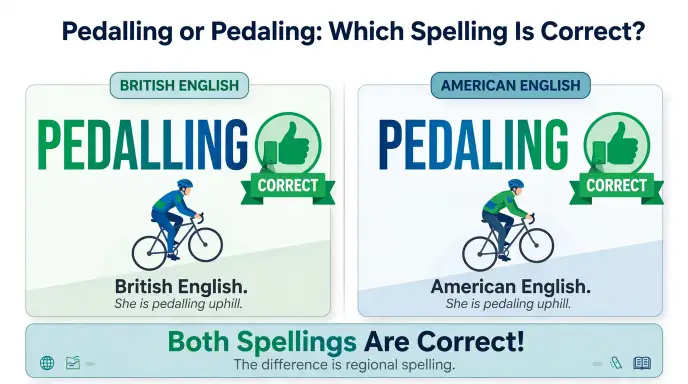
Pedalling and pedaling are both correct spellings, but pedalling is standard in British English, while pedaling is standard in American English. Both words mean pushing pedals with your feet to move a bicycle or operate a machine.
If you have searched for “pedalling or pedaling,” you may be unsure which spelling to use in an article, school assignment, email, or everyday message. The difference can be confusing because the words have the same meaning and pronunciation. Only the spelling changes.
English often uses different spelling rules in the United States and the United Kingdom. One common difference is how words ending in a consonant plus -l form their endings. British English often doubles the final l before adding -ing, while American English often keeps a single l in words such as traveling and canceled. The same pattern explains pedalling and pedaling.
In this guide, you will learn what both spellings mean, where they come from, and when to use each one. You will also see simple examples, common mistakes, and practical tips for choosing the right spelling for your audience.
Pedalling or Pedaling – Quick Answer
Pedalling is the preferred British English spelling, while pedaling is the preferred American English spelling. Both refer to the action of pushing or turning pedals.
Examples:
- British English: She is pedalling her bicycle to school.
- American English: She is pedaling her bicycle to school.
The meaning stays the same. The difference is regional spelling.
| Spelling | Preferred usage | Example |
| Pedalling | British English | He is pedalling up the hill. |
| Pedaling | American English | He is pedaling up the hill. |
Remember this simple rule: use pedalling for British English and pedaling for American English.
Definition and Meaning of Pedalling or Pedaling
Both pedalling and pedaling are forms of the verb pedal. They describe using a pedal with your foot to produce movement or control a device.
What Does Pedalling Mean?
Pedalling is the British English spelling of the present participle and gerund form of pedal.
It commonly describes riding a bicycle by pushing its pedals with your feet.
Examples:
- She was pedalling quickly along the road.
- Pedalling uphill requires more effort.
- The child is learning to pedal a small bicycle.
The word can also describe operating a machine that uses foot pedals.
What Does Pedaling Mean?
Pedaling has the same meaning as pedalling, but it follows standard American English spelling.
Examples:
- He kept pedaling until he reached the park.
- Pedaling a bicycle helps him stay active.
- She was pedaling slowly through the neighborhood.
American writers use this spelling in everyday writing, educational materials, news articles, and formal documents.
Can Pedalling and Pedaling Have Different Meanings?
No. The two spellings do not have different meanings. They represent the same verb form in different spelling systems.
Both can describe:
- Riding a bicycle.
- Turning the pedals of an exercise bike.
- Operating a pedal-powered machine.
- Using a foot pedal to control equipment.
The correct choice depends on your audience and the spelling style you follow.
The Origin of Pedalling or Pedaling
The word pedal comes from the Latin word pedalis, meaning “of the foot.” This word is related to pes, the Latin word for “foot.”
English adopted pedal for devices operated by the foot. Such devices include bicycle pedals, piano pedals, and the pedals used to control certain machines.
As bicycles became more common, the verb to pedal developed to describe pushing bicycle pedals to move forward.
The spelling difference appeared through regional English spelling conventions.
British English often doubles the final l when adding endings such as -ing to certain verbs. Therefore, pedal becomes pedalling.
American English often uses a single l in comparable forms. As a result, pedal becomes pedaling.
Similar differences appear in other words:
- Travelling / Traveling
- Cancelled / Canceled
- Modelling / Modeling
- Signalling / Signaling
These differences do not usually change pronunciation or meaning. They reflect the spelling standards used in different English-speaking regions.
British English vs American English Spelling
The main difference between pedalling and pedaling is the spelling convention used in British and American English.
British English generally doubles the final l in pedalling. American English usually keeps one l in pedaling.
Spelling Comparison Table
| Feature | British English | American English |
| Preferred spelling | Pedalling | Pedaling |
| Base verb | Pedal | Pedal |
| Present participle | Pedalling | Pedaling |
| Gerund | Pedalling | Pedaling |
| Past tense | Pedalled | Pedaled |
| Common context | UK publications and writing | US publications and writing |
| Meaning | Using a pedal | Using a pedal |
Why Does British English Double the L?
British English commonly doubles the final l in certain words when adding a suffix that begins with a vowel. This pattern appears in pedalling, travelling, and modelling.
The rule helps maintain a consistent British spelling style.
Why Does American English Use One L?
American English often keeps a single l in these forms. This pattern appears in pedaling, traveling, and modeling.
However, spelling rules depend on the word and its structure. Not every verb follows the same pattern, so it is best to check a reliable dictionary when unsure.
Are Both Spellings Accepted?
Yes. Both are accepted English spellings. The important point is to use the form that matches your intended audience.
A British publication may prefer pedalling, while an American publication may require pedaling. Neither form is inherently better or more correct in all contexts.
Which Spelling Should You Use?
The best spelling depends on where your readers live and which style guide you follow.
Use Pedalling for British English
Choose pedalling when writing for readers in the United Kingdom or for publications that follow British spelling conventions.
Examples:
- The cyclist was pedalling along a country lane.
- Regular pedalling can improve cycling skills.
- He continued pedalling despite the strong wind.
This spelling is also common in many Commonwealth English contexts, although local style guides may differ.
Use Pedaling for American English
Choose pedaling when writing for an American audience.
Examples:
- She was pedaling toward the finish line.
- Pedaling uphill can be difficult for beginners.
- The cyclist stopped pedaling to rest.
American newspapers, school assignments, and websites generally use this form.
What About International Readers?
If your content is intended for readers worldwide, either spelling can work. The most important thing is consistency.
For an international grammar website, you can explain both forms and clearly identify their regional preferences. This helps readers understand the difference without treating either spelling as incorrect.
Common Mistakes with Pedalling or Pedaling
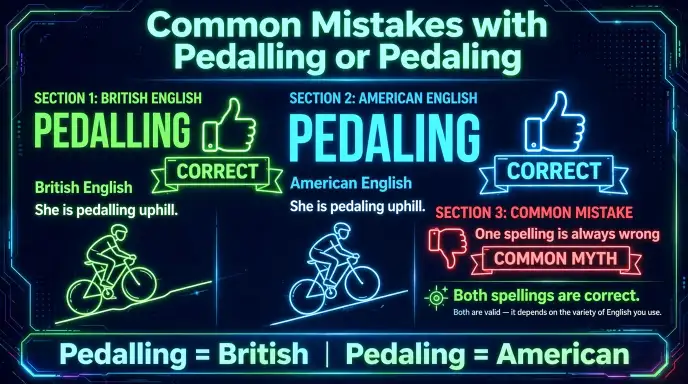
Writers sometimes confuse regional spelling differences with grammatical errors. Understanding the rules can help you avoid common mistakes.
1. Treating One Spelling as Always Wrong
Incorrect assumption: Pedalling is always incorrect.
Correction: Pedalling is standard in British English, while pedaling is standard in American English.
Both spellings are correct in their respective conventions.
2. Mixing British and American Spellings
A paragraph might use travelling, color, and pedaling together. Although readers can understand it, the mixture may look inconsistent.
Better approach: Choose a spelling convention and apply it throughout your writing.
For example, British English uses travelling and pedalling. American English uses traveling and pedaling.
3. Using the Wrong Past-Tense Form for Your Style
British English commonly uses pedalled, while American English commonly uses pedaled.
Examples:
- British: She pedalled home.
- American: She pedaled home.
Both are accepted forms, but the regional preference matters.
4. Confusing Pedal with Peddle
The words pedal and peddle have different meanings.
- Pedal: To operate or push a pedal.
- Peddle: To sell goods, often by traveling from place to place.
Examples:
- He began pedalling his bicycle.
- They peddle handmade goods at the market.
Using peddling when you mean riding a bicycle is a spelling and word-choice error.
5. Assuming the Pronunciation Changes
The spellings pedalling and pedaling generally have the same pronunciation. The extra l in British spelling does not create a different meaning or a separate spoken form.
Pedalling or Pedaling in Everyday Examples
Both forms appear in many types of writing. The examples below show how to use each spelling naturally.
In Emails
British English:
“Hi Alex, I will be pedalling to the office tomorrow, so I may arrive a little later than usual.”
American English:
“Hi Alex, I will be pedaling to the office tomorrow, so I may arrive a little later than usual.”
In News Articles
British English:
“The cyclist continued pedalling through the rain to reach the finish line.”
American English:
“The cyclist continued pedaling through the rain to reach the finish line.”
On Social Media
British English:
“Enjoying a sunny afternoon and pedalling through the park!”
American English:
“Enjoying a sunny afternoon and pedaling through the park!”
In Formal Writing
British English:
“Regular pedalling can support cardiovascular fitness when combined with an appropriate exercise routine.”
American English:
“Regular pedaling can support cardiovascular fitness when combined with an appropriate exercise routine.”
In School Assignments
British English:
“The child was pedalling carefully while learning to ride a bicycle.”
American English:
“The child was pedaling carefully while learning to ride a bicycle.”
These examples show that the meaning remains unchanged across regions. Only the spelling convention differs.
Pedalling or Pedaling – Google Trends & Usage Data
The relative popularity of pedalling and pedaling depends largely on the country, audience, and context in which the words appear.
British publications commonly use pedalling, while American publications generally use pedaling. This regional pattern follows the wider differences between British and American spelling.
Which Countries Use Pedalling?
The spelling pedalling is associated with British English. It is commonly used in writing aimed at readers in the United Kingdom and may also appear in other regions that follow British spelling conventions.
Examples include British news reports, cycling articles, educational materials, and general writing.
Which Countries Use Pedaling?
The spelling pedaling is standard in American English. It is commonly found in US news articles, sports coverage, school materials, and online content.
American websites generally prefer the single-l spelling.
What Do Google Trends Show?
Google Trends can help compare search interest in pedalling and pedaling over a selected period and across different regions. However, search interest is not the same as total word usage.
A reliable comparison requires choosing a time range, location, and search category. Without checking live data for those settings, it would be misleading to claim exact search volumes or identify a definitive worldwide winner.
For content, the best approach is to consider your target audience. A US-focused article should generally use pedaling, while a UK-focused article should use pedalling. You can mention both spellings to answer readers’ questions and cover regional search intent.
Pedalling vs Pedaling: Quick Comparison
| Word or form | British English | American English |
| Present participle | Pedalling | Pedaling |
| Past tense | Pedalled | Pedaled |
| Base verb | Pedal | Pedal |
| Meaning | Operating a pedal | Operating a pedal |
| Example | He is pedalling uphill. | He is pedaling uphill. |
The table highlights the main differences. The base verb pedal remains the same in both varieties of English, but the spelling changes when certain endings are added.
Frequently Asked Questions
1. Is pedalling or pedaling correct?
Both are correct. Pedalling is the preferred British English spelling, while pedaling is the preferred American English spelling.
2. Is pedalling British or American?
Pedalling is the standard British English form. It is also used in writing that follows British spelling conventions in other regions.
3. Is pedaling American English?
Yes. Pedaling is the standard American English spelling and is widely used in US publications and everyday writing.
4. What is the past tense of pedal?
The past tense is pedalled in British English and pedaled in American English.
5. Do pedalling and pedaling mean the same thing?
Yes. Both words describe using a pedal, such as when riding a bicycle or operating a pedal-powered machine.
6. Why does British English use two Ls?
British English commonly doubles the final l in certain words before adding endings such as -ing. This produces pedalling.
7. Which spelling should I use for ?
Use the spelling that matches your target audience. Choose pedaling for US-focused content and pedalling for UK-focused content. You can mention the alternative naturally to address both search queries.
Conclusion
Both pedalling and pedaling are correct spellings of the same word. The main difference is regional: British English generally uses pedalling, while American English uses pedaling. Both forms describe pushing or turning a pedal, especially when riding a bicycle or operating a machine.
The spelling difference follows a wider pattern in English. British English often doubles the final l in words such as pedalling, travelling, and modelling. American English commonly uses one l in pedaling, traveling, and modeling.
When writing for a specific audience, follow its usual spelling rules. Use pedalling for British readers and pedaling for American readers. If you write for an international audience, explain both forms and stay consistent throughout your content.
It is also helpful to distinguish pedal from peddle. A person pedals a bicycle but may peddle goods for sale. Choosing the right word and spelling makes your writing clearer and more professional.
Ultimately, you do not need to memorize two different meanings. Just remember the regional spelling rule, and you can use either form with confidence.
Improve Your Grammar!

I’m Ethan Carter, a grammar-focused writer and English language enthusiast at SpellGrammar. I enjoy explaining confusing words, spelling differences, and grammar rules in clear, simple language. My goal is to help readers write with greater accuracy and confidence in everyday and professional English.








3 thoughts on “Pedalling or Pedaling: Simple Grammar Rules and Examples”