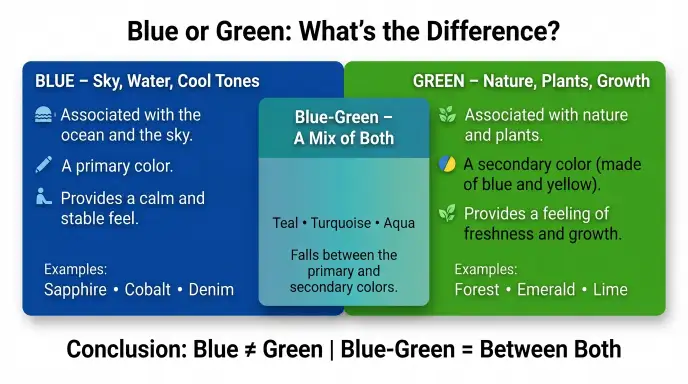
Blue and green are two different colors, but people often compare them because they can look similar in certain shades, designs, and lighting. The confusion becomes stronger with colors such as turquoise, teal, aqua, and blue green, which sit between the two on the color spectrum. The answer depends on the exact shade, lighting, surrounding colors, and personal perception.
In basic color terms, blue is a primary color in traditional color models, while green is a distinct color. However, some shades combine characteristics of both. A shade with more blue may appear cooler, while one with more green may look warmer or more natural. This guide explains their differences, how to describe mixed shades, common mistakes, and how these color terms are used in everyday English. It also explains why people may describe the same shade differently.
Quick Answer
Blue and green are different colors, but some shades can appear between them.
- Blue usually describes colors associated with the sky, ocean, and cooler tones.
- Green usually describes colors associated with grass, leaves, and nature.
- Blue green describes a color that combines characteristics of both.
For example:
The shirt is blue.
The grass is green.
The wall is blue green.
Definition and Meaning of Blue or Green
What Does Blue Mean?
Blue is a color commonly associated with the sky and water. It can range from very light shades, such as sky blue, to very dark shades, such as navy blue.
Examples include:
- Light blue
- Sky blue
- Royal blue
- Navy blue
- Powder blue
The word blue can also have meanings beyond color. In English, “feeling blue” can mean feeling sad.
Example:
She wore a bright blue dress.
What Does Green Mean?
Green is a color commonly associated with plants, grass, leaves, and nature. It ranges from pale green to deep forest green.
Examples include:
- Lime green
- Mint green
- Olive green
- Forest green
- Emerald green
Green can also have symbolic meanings. It may represent nature, growth, freshness, or environmental awareness.
Example:
The leaves are bright green.
What Does Blue Green Mean?
Blue green describes a color that contains both qualities.
The exact appearance can change depending on the balance between the two colors.
A shade with more blue may appear closer to one end of the color spectrum, while a shade with more green may appear closer to the other.
The Origin of Blue or Green
The words blue and green have different histories.
The English word blue developed from older Germanic words related to colors that were dark or blue. Over time, English speakers used the word specifically for the color we now recognize as blue.
The word green comes from an Old English word related to grow. This connection makes sense because green is strongly associated with growing plants and vegetation.
Both color words have been part of English for many centuries. Their meanings became more specific as English developed and speakers needed names for different colors.
Modern English has many terms for shades that blend the two colors. Words such as teal, turquoise, aqua, and cyan help speakers describe these shades more precisely.
British English vs American English Spelling
British and American English use the same standard spellings for both terms.
| Color | American English | British English | Meaning |
| Blue | blue | blue | A primary color |
| Green | green | green | A distinct color |
| Blue green | blue green | blue green | A mixture of blue and green |
| Teal | teal | teal | A dark blue green shade |
| Turquoise | turquoise | turquoise | A blue green shade |
The same spellings are normally used in both varieties of English.
Examples
American English:
The company chose a two-tone logo.
British English:
The company chose a two-tone logo.
The spelling stays the same.
Which Spelling Should You Use?
You do not need to choose between different spellings when writing both. Both words have the same spelling in standard American and British English.
Choose the word based on the color you want to describe.
Use “Blue” When:
- The shade clearly looks blue.
- You are describing a blue object.
- The color has stronger blue tones.
Example:
He bought a blue car.
Use “Green” When:
- The shade clearly looks green.
- You are describing plants or nature.
- The color has stronger green tones.
Example:
She painted the room green.
Use “Blue Green” When:
- The exact shade does not clearly fit one category.
- You need a more precise description.
Example:
The ocean had a beautiful color.
Common Mistakes with Blue or Green
1. Treating Them as Different Spellings
Incorrect idea: Both are two spellings for the same color.
Correct: They are separate color words.
2. Calling Every Shade the Same Color
Some shades contain enough green to make the original description less precise.
Better:
The fabric has a cool, mixed tone.
3. Calling Every Blue Green Shade Green
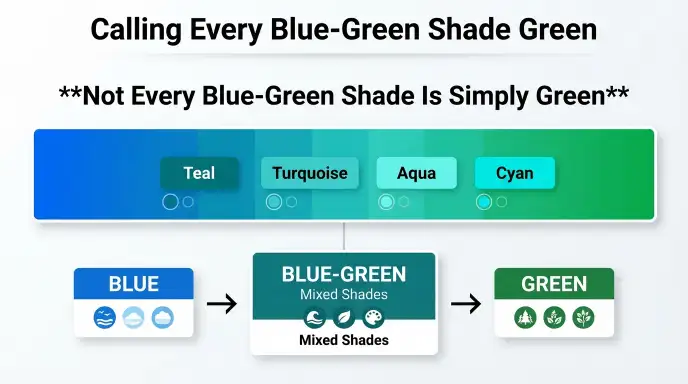
The opposite mistake can also happen.
Better:
The water is turquoise.
4. Confusing Teal with Plain Blue
Teal is a cool-toned shade with a balanced mix of two hues.
Example:
The website uses a dark teal background.
5. Assuming Everyone Sees a Shade the Same Way
People can describe borderline colors differently. Lighting, screens, surrounding colors, and individual color perception can affect how a shade appears.
Everyday Color Examples
In Emails
Color words often appear in product descriptions and instructions.
Please use the blue button to continue.
Select the green option on the form.
In News
News articles may use colors to describe clothing, objects, maps, or visual symbols.
The team wore blue uniforms during the event.
On Social Media
People often use color names when discussing fashion, photography, design, and decoration.
Should I choose the first or second version?
In Formal Writing
Technical and professional writing may use more precise color terms.
The design uses a two-tone color scheme.
In Fashion
Fashion descriptions often use specific shade names.
The jacket is available in two distinct shades.
In Interior Design
Designers may compare colors based on tone and visual effect.
Cool tones can create a calm feeling, while natural tones often add a fresh look.
Google Trends & Usage Data
Search interest can vary greatly because both terms have many meanings and uses.
People search for blue in contexts such as:
- Clothing
- Paint
- Interior design
- Sports
- Technology
- Branding
- Color matching
People search for green in contexts such as:
- Nature
- Gardening
- Fashion
- Sustainability
- Food
- Design
- Environmental topics
Searches can also focus on related shades such as teal, turquoise, and aqua.
Because search interest changes by country, season, industry, and current events, trend data should be treated as a measure of search behavior, not as proof that one color is universally preferred.
Quick Comparison Table
| Feature | Blue | Green |
| Basic meaning | A distinct color | A distinct color |
| Common associations | Sky, water, coolness | Plants, grass, nature |
| Common shades | Navy, royal, sky blue | Olive, lime, forest green |
| British spelling | Blue | Green |
| American spelling | Blue | Green |
| Mixed shade | Blue green | Blue green |
| Example | Blue shirt | Green shirt |
FAQs About Blue or Green
1. Are They the Same Color?
No. They are distinct colors, although some shades may fall between them.
2. What color is between blue and green?
Blue green shades sit between the two. Teal, turquoise, aqua, and cyan are common examples.
3. Is teal blue or green?
Teal is generally considered a blue green color. Its appearance can vary depending on the exact shade.
4. Is turquoise blue or green?
Turquoise is a blue green color, usually with a brighter and lighter appearance than many teal shades.
5. Do British and American English spell blue differently?
No. Blue has the same spelling in British and American English.
6. Do British and American English spell green differently?
No. Green is spelled the same in both varieties of English.
7. Why can blue green colors look different?
Lighting, screens, surrounding colors, color balance, and individual perception can change how a blue green shade appears.
Conclusion
Blue and green are separate color words with clear basic meanings, but some shades fall between them. Blue commonly describes cooler colors associated with the sky and water, while green is strongly connected with plants, nature, and growth. When a shade combines noticeable qualities of both colors, terms such as blue green, teal, turquoise, aqua, or cyan can provide a more precise description.
There is no British versus American spelling issue with blue or green. Both varieties of English use the same spellings. The main challenge is choosing the word that best describes the actual shade and context.
If a color clearly looks blue, call it blue. If it clearly looks green, call it green. For shades between the two, a specific color name can make your writing clearer. When appearance matters, remember that lighting, screens, and surrounding colors can affect how people perceive the same shade.
Explore More English!

Hi, I’m Olivia Bennett, an English grammar and spelling content writer. I enjoy exploring confusing words, spelling differences, and everyday language questions. My goal is to share clear, simple, and helpful explanations that make English easier to understand.






2 thoughts on “Blue or Green: Meaning, Shades, and Differences”