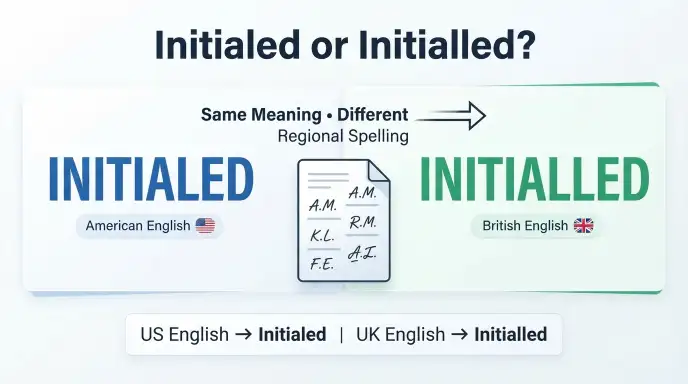
The correct spelling depends on the variety of English you use: initialed is standard in American English, while initialled is standard in British English and many other varieties. Both forms come from the verb initial, which means to mark something with your initials or to begin something.
People often search for “initialed or initialled” because both spellings appear in dictionaries, books, documents, and online writing. The difference follows a common British and American spelling pattern. American English often uses one l before -ed, while British English often doubles the final consonant in certain verbs.
This difference can be confusing when you write for an international audience. A contract, form, letter, or article may use either version depending on the regional style being followed. The meaning does not change.
In this guide, you will learn what initialed and initialled mean, where the spellings come from, which version belongs to each variety of English, and how to use them correctly in everyday and professional writing.
Initialed or Initialled: Featured Snippet & AI Overview
Initialed is the standard American English spelling, while initialled is the standard British English spelling. Both mean that someone marked or signed something with their initials. The difference is mainly a regional spelling preference, similar to other British and American forms that use one or two consonants.
Initialed or Initialled: Quick Answer
Both initialed and initialled are correct, but they belong to different varieties of English.
- Initialed = American English
- Initialled = British English
- Both mean “marked with initials” or “signed using initials.”
- The pronunciation and basic meaning are the same.
Examples
American English:
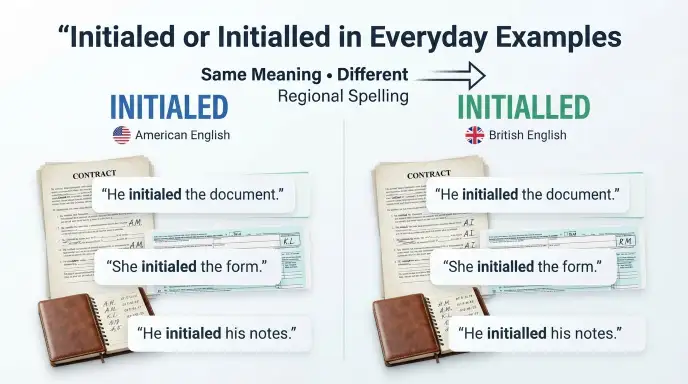
The manager initialed every page of the contract.
British English:
The manager initialled every page of the contract.
Another example:
She initialed the form before submitting it.
British English would normally write:
She initialled the form before submitting it.
The choice depends on the English variety and style guide you are following.
What Does Initialed or Initialled Mean?
The words initialed and initialled are past-tense and past-participle forms of the verb initial.
Meaning of Initial
As a verb, initial means to mark something with a person’s initials.
For example:
Please initial each page before signing the agreement.
If someone completed that action, you can say:
He initialed each page.
Or, in British English:
He initialled each page.
What Are Initials?
Initials are the first letters of a person’s name.
For example, a person named Sarah Jane Miller might use:
SJM
When someone initials a document, they usually write one or more of these letters on it.
Another Meaning of Initial
The word initial can also be an adjective or noun.
As an adjective, it means first or happening at the beginning.
The initial plan worked well.
As a noun, it can refer to the first letter of a name.
Her initial is S.
The verb form has a different use:
Please initial the bottom of the page.
The Origin of Initialed or Initialled
The word initial comes from the Latin word initialis, which means “relating to a beginning.” It entered English through French and developed into the modern word used for beginnings and first letters.
English later developed the verb initial, meaning to mark something with initials.
The difference between initialed and initialled developed from regional spelling conventions rather than from a difference in meaning.
Why Does British English Use Two Ls?
British English often doubles a final consonant before certain endings when the final syllable is stressed or according to established spelling patterns.
This can produce forms such as:
- travelled
- cancelled
- labelled
- modelled
- initialled
American English often keeps one consonant in comparable forms:
- traveled
- canceled
- labeled
- modeled
- initialed
The pattern is not identical for every English verb, so writers should check the accepted spelling for a specific word.
The Important Point
Initialed and initialled are not different words. They are regional spelling variants of the same verb form.
British English vs American English
The main difference is regional spelling.
| British English | American English | Example |
| initialled | initialed | She initialled/initialed the contract. |
| labelled | labeled | The box was labelled/labeled correctly. |
| modelled | modeled | The system was modelled/modeled carefully. |
| travelled | traveled | They travelled/traveled abroad. |
| cancelled | canceled | The event was cancelled/canceled. |
British English
British English normally uses:
initialled
Example:
The solicitor initialled every page.
American English
American English normally uses:
initialed
Example:
The attorney initialed every page.
Canadian and Australian English
Canadian English can show both British and American spelling influences, so the preferred form may depend on the publication or organization.
Australian English generally follows British-style spelling conventions and commonly uses initialled.
For professional work, always follow the style guide required by your employer, publisher, school, or organization.
Which Version Should You Use?
Choosing between initialed and initialled is simple once you know your audience.
United States
Use:
initialed
Example:
The client initialed the agreement.
United Kingdom
Use:
initialled
Example:
The client initialled the agreement.
Canada
Check the style guide used by your organization or publication. Both British and American spelling influences appear in Canadian English.
Australia
Use:
initialled
This follows the spelling pattern commonly used in Australian English.
International Writing
If your audience is international, choose one spelling system and use it consistently.
Do not switch between initialed and initialled within the same document unless you are discussing the regional difference itself.
Academic Writing
Follow your institution’s preferred English variety.
For a US institution, initialed will usually fit.
For a UK institution, initialled will usually fit.
Business Writing
Business documents should follow the organization’s established style.
Contracts, forms, reports, and official documents should use consistent spelling throughout.
Common Mistakes with Initialed or Initialled
1. Mixing Both Spellings
❌ The client initialed the first page and initialled the second.
✅ The client initialed both pages.
Or:
✅ The client initialled both pages.
Choose one regional form and stay consistent.
2. Using “Initialled” in American English Without a Reason
In standard American English, initialed is the usual form.
The employee initialed the document.
3. Using “Initialed” in British English
In standard British spelling, initialled is normally preferred.
The employee initialled the document.
4. Confusing the Verb With the Noun
The noun is:
Her initials are J.R.
The verb is:
She initialled the document.
The two forms have related meanings but serve different grammatical roles.
5. Forgetting the Meaning
Initial as a verb means to mark something with initials.
It does not simply mean “to begin.”
For example:
Please initial the form.
This means to add your initials, not to begin the form.
Memory Tip
Think:
US → initialed
UK → initialled
The British version follows the familiar doubled-l pattern found in words such as labelled and travelled.
Initialed or Initialled in Everyday Examples
Emails
Please initial each page and return the completed document.
In a follow-up email, you might write:
I have initialed all the required pages.
A British writer may use:
I have initialled all the required pages.
Business Writing
The client initialed the revised terms.
British English:
The client initialled the revised terms.
News Headlines
New Agreement Initialed by Both Parties
A British publication may write:
New Agreement Initialled by Both Parties
The spelling depends on the publication’s house style.
Blogs
Before sending the form, make sure you have initialed every page.
A British blog would normally use initialled.
Social Media
I finally initialed all the paperwork!
For a British audience:
I finally initialled all the paperwork!
Academic Writing
Each participant initialed the consent form.
The regional spelling should match the institution’s preferred style.
Daily Conversation
Did you initial the last page?
The verb can appear naturally in everyday speech, especially when discussing paperwork.
Initialed or Initialled: Google Trends & Modern Usage
People search for “initialed or initialled” because both forms appear in real English writing. Searchers may encounter one version in American content and another in British or Australian content.
The difference is mainly regional rather than semantic.
Why Do People Search This Phrase?
Common reasons include:
- Checking a spelling before submitting a document
- Writing contracts or forms
- Editing academic work
- Comparing British and American English
- Editing international content
- Understanding differences in dictionaries
Modern Usage
Both forms remain in use.
American publications generally use initialed, while British publications generally use initialled. Other English-speaking regions may follow one convention or use an organization-specific style guide.
Exact search-volume numbers can change over time and by country. Without a specific Google Trends date range and location, it would be misleading to give a fixed popularity figure.
The key usage pattern is clear: initialed is associated with American English, while initialled is associated with British English and related spelling conventions.
Quick Comparison Table
| Version | Meaning | Correct? | Region | Example |
| initialed | Marked with initials | ✅ Yes | American English | She initialed the form. |
| initialled | Marked with initials | ✅ Yes | British English | She initialled the form. |
| initial | Mark with initials | ✅ Yes | All major varieties | Please initial here. |
| initials | First letters of a name | ✅ Yes | All major varieties | His initials are J.W. |
| initialed in UK style | Same meaning | ⚠️ Usually avoided | British English | Use initialled instead. |
| initialled in US style | Same meaning | ⚠️ Usually avoided | American English | Use initialed instead. |
Key Takeaways
- Initialed is the standard American English spelling.
- Initialled is the standard British English spelling.
- Both forms have the same meaning.
- Both come from the verb initial.
- The difference comes from regional spelling conventions.
- Australian English generally follows the doubled-l pattern.
- Canadian usage can vary by style and context.
- Use one spelling consistently within a document.
- Initial means to mark something with your initials.
- Initial can also mean “first” when used as an adjective.
FAQs About Initialed or Initialled
1. Is it initialed or initialled?
Both spellings are correct. Initialed is the standard American English form, while initialled is the standard British English form. They have the same meaning and pronunciation. The choice depends on the English variety you are using and the style guide that applies to your writing.
2. Is initialled British or American?
Initialled is the British English spelling. It is also commonly used in other varieties influenced by British English, including Australian English. American English normally uses initialed with one l before the -ed ending.
3. Is initialed correct in American English?
Yes. Initialed is the standard American English spelling. For example, you can write, “The customer initialed each page.” American English commonly uses one l in this type of past-tense form.
4. What does initialled mean?
Initialled means marked or signed with someone’s initials. For example, “She initialled every page of the contract” means she wrote her initials on every page. The American English equivalent is initialed.
5. Why does British English have two Ls?
British spelling often doubles the final consonant in certain words before endings such as -ed. This creates forms such as labelled, travelled, and initialled. American English often uses one l in comparable forms, producing labeled, traveled, and initialed.
6. Can I use initialed in the UK?
Readers in the UK will understand initialed, but initialled is the usual British spelling. If you are writing for a British publisher, school, company, or official organization, it is better to follow its preferred style.
7. What is the past tense of initial?
The past tense is initialed in American English and initialled in British English. Both forms are grammatically correct. The difference is spelling, not tense or meaning.
8. Is initial a verb or adjective?
Initial can be both. As a verb, it means to mark something with your initials. As an adjective, it means first or occurring at the beginning. For example, “Please initial the form” uses it as a verb, while “the initial stage” uses it as an adjective.
9. How do you remember initialed vs initialled?
Use a simple regional rule: US = initialed, UK = initialled. The British form follows the doubled-l pattern found in words such as travelled and labelled, while American English usually keeps one l.
10. Should I use initialed or initialled in formal writing?
Use the form that matches your audience and style guide. Choose initialed for American English and initialled for British English. The most important rule is consistency. Do not switch between the two forms in the same document without a clear reason.
Conclusion
Initialed and initialled are both correct spellings, but they belong to different regional forms of English. American English normally uses initialed, while British English normally uses initialled. Both forms mean that someone marked a document or another item with their initials.
The difference comes from spelling conventions, not from a difference in meaning or pronunciation. Australian English generally follows the British pattern, while Canadian usage can vary depending on the style being followed. For academic, business, and professional writing, always check the preferred style of your audience or organization.
The easiest way to remember the difference is US = initialed and UK = initialled. Once you know your target audience, choosing the correct form becomes simple.
If you are editing a document for an international audience, consistency matters more than choosing one form over the other. Pick the spelling that matches your chosen English variety and use it throughout.
Learn More Spelling!

Hi, I’m Olivia Bennett, an English grammar and spelling content writer. I enjoy exploring confusing words, spelling differences, and everyday language questions. My goal is to share clear, simple, and helpful explanations that make English easier to understand.





2 thoughts on “Initialed or Initialled: Definition and Examples ”