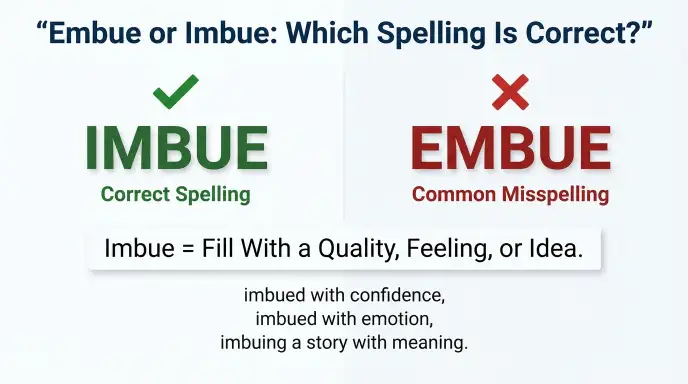
Imbue is the correct standard spelling; embue is a common misspelling. The word imbue means to fill someone or something with a quality, feeling, or idea. People often search for “embue or imbue” because the pronunciation can make the first vowel sound unclear. This confusion is easy to understand because English has many words that begin with similar sounds but use different spellings.
The correct form is imbue, and it works as a verb. You can use it when describing something that gives a person, object, idea, or work a strong quality or feeling. For example, “The story is imbued with hope” means that the story contains or expresses a strong sense of hope.
Whether you are writing an email, essay, article, or formal document, imbue is the spelling you should use. This guide explains its meaning, origin, pronunciation, common mistakes, regional usage, and everyday examples so you can use the word with confidence.
Embue or Imbue : Quick Answer
Imbue is the correct spelling. Embue is not the standard English spelling.
The verb imbue means to fill or inspire something with a particular quality, feeling, or idea.
Examples:
- The teacher imbued the students with confidence.
- The painting is imbued with emotion.
- Her speech was imbued with optimism.
The main forms are:
| Form | Correct? | Example |
| imbue | ✅ Yes | The story can imbue readers with hope. |
| imbued | ✅ Yes | The poem is imbued with emotion. |
| imbuing | ✅ Yes | The artist is imbuing the work with meaning. |
| embue | ❌ No | Common misspelling |
| embued | ❌ No | Common misspelling |
Definition and Meaning of Embue or Imbue
Imbue is a verb that means to fill something or someone with a particular quality, feeling, idea, or influence.
In simple English, imbue means to fill with a quality or feeling.
Common Meaning
The word often describes an effect that becomes part of something.
For example:
The music was imbued with sadness.
This means the music strongly expressed or contained a feeling of sadness.
Another example is:
The coach imbued the team with confidence.
Here, the coach gave the team a strong sense of confidence.
Common Contexts
You may see imbue in:
- Literature
- Academic writing
- News articles
- Essays
- Reviews
- Formal speeches
- Creative writing
The word often appears with with:
imbue + something/someone + with + quality
Examples:
- imbue a story with meaning
- imbue a speech with emotion
- imbue students with confidence
- imbue a painting with warmth
Imbue vs. Inspire
These words can be close in meaning, but they are not always interchangeable.
Inspire often means to encourage a feeling, action, or idea.
Imbue focuses more on filling something or someone with a particular quality.
For example:
- The speech inspired hope.
- The speech was imbued with hope.
Both sentences express a similar idea, but the structure is different.
The Origin of Embue or Imbue
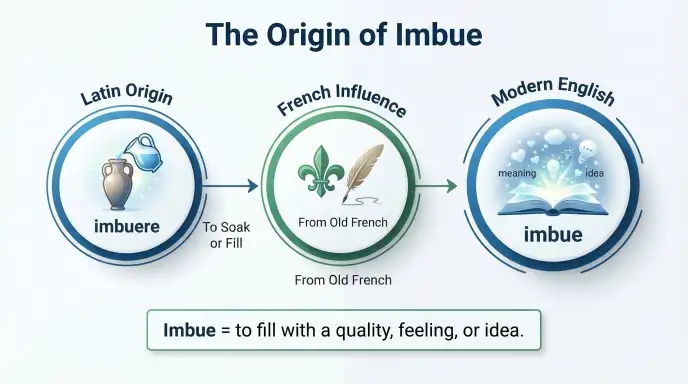
The correct word imbue has a long history in English.
It comes from the Latin verb imbuere, meaning “to moisten,” “soak,” or “stain.” Over time, the meaning developed from physically soaking something to filling a person or thing with an idea, quality, or feeling.
English adopted imbue from French and Latin influences.
The spelling embue likely appears because speakers may expect an e sound or spelling at the beginning. However, standard English uses im , not em , in this word.
The related form imbued follows the same spelling:
- imbue
- imbued
- imbuing
So, if you remember the base form imbue, the other forms become easier to spell correctly.
British English vs American English Spelling
There is no major British American spelling difference for this word.
Both British English and American English use:
imbue
The incorrect form embue is not a standard regional alternative.
| Variety | Correct Spelling | Example |
| American English | imbue | The novel is imbued with mystery. |
| British English | imbue | The novel is imbued with mystery. |
| Canadian English | imbue | The speech was imbued with emotion. |
| Australian English | imbue | The film is imbued with humor. |
| International English | imbue | The work is imbued with meaning. |
Verb Forms
| Form | Spelling | Example |
| Base | imbue | Writers imbue stories with meaning. |
| Past | imbued | The story was imbued with hope. |
| Present participle | imbuing | The writer is imbuing the story with emotion. |
The spelling stays consistent across major varieties of English.
Which Spelling Should You Use?
Use imbue in all standard English writing.
You do not need to change the spelling for an American, British, or international audience.
For American English
Use:
The author imbued the novel with humor.
For British English
Use:
The author imbued the novel with humor.
The spelling remains the same.
For Students
If you are writing an essay, remember:
Imbue = correct
Embue = incorrect
For Professional Writing
Use imbue in reports, articles, emails, reviews, and formal documents when the meaning fits.
If you want a simpler word, you can often use fill, give, inspire, or infuse, depending on the sentence.
Common Mistakes with Embue or Imbue
1. Writing “Embue” Instead of “Imbue”
❌ The author embued the story with emotion.
✅ The author imbued the story with emotion.
The first version uses the common misspelling.
2. Using “Imbue” Without Understanding the Meaning
Imbue usually describes giving or filling something with a quality.
For example:
✅ The experience imbued her with confidence.
This means the experience gave her confidence.
3. Confusing “Imbue” and “Infuse”
These words can have similar meanings.
- The writer imbued the article with humor.
- The writer infused the article with humor.
Both can work in some contexts, but imbue often focuses on giving something a quality or character.
4. Misspelling “Imbuing”
❌ embuing
❌ imbueing
✅ imbuing
The correct form removes the final e before adding ing.
5. Misspelling “Imbued”
❌ embued
❌ imbueed
✅ imbued
Embue or Imbue in Everyday Examples
The correct form appears in many types of writing.
In Emails
The new project has imbued the team with fresh energy.
This works in a professional email when discussing motivation or attitude.
In News Writing
The campaign was imbued with a strong sense of optimism.
The word can describe the tone or character of an event.
In Social Media
This song is imbued with nostalgia.
This is a natural way to describe the strong feeling created by a song.
In Academic Writing
The novel is imbued with social and political themes.
The word works well when analyzing literature or ideas.
In Creative Writing
The quiet village was imbued with a sense of mystery.
This creates a more formal and descriptive tone.
In Reviews
The film is imbued with warmth and humor.
Reviewers often use the word to describe the overall character of a creative work.
Embue or Imbue : Google Trends & Usage Data
Search interest for “embue or imbue” usually comes from people checking the correct spelling of the word. The confusion is mainly spelling based rather than a difference in meaning.
Search behavior can vary by country, language background, and writing context. Students, writers, editors, and English learners may search for the two forms when they are unsure about the first letters.
The standard form remains imbue across major English varieties.
Searches may also include related forms such as:
- imbued
- imbuing
- imbue meaning
- imbue definition
- imbue synonym
- imbued with meaning
Search data can show how often people look for these terms, but it does not change the standard spelling rule. When writing in English, imbue remains the correct form.
Quick Comparison Table
| Feature | Imbue | Embue |
| Standard English | ✅ Yes | ❌ No |
| Verb | Yes | No |
| Meaning | Fill with a quality or feeling | — |
| Past form | Imbued | Embued ❌ |
| ing form | Imbuing | Embuing ❌ |
| British English | Correct | Incorrect |
| American English | Correct | Incorrect |
| Formal writing | Recommended | Avoid |
FAQs About Embue or Imbue
1. Is “imbue” or “embue” correct?
Imbue is correct. Embue is a common misspelling and is not the standard form.
2. What does “imbue” mean?
Imbue means to fill someone or something with a quality, feeling, idea, or influence.
3. Is “imbued” the correct past tense?
Yes. Imbued is the correct past tense and past participle of imbue.
4. Is “imbuing” spelled correctly?
Yes. Imbuing is the correct ing form. The final e in imbue is dropped before adding ing.
5. Is “imbue” used in British English?
Yes. British English uses imbue, just like American English.
6. Can I use “embue” in formal writing?
No. Use imbue in formal, academic, professional, and standard English writing.
7. What is an example of “imbue”?
A simple example is: “The teacher imbued the students with confidence.”
Conclusion
Imbue is the correct spelling, while embue is a common spelling mistake. The verb means to fill a person, object, story, or idea with a particular quality, feeling, or influence. You may see it in phrases such as imbue someone with confidence, imbue a story with meaning, or imbued with emotion.
The spelling does not change between British and American English, so you can safely use imbue for both audiences. Remember its main forms: imbue, imbued, and imbuing. Avoid forms such as embue, embued, and embuing.
If you are unsure which version to use in an essay, article, email, or professional document, choose imbue. It is the standard English form and clearly communicates the intended meaning.
Learn More Spelling!

Hi, I’m Olivia Bennett, an English grammar and spelling content writer. I enjoy exploring confusing words, spelling differences, and everyday language questions. My goal is to share clear, simple, and helpful explanations that make English easier to understand.






1 thought on “Embue or Imbue: Meaning, Spelling, and Usage”