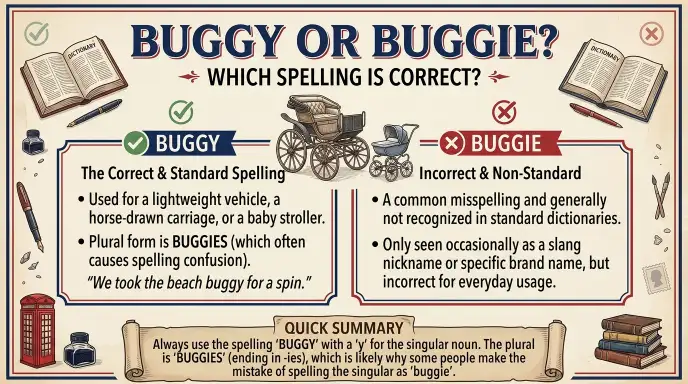
If you are unsure if to write buggy or buggie, the correct spelling in standard English is buggy. The word buggy can refer to a small vehicle, a baby carriage in British English, or something that has bugs or problems, especially in computing. Buggie is not the standard spelling for these common meanings.
This confusion often happens because both words sound the same when spoken. People may also add -ie because many English words use that ending for informal or diminutive forms. However, when you are writing about a vehicle, baby carriage, or faulty software, buggy is the spelling you should normally use.
In this guide, you will learn the definition of buggy, if buggie is a correct word, where the spelling comes from, how the word is used in American and British English, and which form is best for formal writing.
Buggy or Buggie: Quick Answer
Buggy is the standard spelling in English. Buggie is generally not the standard spelling when you mean a small vehicle, baby carriage, or something containing bugs or errors.
Examples:
- We rented a buggy to travel around the resort.
- She pushed the baby in a buggy.
- The new software is still buggy.
If you are choosing between buggy or buggie, use buggy in standard English writing.
Is “Buggie” Correct?
Usually, no. Buggie is not the standard spelling of the common English word buggy.
The spelling buggy appears in major English dictionaries and has several established meanings. Cambridge Dictionary, for example, lists buggy as a noun for a small car, a baby chair, and an older type of horse-drawn carriage. It also lists buggy as an adjective for software that contains mistakes or does not work correctly.
What Does “Buggy” Mean?
Buggy is a word with several meanings. Its exact meaning depends on the context.
Buggy as a Vehicle
A buggy can mean a small vehicle, often one without a roof. The word is commonly used for golf buggies, dune buggies, beach buggies, and similar vehicles.
Example:
We used a golf buggy to get around the course.
A dune buggy is a small vehicle designed for driving on sand, usually with large wheels and an open design.
Buggy as a Baby Carriage
In British English, buggy can mean a small folding chair on wheels used for carrying a baby or young child. In American English, stroller is more common for this meaning.
Example:
She put the baby in the buggy before going for a walk.
American English may use stroller instead:
She put the baby in the stroller.
Buggy in Computing
In technology, buggy means that software contains errors or does not work correctly.
Example:
The website is still buggy after the latest update.
Here, buggy comes from bug, meaning a mistake or problem in a computer program. Cambridge Dictionary defines a computer bug as a mistake or problem in a computer program and uses buggy for software that contains such problems.
Buggy Meaning “Full of Bugs”
Buggy can also describe a place that has many annoying insects.
Example:
It was too buggy to sit outside.
In this use, buggy means full of bugs or insects.
What Does “Buggie” Mean?
Buggie is not the standard spelling used for the common meanings of buggy.
If you are writing about a small vehicle, a baby carriage, or software with errors, buggy is the safer and standard choice.
For example:
- Correct: The software is buggy.
- Incorrect in standard usage: The software is buggie.
- Correct: We rented a buggy.
- Incorrect in standard usage: We rented a buggie.
The spelling can look natural because English has many words ending in -ie, but spelling patterns do not always determine the correct form of an established word.
The Definition of Buggy
A simple definition of buggy is:
Buggy is a noun for a small vehicle or baby carriage, or an adjective describing something that contains bugs, errors, or problems.
The meaning changes with the context.
| Meaning | Part of Speech | Example |
| Small vehicle | Noun | We drove a buggy. |
| Baby carriage | Noun | The baby is in the buggy. |
| Software with errors | Adjective | The app is buggy. |
| Full of insects | Adjective | The area is very buggy. |
This makes buggy a useful word with several meanings rather than a simple spelling variant of another word.
The Origin of “Buggy”
The word buggy has a long history in English and has been used for different kinds of vehicles over time.
One older meaning refers to a light carriage pulled by a horse. This use appears in the traditional expression horse and buggy. Modern English later developed other uses for the word, including small motor vehicles and baby carriages. Cambridge Dictionary still records the horse-drawn carriage meaning alongside its modern vehicle and baby-carriage meanings.
The adjective buggy developed another meaning from bug, referring to insects. From this sense, buggy can describe a place that has many bugs.
In modern technology, buggy has become especially common because software can contain bugs, or programming errors. As a result, phrases such as buggy software, buggy code, and buggy app are now common in everyday technical writing.
The important point is that these meanings all use the established spelling buggy, not buggie.
Buggy vs. Buggie: The Main Difference
The easiest way to remember the difference is simple:
Buggy = standard spelling
Buggie = generally not the standard spelling for these meanings
If you are writing an article, email, school assignment, product description, or business document, choose buggy when that is the word you mean.
Quick Examples
Correct:
- The golf buggy is waiting outside.
- This app is very buggy.
- She bought a new baby buggy.
- They drove a dune buggy across the sand.
Avoid:
- The golf buggie is waiting outside.
- This app is very buggie.
- She bought a baby buggie.
The pronunciation may make the two spellings seem interchangeable, but standard written English favors buggy.
British English vs American English
The spelling buggy is standard in both British and American English. The main difference is often the meaning and preferred word, especially when talking about a baby carriage.
| British English | American English | Example |
| buggy | stroller | She put the baby in the buggy/stroller. |
| buggy | buggy | We rented a golf buggy/golf buggy. |
| buggy | buggy | The software is buggy. |
| dune buggy | dune buggy | They drove a dune buggy on the sand. |
In British English, buggy is a common term for a baby carriage. In American English, stroller is usually preferred for the same item.
However, when buggy means software with errors or a small vehicle, the word is widely understood in both varieties of English.
The spelling buggie does not become the standard spelling in either British or American English simply because pronunciation can sound similar.
Regional Differences
English speakers may choose different words depending on where they live.
For example:
- UK: baby buggy
- US: baby stroller
- UK and US: golf buggy
- UK and US: dune buggy
- UK and US: buggy software
So, the difference is more about vocabulary and context than spelling.
Which Version Should You Use?
If you are deciding between buggy or buggie, use buggy in standard English writing.
United States
Use buggy when referring to a small vehicle or software with errors. For a baby carriage, stroller is usually more natural.
Example:
The app is still buggy.
United Kingdom
Use buggy for a small vehicle, baby carriage, or software that contains problems.
Example:
The baby is sleeping in the buggy.
Canada
Canadian English commonly follows both British and American vocabulary patterns. Buggy is the correct spelling, while stroller is commonly used for a baby carriage.
Australia
Australian English also uses buggy in several contexts. Depending on the context, Australians may use pram or stroller for a baby carriage.
International Writing
For international readers, buggy is the safest spelling when you mean the standard English word.
If the word refers to a baby carriage, adding context can make your meaning clearer.
Example:
The baby was placed in a folding buggy.
Academic Writing
Use buggy when it is the correct term for your subject. Avoid buggie unless you are reproducing a specific name, title, or quotation where that spelling is intentionally used.
Business Writing
Use buggy in professional documents, reports, product descriptions, and technical writing.
Example:
Users reported that the latest version of the application was buggy.
Common Mistakes
Mistake 1: Writing “Buggie” Instead of “Buggy”
Incorrect:
The software is buggie.
Correct:
The software is buggy.
Why:
Buggy is the standard adjective for software that contains bugs or errors.
Memory tip:
Think bug + y = buggy.
Mistake 2: Using “Buggie” for a Small Vehicle
Incorrect:
We rented a buggie for the trip.
Correct:
We rented a buggy for the trip.
Why:
The established spelling for this type of vehicle is buggy.
Mistake 3: Confusing “Buggy” With “Stroller”
Example:
She bought a buggy for her baby.
This is understandable and standard, especially in British English. In American English, stroller is usually the more natural term.
The issue here is not that buggy is misspelled. It is a regional vocabulary difference.
Mistake 4: Assuming Similar Sounds Mean Similar Spellings
English has many words that sound alike or almost alike but have different spellings.
Buggy and buggie may look like possible alternatives, but pronunciation alone does not determine standard spelling.
Everyday Examples
Emails
The new software is still buggy, so we recommend waiting for the next update.
This is a natural use of buggy in a professional email.
Business Writing
Customers reported several buggy features after the latest release.
Here, buggy means the features do not work correctly.
News Headlines
New App Update Remains Buggy for Some Users
The word is short, clear, and common in technology-related writing.
Blogs
If your website feels buggy after an update, check your plugins and browser settings.
This use is common in technology and troubleshooting content.
Social Media
The new update is so buggy today!
This is an informal but natural use of buggy.
Academic Writing
The researchers removed the buggy version of the software before testing the final model.
Here, buggy clearly means that the software contained errors.
Daily Conversation
The game is a little buggy after the update.
Or:
We took a buggy around the resort.
The meaning is clear from the context.
Baby-Related Conversation
British English:
I left the baby buggy near the door.
American English:
I left the baby stroller near the door.
Both sentences communicate the same basic idea, but stroller is more common in American English.
When “Buggy” Is an Adjective
One useful way to understand buggy is to look at how it works as an adjective.
When something is buggy, it has bugs, problems, or errors.
For example:
- buggy software
- buggy website
- buggy app
- buggy game
- buggy code
- buggy system
These phrases are especially common in technology.
Example
The website looks good, but some features are still buggy.
Here, buggy does not mean that insects are present. It means the website has technical problems.
When “Buggy” Is a Noun
Buggy can also be a noun.
A noun names a person, place, thing, or idea. When buggy is used as a noun, it can refer to certain types of vehicles or a baby carriage, depending on regional usage.
Examples:
The golf buggy is parked outside.
We rented a dune buggy.
She folded the baby buggy and put it in the car.
The exact meaning comes from the surrounding words.
Buggy or Buggie for a Baby Carriage?
If you are writing about a baby carriage, buggy is the correct standard spelling.
In British English:
She pushed the baby in the buggy.
In American English, the more common term is:
She pushed the baby in the stroller.
So, if your question is “buggy or buggie for a baby?”, choose buggy when using that word.
Buggie is not the normal standard spelling.
Buggy or Buggie in Technology?
For technology, the answer is even clearer.
Use buggy.
Examples:
The app is buggy.
The game has become buggy after the update.
Developers are fixing the buggy code.
This version of the software is still buggy.
In technical English, buggy is directly related to the noun bug, which means a fault or error in computer software.
Therefore, buggy is the natural spelling.
Buggie should not normally be used in its place.
Google Trends & Modern Usage
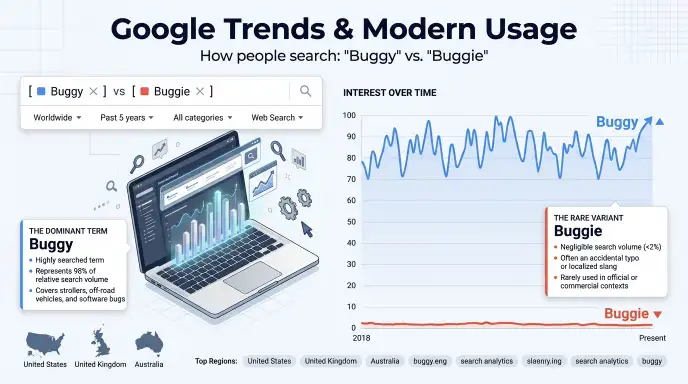
People often search “buggy or buggie” because the two spellings can sound similar when spoken.
In standard English, buggy is the established spelling. Buggie is generally not used as the standard spelling for a small vehicle, baby carriage, or software with errors.
Exact Google Trends numbers can change by country and over time, so no specific statistics are given here. The general usage pattern shows that buggy is the standard form in modern English.
Quick Comparison Table
| Version | Meaning | Correct? | Region | Example |
| Buggy | Small vehicle | Yes | UK, US, International | We rented a buggy. |
| Buggy | Baby carriage | Yes | Especially UK | The baby is in the buggy. |
| Buggy | Software with errors | Yes | UK, US, International | The app is buggy. |
| Buggy | Full of insects | Yes | UK, US, International | The garden is buggy. |
| Buggie | Alternative spelling | Generally no | Not standard | Avoid in standard writing. |
Buggy or Buggie: Which One Is Correct?
Buggy is the correct standard spelling.
Use buggy when talking about:
- A small vehicle
- A golf buggy
- A dune buggy
- A baby carriage
- Software with errors
- Something full of insects
Buggie should generally be avoided in standard English writing.
Key Takeaways
- Buggy is the standard spelling.
- Buggie is generally not the standard form.
- Buggy can be a noun or an adjective.
- A buggy can mean a small vehicle.
- British English uses buggy for a baby carriage.
- American English commonly uses stroller.
- Buggy can describe software with errors.
- Use buggy in formal and professional writing.
FAQs
1. Is “buggy” or “buggie” correct?
Buggy is the standard English spelling.
Buggie is generally not the standard spelling.
2. Is “buggie” a real word?
Buggie can appear in names or informal contexts.
It is not the standard spelling of buggy.
3. What does “buggy” mean?
Buggy can mean a small vehicle or baby carriage.
It can also describe software that has errors.
4. Is “buggy” British or American English?
Buggy is used in both British and American English.
For baby carriages, Americans commonly use stroller.
5. Is “buggy” correct for software?
Yes, buggy is commonly used for software with errors.
For example: “The new app is still buggy.”
6. What is a buggy vehicle?
A buggy is a small vehicle used for different purposes.
Examples include golf buggies and dune buggies.
7. Should I use “buggy” or “buggie” in formal writing?
Use buggy in formal, academic, and professional writing.
It is the standard spelling for the common word.
8. Is a baby stroller called a buggy?
Yes, buggy can mean a baby stroller, especially in British English.
American English usually prefers the word stroller.
9. Why do people spell buggy as buggie?
The spelling buggie may seem natural because of words ending in -ie.
However, the standard spelling of this word is buggy.
10. How can I remember the spelling of buggy?
Think of bug + gy = buggy.
Remember that the standard ending is -gy, not -gie.
Conclusion
When choosing between buggy or buggie, use buggy as the standard English spelling. It can refer to a small vehicle, a baby carriage in British English, or something that contains bugs or technical problems.
The word is also very common in technology. A website, app, game, or software program can be described as buggy when it has errors or does not work correctly.
The confusion mainly comes from pronunciation and the familiar -ie spelling pattern. However, buggie is generally not the standard spelling for these meanings.
For US, UK, Canadian, Australian, and international writing, buggy is the safest standard form. If you mean a baby carriage for an American audience, stroller may be more natural.
Discover More About Word Usage!

Hi, I’m Olivia Bennett, an English grammar and spelling content writer. I enjoy exploring confusing words, spelling differences, and everyday language questions. My goal is to share clear, simple, and helpful explanations that make English easier to understand.







3 thoughts on “Buggy vs Buggie: Correct Spelling and Meaning Explained”