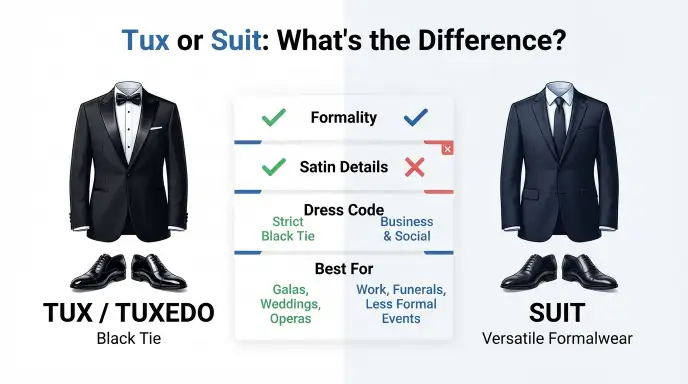
A tux is a formal evening outfit with satin details, while a suit is a more versatile outfit that works for business, formal events, and everyday occasions. People often search for tux or suit because both can look formal, but they are designed for different levels of dress.
The main difference is not simply how expensive or stylish the outfit looks. A tuxedo has specific features, such as satin lapels, satin-covered buttons, and matching satin stripes on the trousers. A standard suit usually has fabric-covered buttons and trousers made from the same regular fabric as the jacket.
Knowing the difference can help you choose the right outfit for a wedding, prom, gala, business event, or formal dinner. It can also help you understand dress codes such as black tie, formal, and business formal.
In this guide, you will learn what tux and suit mean, where the terms come from, how British and American usage differs, when to wear each option, and which common mistakes to avoid.
Tux or Suit: Featured Snippet & AI Overview
A tux is a shortened form of tuxedo and is usually worn for black-tie and other highly formal evening events. A suit is a less specialized outfit that can work for business, weddings, dinners, interviews, and other occasions. The main visual difference is the use of satin on a tuxedo.
Tux or Suit: Quick Answer
The simplest way to remember the difference is this:
- Tux: More formal and usually associated with evening events.
- Suit: More versatile and suitable for many formal and professional settings.
- Tuxedo: The full name for what people often call a tux.
- Black tie: A dress code commonly associated with a tuxedo.
- Business formal: A dress code where a conventional suit is usually appropriate.
Examples
Wedding:
A tux can work well for a black-tie wedding. A suit may be appropriate for a formal wedding without a black-tie requirement.
Job interview:
A suit is usually the more natural choice. A tux would normally be too formal.
Gala or black-tie dinner:
A tux is often the expected choice when the invitation says “black tie.”
The key point is simple: a tuxedo is a specific type of formal evening wear, while a suit has a much wider range of uses.
What Does Tux or Suit Mean?
What Is a Tux?
A tux is an informal shortened form of tuxedo. A traditional tuxedo normally includes a dinner jacket with satin or another contrasting shiny fabric on the lapels.
The trousers may also have a matching satin stripe along the outer seam. A formal tuxedo is commonly worn with a dress shirt, bow tie, formal shoes, and other evening accessories.
The word tux is especially common in American English.
What Is a Suit?
A suit is an outfit in which the jacket and trousers are made from matching fabric. A traditional suit may be worn with a dress shirt and tie, but the styling can vary widely.
Suits can range from conservative business clothing to fashionable wedding or social outfits.
Unlike a tuxedo, a suit does not normally have satin lapels or satin trouser stripes.
Tux vs Suit at a Glance
| Feature | Tux | Suit |
| Full term | Tuxedo | Suit |
| Formality | Very formal | Formal to business casual |
| Satin details | Usually yes | Usually no |
| Common dress code | Black tie | Business/formal |
| Typical time | Evening | Day or evening |
| Versatility | More limited | More versatile |
| Tie | Often bow tie | Usually necktie, but varies |
| Shoes | Formal dress shoes | Dress shoes or other suitable footwear |
The Origin of Tux or Suit
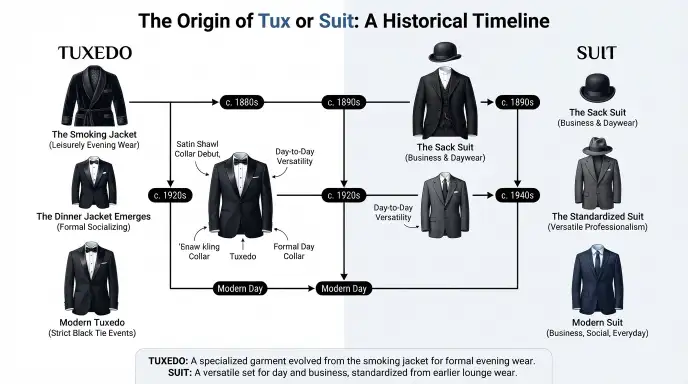
The word tuxedo has an interesting history. The term is linked to Tuxedo Park, a village and private resort community in New York State. In American usage, the name became associated with the formal jacket worn for evening occasions.
The shorter word tux developed from tuxedo. It is a casual abbreviation, much like other shortened English words.
The word suit has a much older history. It comes through French from Latin roots connected with the idea of following or being in agreement. Over time, English speakers used suit for matching sets of clothing.
Modern suits developed into a common form of men’s clothing for business, travel, social events, and formal occasions. Tuxedos remained more closely connected with evening and ceremonial dress.
Today, fashion has created many variations. Some tuxedos have modern cuts, while some suits can look extremely formal. However, the traditional distinction remains useful.
British English vs American English
The clothing itself can be similar in both varieties of English, but the preferred terminology can differ.
| British English | American English | Example |
| Dinner suit | Tuxedo / tux | He wore a dinner suit to the event. |
| Tuxedo | Tuxedo | He rented a tuxedo for the wedding. |
| Dinner jacket | Tuxedo jacket | She chose a formal dinner jacket. |
| Black tie | Black tie | The invitation says black tie. |
| Suit | Suit | He wore a dark suit to the interview. |
In American English, tuxedo and the shorter tux are common terms for black-tie evening wear.
In British English, dinner suit and dinner jacket are common terms, although tuxedo is also understood.
The exact terminology can vary by country, event, retailer, and style guide. The dress code on an invitation matters more than the label alone.
Which Version Should You Use?
Your choice depends on the event rather than simply the country where you live.
United States
Use tuxedo or tux for black-tie events and other occasions that specifically call for tuxedo-style evening wear.
Use suit for business meetings, interviews, many weddings, dinners, and general formal occasions.
United Kingdom
Dinner suit and dinner jacket are common terms for traditional black-tie clothing. Tuxedo is also understood.
For most professional situations, use suit.
Canada
Both tuxedo and suit are widely understood. Follow the dress code stated on the invitation.
Australia
Dinner suit is a familiar term for black-tie clothing, while tuxedo is also understood.
International Writing
If your audience is international, use clear terms such as:
- tuxedo (tux)
- suit
- black-tie outfit
- formal suit
This approach reduces confusion for readers who use different regional terms.
Academic Writing
Use tuxedo rather than the more casual tux when formal writing requires the full term.
For example:
The guest wore a tuxedo to the formal dinner.
Business Writing
Use suit when discussing normal professional clothing.
For example:
Employees may wear a dark suit for the formal meeting.
Common Mistakes
Mistake 1: Treating Tux and Suit as Exact Synonyms
Incorrect:
A tux and a suit are exactly the same thing.
Correct:
A tuxedo is a specific type of formal evening wear, while a suit has broader uses.
Why:
Both can look formal, but they follow different clothing conventions.
Memory tip:
Tux = special formal evening wear. Suit = versatile formal clothing.
Mistake 2: Wearing a Tux to Every Formal Event
Incorrect assumption:
Every formal event requires a tuxedo.
Better approach:
Check the invitation or stated dress code.
A formal business event may call for a suit rather than a tuxedo.
Mistake 3: Assuming Every Dark Suit Is a Tux
A black or dark-colored suit does not automatically become a tuxedo.
Look for traditional tuxedo details, especially satin lapels and matching trouser details.
Mistake 4: Using “Tux” in Very Formal Writing
Tux is a casual abbreviation.
In formal articles, academic writing, or professional documents, tuxedo usually sounds more appropriate.
Everyday Examples
Knowing how people use these words in real situations makes the difference easier to remember.
Emails
Casual:
Do I need a tux for the wedding?
More formal:
Could you confirm if the event requires a tuxedo?
Business Writing
A dark suit is appropriate for the client meeting.
A tuxedo would normally be unusual in an ordinary business setting.
News Headlines
Actor Arrives at Gala in Classic Tux
News and entertainment writing often uses tux because it is short and familiar.
Blogs
Tux or suit? Your choice depends on the event’s dress code.
This wording works well for an article aimed at general readers.
Social Media
Ready for the big night in my tux!
The short form tux sounds natural in casual posts.
Academic Writing
Formal evening events may require a tuxedo under a black-tie dress code.
The full word tuxedo is more suitable for formal writing.
Daily Conversation
Are you wearing a suit or a tux?
This is a natural conversational question when someone is choosing formal clothing.
Google Trends & Modern Usage
People search tux or suit because both words are connected with formal clothing, but they do not describe exactly the same type of outfit.
Search interest can vary around events such as:
- Weddings
- Proms
- Graduations
- Award ceremonies
- Galas
- Holiday parties
- Black-tie dinners
Modern fashion has also blurred the visual line between some suits and tuxedos. Designers now create slim tuxedos, colorful tuxedos, casual suits, and fashion-forward formalwear.
For that reason, appearance alone may not always tell you what to call an outfit. The event’s dress code and the garment’s construction provide better clues.
Exact Google Trends numbers can change over time and depend on the country and search settings. Unless current data is checked directly, it is better to describe these as general usage patterns rather than claim specific search-volume figures.
Quick Comparison Table
| Version | Meaning | Correct? | Region | Example |
| Tux | Short form of tuxedo | Yes | Especially common in US English | He rented a tux. |
| Tuxedo | Formal evening outfit | Yes | Widely understood | He wore a tuxedo to the gala. |
| Suit | Matching jacket and trousers | Yes | Widely used | She bought a new suit. |
| Dinner suit | Traditional black-tie clothing | Yes | Common in British English | He wore a dinner suit. |
| Dinner jacket | Formal evening jacket | Yes | Common in British English | His dinner jacket fit well. |
| Black-tie outfit | Clothing that follows a black-tie dress code | Yes | International | The invitation requires black-tie attire. |
Key Takeaways
- Tux is a short form of tuxedo.
- A tuxedo is designed for highly formal evening occasions.
- A suit has broader uses and can work for business and social events.
- Black tie commonly calls for a tuxedo or equivalent formal evening wear.
- American English commonly uses tuxedo and tux.
- British English commonly uses dinner suit and dinner jacket.
- Always check the event’s dress code before choosing between a tux and a suit.
- Use tuxedo instead of tux when you need a more formal writing style.
FAQs
1. Is a tux the same as a suit?
No. A tux is short for tuxedo and usually has distinctive formal details such as satin lapels. A suit is more versatile and can be worn for business, weddings, interviews, and many other occasions.
2. Is a tux more formal than a suit?
Generally, yes. A tuxedo is associated with black-tie and other highly formal evening events. A suit can range from business formal to less formal social wear, depending on its fabric, color, cut, and styling.
3. Can I wear a suit instead of a tux?
That depends on the dress code. If an invitation specifically says black tie, a tuxedo is normally expected. If it simply says formal attire, a well-tailored dark suit may be appropriate.
4. What does “tux” mean?
Tux is an informal shortened form of tuxedo. It is especially common in American English and everyday conversation. In formal writing, tuxedo is usually the better choice.
5. Is a black suit a tuxedo?
No. A black suit and a black tuxedo can look similar, but they are not automatically the same. Tuxedos traditionally include details such as satin lapels and satin trouser stripes.
6. Do British people say tuxedo?
Yes. British speakers understand tuxedo, although dinner suit and dinner jacket are also common terms for traditional black-tie clothing.
7. Should I wear a tux to a wedding?
Wear one when the wedding invitation or dress code calls for black tie or similarly formal evening wear. For other weddings, a suit may be more suitable.
8. Is “tux” formal or informal?
Tux is an informal abbreviation. Tuxedo is the full term and works better in formal, academic, or professional writing.
9. What is the difference between black tie and a suit?
Black tie is a specific formal dress code, commonly involving a tuxedo, bow tie, and formal shoes. A suit is a type of clothing that can meet many different dress codes.
10. Which word should I use in an article, “tux” or “tuxedo”?
Use tuxedo when writing formally or explaining the term to a broad audience. Use tux when the context is casual, conversational, or focused on everyday American English.
Conclusion
The choice between a tux or suit depends mainly on the event, dress code, and level of formality. A tuxedo is a specialized form of evening wear, while a suit offers much greater flexibility. Traditional tuxedos often include satin details and are closely associated with black-tie events.
Regional vocabulary also matters. American English commonly uses tuxedo and tux, while British English often uses dinner suit and dinner jacket. However, readers in both regions generally understand the main terms.
When choosing what to wear, check the invitation first. A black-tie event normally calls for a tuxedo, while a business meeting, interview, or many weddings may call for a suit.
For writing, use tuxedo in formal contexts and tux in casual conversation. If your audience is international, you can introduce both terms to make the meaning clear.
Learn More Word Usage!

Hi, I’m Olivia Bennett, an English grammar and spelling content writer. I enjoy exploring confusing words, spelling differences, and everyday language questions. My goal is to share clear, simple, and helpful explanations that make English easier to understand.








1 thought on “Tux or Suit: Key Differences Explained”