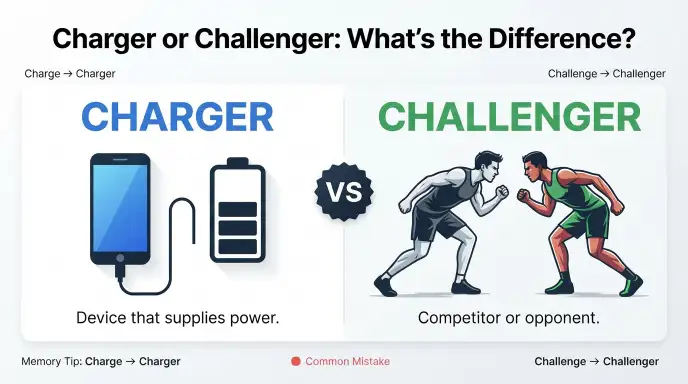
Charger and challenger are different words with different meanings, although both can describe a person, object, or vehicle depending on context. A charger can mean someone or something that charges forward, a device used to recharge a battery, or a horse used in battle. A challenger is someone or something that competes against another person or tries to defeat an existing leader.
People often search for charger or challenger because the words look similar and can appear in sports, business, technology, and automotive writing. The confusion becomes even stronger when discussing cars, especially the Dodge Charger and Dodge Challenger, two well known names in American automotive history.
The words also have different grammatical forms. Charger comes from the verb charge, while challenger comes from challenge. Knowing the base verbs makes the difference easier to remember.
This guide explains the meanings, origins, spelling, regional usage, common mistakes, everyday examples, and modern search context of charger or challenger.
Charger or Challenger – Quick Answer
Use charger when you mean something or someone that charges.
Use challenger when you mean someone or something that challenges another person, team, or leader.
Examples
- I forgot my phone charger.
- The charger moved quickly toward the enemy.
- She is the main challenger for the title.
- The challenger wants to beat the current champion.
Easy memory tip
Charge → Charger
Challenge → Challenger
The extra llenge in challenger comes from challenge, so the two words should not be treated as alternative spellings.
Definition and Meaning of Charger or Challenger
What Does Charger Mean?
Charger is a noun formed from the verb charge.
It has several meanings.
1. A Device That Recharges a Battery
This is one of the most common modern meanings.
Where is my phone charger?
A charger supplies electrical energy to a rechargeable battery.
Examples include:
- phone charger
- laptop charger
- battery charger
- electric vehicle charger
2. A Person or Animal That Charges
A charger can describe someone or something that moves forward quickly or aggressively.
The horse was a powerful charger.
Historically, a charger could refer to a horse trained for battle.
3. A Person Who Charges
In some contexts, charger can refer to someone who makes a charge or accusation, although this use is less common in everyday English.
What Does Challenger Mean?
Challenger comes from the verb challenge.
It means a person, team, or organization that competes against another person or group, especially someone trying to defeat a current leader.
For example:
The challenger faced the defending champion.
The word is common in:
- sports
- elections
- business
- competitions
- debates
- games
Examples include:
- championship challenger
- political challenger
- business challenger
- title challenger
- leading challenger
Charger vs Challenger
The simplest distinction is:
| Word | Basic meaning |
| Charger | Something or someone that charges |
| Challenger | Someone or something that challenges |
The Origin of Charger or Challenger
The two words come from different base verbs.
Origin of Charger
Charger comes from charge.
The English verb charge developed from Old French chargier, meaning to load, burden, or entrust with something. The word ultimately traces back to Latin carricare, related to loading a vehicle or cart.
Over time, charge developed many meanings, including attacking, demanding payment, assigning responsibility, and supplying electrical power.
The noun charger developed naturally from these meanings.
That is why modern English can use charger for both a battery device and a person or animal that charges.
Origin of Challenger
Challenger comes from challenge.
The English word challenge came through Old French chalenge, connected with ideas of accusation, claim, dispute, or a demand to prove something.
The suffix er turns the verb into a noun describing someone who performs the action.
So:
challenge + er = challenger
This gives the word its modern meaning of a person or group that challenges another.
Why Are They Confused?
The two words have a similar structure:
- charge + er
- challenge + er
Both end in er, but their base verbs are different.
The spelling difference is therefore not a British or American English issue. The words simply have different meanings.
British English vs American English Spelling
Charger and challenger are spelled the same in British and American English.
Unlike words such as colour/color or centre/center, these terms do not have a major regional spelling difference.
| Word | British English | American English | Example |
| charger | charger | charger | I need my phone charger. |
| challenger | challenger | challenger | The challenger won the match. |
| charging | charging | charging | The phone is charging. |
| challenged | challenged | challenged | The champion was challenged. |
Regional Usage
The spelling remains stable across major English varieties.
You can write:
She is the leading challenger.
in the United States, United Kingdom, Canada, Australia, or other English speaking regions.
Likewise:
My laptop charger is missing.
uses the same spelling everywhere.
The main differences you may notice come from context, not spelling.
Which Spelling Should You Use?
There is no need to choose between charger and challenger based on your country.
Choose the word according to its meaning.
United States
Use charger for a charging device or something that charges.
Use challenger for a competitor.
I need a new charger.
The challenger won the race.
United Kingdom
The same distinction applies.
British English uses both words with the same spellings.
Canada
Canadian English also uses charger and challenger according to their meanings.
Australia
Australian English follows the same basic distinction.
International Writing
For international readers, use the word that clearly matches the context.
If you mean a battery device, use charger.
If you mean a competitor, use challenger.
Academic Writing
Academic writing should use the exact word needed for the subject.
For example:
The challenger questioned the study’s conclusion.
Do not replace challenger with charger.
Business Writing
Business writers commonly use challenger when discussing competitors.
The company has become a strong challenger in the market.
In technology writing, charger usually refers to a device.
The new charger supports faster charging.
Common Mistakes with Charger or Challenger
Mistake 1: Using Charger for a Competitor
Incorrect:
The charger is competing for the championship.
Correct:
The challenger is competing for the championship.
Why? A competitor is a challenger.
Memory tip: Challenge a champion → challenger.
Mistake 2: Using Challenger for a Charging Device
Incorrect:
I need to buy a new challenger for my phone.
Correct:
I need to buy a new charger for my phone.
Why? A device that supplies power is a charger.
Memory tip: Charge your phone → charger.
Mistake 3: Treating Them as Spelling Variants
Incorrect idea:
Charger is the British spelling, and challenger is American.
Correct idea:
They are separate words with separate meanings.
Mistake 4: Confusing the Car Names
The terms can also appear as automobile names.
The Dodge Charger and Dodge Challenger are different vehicle nameplates. Using one name when referring to the other can create confusion in automotive writing.
Charger or Challenger in Everyday Examples
Emails
Please bring your laptop charger to the meeting.
Here, charger means a power device.
Business Writing
The company has emerged as a serious challenger to the market leader.
Here, challenger means a competitor.
News Headlines
New Challenger Takes the Lead in Championship Race
The word refers to a competitor.
Another example:
New Fast Charger Cuts Charging Time
Here, charger refers to technology.
Blogs
Choosing the right phone charger can help you charge your device safely and efficiently.
Social Media
Forgot my charger again!
Or:
The challenger pulled off a surprise victory.
Academic Writing
The challenger proposed a different explanation for the results.
Daily Conversation
“Where is my charger?”
“It is next to your laptop.”
Another example:
“Who is the challenger?”
“She is the player trying to defeat the current champion.”
Charger or Challenger : Google Trends & Usage Data
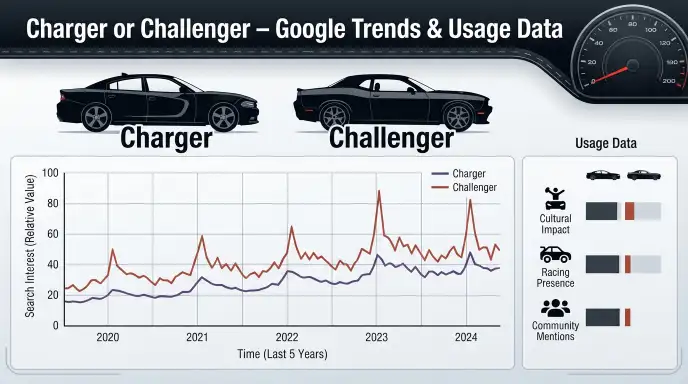
Search interest for charger and challenger can vary greatly because both words have several meanings.
Charger Search Contexts
The word charger is commonly connected with:
- phones
- laptops
- batteries
- electric vehicles
- charging stations
- electronics
- cars
- horses
Automotive searches may also involve the Dodge Charger, while technology searches often involve phone and laptop chargers.
Challenger Search Contexts
The term challenger is often connected with:
- sports
- championships
- competitions
- business
- politics
- debates
- military history
- automobiles
Automotive searches may refer to the Dodge Challenger, while sports searches may focus on a competitor trying to defeat a champion.
Why People Search These Words
The search intent depends heavily on context.
Someone searching for phone charger wants technology information. Someone searching for Dodge Charger is searching for a vehicle. A person searching for title challenger is looking for a competitor in sports.
Because of these different meanings, a single Google Trends comparison between charger and challenger may not provide a meaningful picture of general word usage without selecting a specific country, date range, and search category.
Quick Comparison Table
| Version | Meaning | Correct? | Region | Example |
| charger | Device that supplies power | Yes | All major English varieties | I need my phone charger. |
| charger | Person or animal that charges | Yes | All major English varieties | The horse was a powerful charger. |
| challenger | Competitor or opponent | Yes | All major English varieties | The challenger defeated the champion. |
| challenger | Company competing with a leader | Yes | All major English varieties | The brand is a strong challenger. |
| charger for competitor | Wrong word | No | All regions | ❌ The charger entered the contest. |
| challenger for power device | Wrong word | No | All regions | ❌ I need a phone challenger. |
FAQs About Charger or Challenger
Is a charger the same as a challenger?
No. Charger and challenger have different meanings. A charger can be a device that supplies electrical power, while a challenger is a person or group competing against another.
What is the difference between charger and challenger?
Charger comes from charge and can refer to a power device or something that charges. Challenger comes from challenge and means a person or group competing against another.
Is charger a British or American spelling?
Charger is spelled the same in British and American English. The word does not have a major regional spelling variation.
Is challenger a British or American spelling?
Challenger is also spelled the same in British and American English. Its meaning remains essentially the same across major English varieties.
Is a phone charger called a charger?
Yes. Charger is the standard term for a device used to supply electrical power to a rechargeable battery, such as the battery in a phone or laptop.
What does challenger mean in sports?
In sports, a challenger is a competitor trying to defeat a current champion or leading player. For example, a title challenger competes for a championship.
Are Charger and Challenger car names?
Yes. Dodge Charger and Dodge Challenger have both been used as names for Dodge automobiles. They are separate vehicle nameplates, so the names should not be used interchangeably.
Conclusion
Charger and challenger are not different spellings of the same word. They come from different verbs and have different meanings. A charger is commonly a device that supplies power to a battery, but the word can also describe someone or something that charges forward. A challenger is a person, team, company, or other competitor that challenges another.
The spelling is the same in British and American English, so regional preference does not determine which word to use. Meaning and context do.
If you are talking about a phone, laptop, battery, or charging equipment, charger is the right choice. If you are describing a competitor, opponent, or contender, use challenger.
A simple memory trick can prevent most mistakes: you charge a device with a charger, and you challenge a champion with a challenger.
When you see these words in automotive writing, remember that the Dodge Charger and Dodge Challenger are separate vehicle names.
Discover More About Grammar!

Hi, I’m Olivia Bennett, an English grammar and spelling content writer. I enjoy exploring confusing words, spelling differences, and everyday language questions. My goal is to share clear, simple, and helpful explanations that make English easier to understand.








1 thought on “Charger vs Challenger: Meaning and Usage Explained”