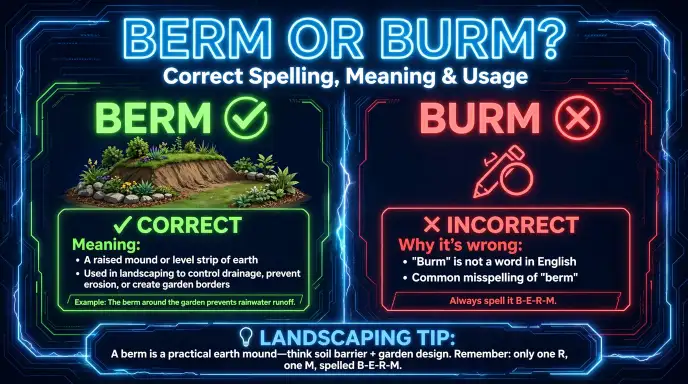
The correct spelling is usually berm, not burm, when referring to a raised strip of land, a narrow ledge, or a mound used for landscaping, drainage, or protection. The word burm appears as a less common variant, but berm is the standard spelling in general English.
People often search for “berm or burm” because the two words sound alike. This can make it hard to know which spelling to use in writing. The confusion often comes up in gardening, road construction, landscaping, and civil engineering, where a berm can serve several useful purposes.
For example, a homeowner may build a berm to improve drainage, add privacy, or create a raised garden feature. Road workers may also use berms to help guide water or mark the edge of an area. In these cases, berm is the spelling most readers will expect.
This guide explains the meaning, origin, and use of berm and burm. It also compares British and American usage, highlights common mistakes, and provides examples to help you choose the right spelling with confidence.
Berm or Burm – Quick Answer
Berm is the standard spelling in modern English. Burm is a less common alternative spelling, so it is best to use berm in most writing.
A berm is a raised strip or bank of earth, or a narrow ledge beside a road, slope, river, or beach.
Examples:
- Correct and recommended: The gardener built a berm around the flower bed.
- Less common: The gardener built a burm around the flower bed.
For schoolwork, professional reports, landscaping plans, and general writing, choose berm.
Definition and Meaning of Berm or Burm
What Does Berm Mean?
A berm is a strip, shelf, or mound of land. It may occur naturally or be built by people. Its shape and purpose depend on where it appears.
Common meanings include:
- Landscaping: A raised mound of soil used to add height, shape, or privacy to a garden.
- Roads: A strip or bank of land beside a road.
- Construction: A raised bank that helps control water, separate areas, or support a site.
- Beaches: A raised strip of sand or gravel formed by wave action.
- Military use: A bank of earth or sand that can serve as a defensive barrier.
For example, a landscaper might build a berm to create a natural boundary between a garden and a driveway.
What Does Burm Mean?
Burm is a much less common spelling associated with berm. Some references identify it as an alternative spelling, but it is not the usual choice in standard modern writing.
If you encounter burm in a website, note, or informal message, the writer may intend to mean berm. In most cases, using the standard spelling will make your meaning clearer.
Are Berm and Burm Different Words?
The two spellings generally refer to the same land feature when burm is used as a variant of berm. The main difference is how commonly readers will recognize each spelling.
| Feature | Berm | Burm |
| Standard spelling | Yes | Less common variant |
| General meaning | Raised strip or bank of land | Usually intended to mean berm |
| Landscaping and construction | Preferred | Avoid in standard writing |
| Professional documents | Recommended | May look like a spelling error |
The Origin of Berm or Burm
The word berm entered English in the early 18th century. It came through French berme from Dutch berm. The word originally referred to a narrow space or ledge.
Early uses included military structures, where a berm described a strip of ground between a defensive wall and a ditch. Over time, the word gained wider use in road building, landscaping, coastal geography, and engineering.
Today, a berm can describe anything from a small garden mound to a large bank of earth used as a barrier.
Why Do People Confuse Berm and Burm?
The main reason is pronunciation. In many English accents, berm sounds much like the way a reader might pronounce burm. When people write a word based on its sound, they may choose the less familiar spelling.
The word’s technical uses can also cause uncertainty. Someone who encounters it for the first time in a gardening or construction guide may not know which letters to use.
However, berm remains the safest spelling for general and professional English.
British English vs American English Spelling
British and American English both use berm. The spelling does not change between these varieties of English.
The meaning may vary slightly by region or context. For example, berm can refer to a roadside strip in some places, while other uses focus on a raised bank, beach feature, or ledge.
| Context | British English | American English |
| Standard spelling | Berm | Berm |
| Garden mound | Berm | Berm |
| Raised bank of earth | Berm | Berm |
| Beach feature | Berm | Berm |
| Roadside land feature | Berm, depending on context | Berm, depending on region |
| Burm | Less common variant | Less common variant |
Examples in British English
- The council planted flowers along the berm beside the road.
- Workers built a berm to protect the path from erosion.
- Waves left a narrow berm along the beach.
Examples in American English
- The landscaper added a berm to create privacy.
- Engineers built an earth berm around the storage area.
- Heavy rain washed soil down the side of the berm.
These examples show that the standard spelling stays the same in both varieties. You do not need to change berm to burm for a British or American audience.
Which Spelling Should You Use?
Choose berm in almost every situation. It is the standard spelling and works for readers in the United States, the United Kingdom, Canada, Australia, and other English speaking regions.
Your choice should depend on your audience and the type of writing you are doing.
- For American readers: Use berm in landscaping guides, construction reports, emails, and everyday writing.
- For British readers: Use berm as well. You may need to explain the local meaning if the word refers to a specific roadside feature.
- For international readers: Choose berm because it is the more widely recognized spelling.
- For academic or technical writing: Use berm consistently and define the term if your audience may not know it.
- For informal messages: You may encounter burm, but use berm when you want clear, standard spelling.
Professional Writing Advice
When writing a report about drainage, a garden design, or a construction project, spell the word berm every time. Consistency helps readers understand the document and makes your writing look professional.
If a source uses burm, check if it is a local term, a quoted spelling, or simply an error before changing it.
Common Mistakes with Berm or Burm
Writers often confuse these spellings because they sound alike. These simple tips can help you avoid mistakes.
1. Using Burm in Formal Writing
Less common: The contractor built a burm beside the road.
Preferred: The contractor built a berm beside the road.
Use berm in reports, articles, and professional documents.
2. Assuming British English Uses Burm
Some writers think that British and American English use different spellings. They do not follow that pattern with this word.
Correct: The team built a berm beside the canal.
This spelling works for both British and American readers.
3. Confusing a Berm with a Dike
A berm is a raised bank, strip, or ledge of land. A dike is a barrier built to control or keep back water. Their purposes can overlap, but the terms do not always mean the same thing.
Example: The workers built a berm around the site to help manage runoff.
Choose the word that best describes the actual structure.
4. Using Berm Without Enough Context
The word has several meanings, so readers may need more detail.
Unclear: The workers repaired the berm.
Clearer: The workers repaired the earthen berm beside the drainage channel.
Adding a few descriptive words helps readers picture the feature.
5. Treating Every Use of Burm as a Separate Meaning
The less common spelling does not usually signal a different land feature. Do not assume that berm and burm have separate meanings without evidence from the source.
Best practice: Use berm unless a specific source or established local usage requires another form.
Berm or Burm in Everyday Examples
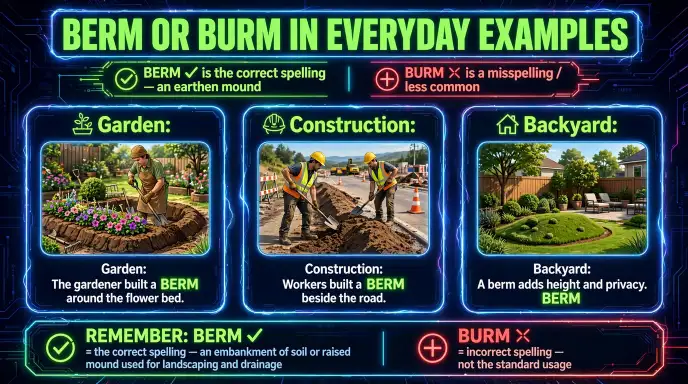
Seeing the word in different situations makes its meaning easier to understand. Here are examples from common types of writing.
In Emails
Subject: Landscaping Project Update
The team will build a berm along the garden boundary to improve the layout and create more privacy.
This example uses berm in a clear, professional way.
In News Reports
Heavy rainfall damaged the earthen berm beside the road, prompting crews to inspect the area.
News writing often uses berm when describing land, drainage, construction, or flood protection.
On Social Media
We’re adding a small berm to the garden to give the plants more height and make the yard look better.
This informal example uses the standard spelling without sounding technical.
In Formal Writing
The proposed berm will help separate the landscaped area from the access road and guide surface runoff away from the building.
Technical documents should use berm consistently and explain its purpose when necessary.
In a Landscaping Guide
A low berm can add depth to a flat garden. Plant shrubs or flowers along its top to create a natural looking feature.
In a Comparison Sentence
The contractor built a berm, not a burm, along the edge of the site.
This sentence directly highlights the preferred spelling.
Berm or Burm – Google Trends & Usage Data
People may search for “berm or burm” when they are unsure how to spell the word. However, the existence of a search query does not prove that both spellings are equally common.
A reliable comparison of search interest by country requires current Google Trends data. Without a verified comparison, it would be misleading to give exact popularity percentages or claim that one country uses burm more often.
Expected Usage by Context
| Context | Preferred spelling | Usage guidance |
| US landscaping | Berm | Standard choice |
| UK road and land descriptions | Berm | Standard spelling |
| Australian and international writing | Berm | Clear general choice |
| Construction and engineering | Berm | Use consistently |
| Informal searches and misspellings | Burm may appear | Verify before using |
How to Check Search Interest
You can compare the terms directly in Google Trends. Set the region to a country such as the United States or United Kingdom, choose a suitable time range, and compare the search terms berm and burm.
Keep in mind that Google Trends reports relative search interest, not the total number of searches. Results may also reflect names or other uses unrelated to the land feature.
The practical takeaway remains simple: use berm in standard writing, regardless of which spelling people happen to search for.
Berm vs Burm – Spelling Comparison Table
Use this table as a quick reference when editing your writing.
| Word or phrase | Status | Example |
| Berm | Standard spelling | The berm protects the garden from runoff. |
| Burm | Less common variant | The writer used burm in an informal note. |
| Earthen berm | Correct phrase | Workers built an earthen berm around the site. |
| Beach berm | Correct phrase | Waves formed a beach berm along the shore. |
| Roadside berm | Correct phrase where applicable | Grass covered the roadside berm. |
| Berms | Correct plural | The project includes two berms. |
Remember that berm can also function as a verb in technical use, as in “Workers bermed the area.” Its common plural form is berms.
Frequently Asked Questions
1. Is berm or burm correct?
Berm is the standard spelling in modern English. Burm is a less common variant, so berm is the better choice for most writing.
2. What does berm mean?
A berm is a raised bank, strip, or ledge of land. People use berms in landscaping, construction, road design, and coastal environments.
3. Is burm ever correct?
Some references record burm as an alternative spelling of berm. However, it is uncommon, and writers should generally use berm.
4. Do British and American English spell berm differently?
No. Both British and American English use berm. The meaning may vary slightly according to the region or context.
5. How do you use berm in a sentence?
You can write, “The gardener built a berm around the flower bed.” Here, berm refers to a raised bank of soil.
6. What is the plural of berm?
The standard plural is berms. For example, “The landscaping plan includes three berms around the property.”
7. Why do people confuse berm and burm?
The two spellings can sound alike when spoken. People may therefore choose burm when spelling the word by sound rather than checking the standard form.
Conclusion
When choosing between berm or burm, the safest and most widely accepted choice is berm. This spelling is used in British and American English and appears in landscaping, construction, road design, military contexts, and coastal geography.
A berm can be a raised bank of soil, a narrow strip beside a road, a ledge along a slope, or a ridge of sand on a beach. Its exact purpose depends on the setting, but the standard spelling stays the same.
Although some references record burm as a less common variant, most writers should avoid it in everyday and professional documents. Using berm helps prevent confusion and keeps your spelling consistent.
For school assignments, emails, news articles, technical reports, and online content, choose berm. If you encounter burm in a source, check the context before deciding if to preserve it.
Ultimately, you do not need separate British and American spellings for this word. Remember berm, use it consistently, and add a short explanation when readers may not know what the land feature looks like.
Improve Your Grammar!

I’m Ethan Carter, a grammar-focused writer and English language enthusiast at SpellGrammar. I enjoy explaining confusing words, spelling differences, and grammar rules in clear, simple language. My goal is to help readers write with greater accuracy and confidence in everyday and professional English.








3 thoughts on “Berm vs Burm: Meaning, Spelling, and Usage”