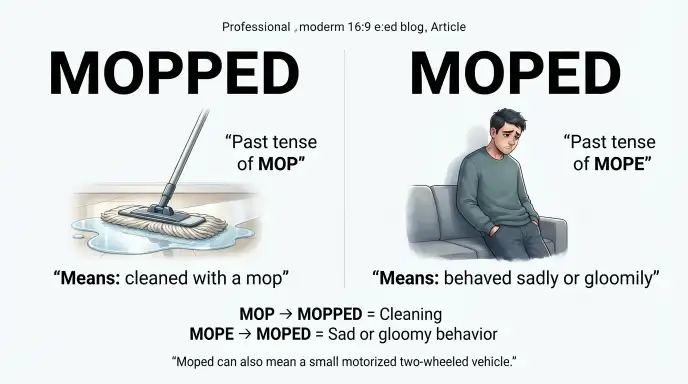
Mopped and moped are both correct English words, but they have different meanings and are used in different contexts. If you are talking about cleaning a floor, the correct word is mopped. If you mean moving around in a slow, unhappy, or depressed way, moped is the correct word.
The confusion usually comes from the fact that these words look and sound very similar. They are both past-tense forms, but they come from different verbs. Mopped comes from mop, while moped comes from mope.
For example, you might say, “She mopped the kitchen floor,” but “He moped around the house all afternoon.” The first sentence is about cleaning. The second describes someone behaving sadly or without much energy.
This difference matters in everyday writing, school assignments, emails, and professional communication. A single letter can change the meaning of the sentence completely.
In this guide, you will learn what mopped or moped means, how each word is formed, common mistakes, and simple ways to remember which one to use.
Featured Snippet: Mopped or Moped?
Mopped is the past tense of mop, meaning to clean or wipe a surface with a mop. Moped is the past tense of mope, meaning to behave in a sad, gloomy, or inactive way. For example, “She mopped the floor” means she cleaned it, while “He moped around” means he acted sadly.
Mopped or Moped: Quick Answer
The correct word depends on what you want to say.
Use mopped when you mean cleaned
She mopped the kitchen floor.
He mopped the hallway after the spill.
Here, mopped means cleaned a surface with a mop.
Use moped when you mean behaved sadly
He moped around the house all day.
She moped after hearing the bad news.
Here, moped means behaved in a sad, gloomy, or discouraged way.
Easy Rule
Remember this simple difference:
- Mop → mopped → cleaning
- Mope → moped → feeling or acting sad
The spelling changes because the two words come from different base verbs.
What Does Mopped or Moped Mean?
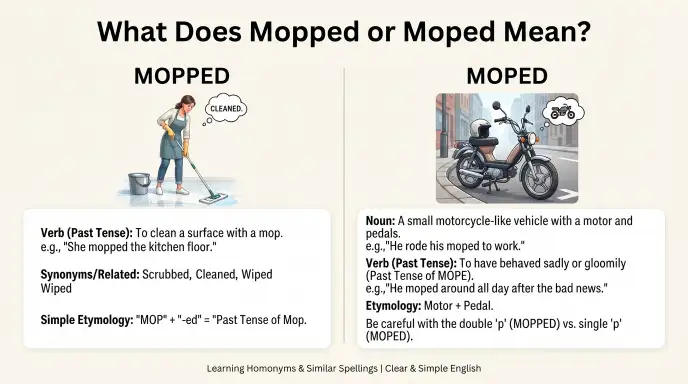
Although mopped and moped look almost identical, they have different meanings.
What Does Mopped Mean?
Mopped is the past tense and past participle of mop.
A mop is a cleaning tool used to clean floors and other surfaces. As a verb, mop means to clean something with a mop.
For example:
I mopped the kitchen floor this morning.
This means the person used a mop to clean the floor.
The word can also be used more broadly for wiping or cleaning something with a mop-like tool.
What Does Moped Mean?
Moped is the past tense and past participle of mope.
To mope means to spend time feeling or behaving in a sad, unhappy, or low-energy way. Someone who mopes may appear quiet, disappointed, or unwilling to take part in activities.
For example:
After losing the game, he moped around all evening.
This means he behaved sadly after the game.
Why the Difference Matters
The two words can create very different meanings.
Compare these sentences:
She mopped around the house.
She moped around the house.
The first sentence suggests cleaning, although the phrase is unusual without an object. The second describes someone moving or behaving sadly.
A single letter changes the verb and its meaning.
The Origin of Mopped or Moped
The words mopped and moped come from different English verbs.
The Origin of Mop
The noun mop refers to a tool used for cleaning floors and other surfaces. The word later developed into a verb meaning to clean with a mop.
When mop becomes a past-tense verb, the final consonant is doubled before -ed:
mop → mopped
This follows a common English spelling pattern for short verbs ending in a consonant that is doubled before a suffix.
Other examples include:
- stop → stopped
- plan → planned
- rub → rubbed
- drop → dropped
The Origin of Mope
Mope is a separate verb. It means to behave in a gloomy, sad, or listless way.
Its past tense is formed by adding -d:
mope → moped
The final e is removed before the -ed ending.
Similar examples include:
- hope → hoped
- smile → smiled
- close → closed
- care → cared
Why Do They Look So Similar?
The words look similar because their base forms are only one letter apart:
mop
mope
But their spelling rules are different.
Mop + ed = mopped
Mope + d = moped
Understanding the base verb makes the difference much easier to remember.
British English vs American English
There is no major British and American spelling difference between mopped and moped. Both forms are standard in British English and American English.
The real difference is meaning. Mopped comes from the verb mop, while moped comes from the verb mope. The words are spelled differently because they come from different base verbs.
| Feature | Mopped | Moped |
| Base verb | Mop | Mope |
| Meaning | Cleaned or wiped with a mop | Behaved in a sad or gloomy way |
| Past tense | Mopped | Moped |
| Present participle | Mopping | Moping |
| US English | Correct | Correct |
| UK English | Correct | Correct |
| Example | She mopped the kitchen. | He moped after the argument. |
This means you do not need to choose one word based on if you are writing for a British or American audience. Choose the word based on what you want to say.
Which Version Should You Use?
The correct choice depends on the meaning of your sentence.
Use mopped when you are talking about cleaning a floor, room, or other surface with a mop.
Example:
“She mopped the hallway before the guests arrived.”
Use moped when you are describing someone behaving sadly, quietly, or without much energy.
Example:
“He moped around the house after hearing the news.”
For US English
American writers should use mopped for the past tense of mop and moped for the past tense of mope.
For UK English
British writers use the same forms. There is no regional spelling change between these two words.
For Canadian and Australian English
Both varieties also commonly use mopped and moped with the same meanings. The important point is the base verb.
For International English
If you write for an international audience, focus on the meaning of the sentence. Since the two words describe different actions, using the correct base verb makes your writing much clearer.
For Academic Writing
Academic and formal writing should use the word that accurately matches the intended meaning. Avoid switching between mopped and moped simply because they look similar.
For Business Writing
Business emails, reports, and workplace messages should also follow the same distinction. Use mopped for cleaning and moped for gloomy or unhappy behavior.
Common Mistakes With Mopped and Moped
Because the words look similar, it is easy to use the wrong one. The best way to avoid mistakes is to connect each word with its base verb.
| Incorrect | Correct | Explanation | Memory Tip |
| She moped the floor. | She mopped the floor. | Cleaning comes from mop. | Mop → mopped |
| He mopped around after the loss. | He moped around after the loss. | Sad behavior comes from mope. | Mope → moped |
| She is moped the floor. | She is mopping the floor. | The present participle of mop is mopping. | Mop → mopping |
| He is mopped in his room. | He is moping in his room. | The present participle of mope is moping. | Mope → moping |
| She mopped the floor with sadness. | She mopped the floor while feeling sad. | Mopped describes the cleaning action, not the emotion. | Keep action and emotion separate |
| He moped his new scooter. | He rode his new moped. | Here, moped can be a noun referring to a small motorized vehicle. | Moped can be a verb or noun |
Mistake 1: Using “moped” for cleaning
Incorrect: “I moped the kitchen floor.”
Correct: “I mopped the kitchen floor.”
The action of cleaning with a mop comes from mop, so its past tense is mopped.
Mistake 2: Using “mopped” for sad behavior
Incorrect: “He mopped around the house all day.”
Correct: “He moped around the house all day.”
The verb mope describes someone who is sad, gloomy, or inactive.
Mistake 3: Confusing mopping and moping
The present forms are also different:
- Mopping = cleaning with a mop
- Moping = behaving sadly or gloomily
Example:
“She was mopping the kitchen while her brother was moping in his room.”
Mistake 4: Forgetting that “moped” can be a noun
The word moped has another common meaning. A moped is a small motorized two-wheeled vehicle.
Example:
“Daniel bought a moped for short trips around town.”
In this sentence, moped is a noun. It does not mean that Daniel behaved sadly.
Mistake 5: Creating incorrect spellings
Forms such as moppped and mopeded are incorrect for standard English.
The correct forms are:
- Mop → mopped
- Mope → moped
Everyday Examples of Mopped and Moped
Seeing both words in different situations makes the distinction easier to remember.
In Emails
Mopped:
“I mopped the office kitchen before leaving.”
Moped:
“He moped around the office after the project was canceled.”
In Business Writing
Mopped:
“The cleaning staff mopped the main entrance this morning.”
Moped:
“The employee seemed to mope after receiving the disappointing news.”
In News Headlines
Mopped:
“Workers mopped the floors after the water leak.”
Moped:
“The player moped after the team suffered a difficult defeat.”
In Blog Writing
Mopped:
“She mopped the floor and opened the windows.”
Moped:
“After the vacation ended, he moped around the house.”
On Social Media
Mopped:
“Finally mopped the entire apartment today!”
Moped:
“I moped all weekend because my plans were canceled.”
In Academic Writing
Mopped:
“The laboratory floor was mopped after the experiment.”
Moped:
“The character moped after losing his closest friend.”
In Daily Conversation
Mopped:
“Have you mopped the kitchen yet?”
Moped:
“Why have you been moping all morning?”
These examples show that the two words cannot normally be swapped. Mopped describes a cleaning action, while moped describes a type of behavior when it comes from mope.
Google Trends & Modern Usage
People often search for mopped or moped because the two words look very similar but have different meanings. The confusion becomes stronger because both words are past-tense forms of short verbs.
The easiest way to understand modern usage is to look at the base verbs:
- Mop → mopped = cleaned with a mop
- Mope → moped = behaved sadly or gloomily
The word moped can also have a completely different meaning as a noun. A moped is a small motorized two-wheeled vehicle. Context usually makes the intended meaning clear.
There is no major US-versus-UK spelling issue with these words. Both mopped and moped are established forms in standard English.
When people are unsure which word to use, checking the base verb is more useful than checking regional spelling. If the sentence is about cleaning, use mopped. If it describes sad or inactive behavior, use moped.
Quick Comparison Table
| Word | Base Verb | Meaning | Correct? | Example |
| Mopped | Mop | Cleaned with a mop | Yes | She mopped the floor. |
| Moped | Mope | Behaved sadly or gloomily | Yes | He moped after the argument. |
| Moped | Moped | A small motorized two-wheeled vehicle | Yes | He rode a moped to work. |
| Mopping | Mop | Cleaning with a mop | Yes | She is mopping the kitchen. |
| Moping | Mope | Behaving sadly or gloomily | Yes | He is moping in his room. |
The key distinction is simple: mopped is connected to cleaning, while moped is connected to mope or, in another context, a type of vehicle.
Key Takeaways
- Mopped is the past tense of mop.
- Moped is the past tense of mope.
- Mopped means cleaned or wiped something with a mop.
- Moped can mean behaved sadly, gloomily, or without energy.
- Moped can also be a noun for a small motorized two-wheeled vehicle.
- Both mopped and moped are correct in British and American English.
- Mopping comes from mop, while moping comes from mope.
- The correct word depends on the meaning, not the English variety.
Frequently Asked Questions
1. Is mopped or moped correct?
Both mopped and moped are correct words, but they have different meanings. Mopped is the past tense of mop and refers to cleaning. Moped is the past tense of mope and describes sad or gloomy behavior. Moped can also be a noun referring to a small motorized vehicle.
2. What is the difference between mopped and moped?
Mopped means cleaned something using a mop. Moped means behaved in a sad, gloomy, or inactive way when it comes from the verb mope. For example, “She mopped the floor” describes cleaning, while “He moped around the house” describes unhappy behavior.
3. Is moped the past tense of mope?
Yes. Moped is the simple past tense of mope. The verb mope means to behave in a sad, gloomy, or listless way. For example, “He moped around his room after the disappointing news.” The spelling follows the normal pattern of adding -d to the verb mope.
4. Is moped also a vehicle?
Yes. Moped is also a noun for a small motorized two-wheeled vehicle. For example, “She rides a moped to work.” In this sentence, moped is a noun rather than the past tense of mope. The surrounding words usually make the meaning clear.
5. Is “mopped” always related to cleaning?
In standard everyday use, mopped is the past tense of mop and normally refers to cleaning or wiping a surface with a mop. For example, “They mopped the kitchen floor.” The word should not be used to describe someone who is feeling sad or withdrawn.
6. Why do mopped and moped look similar?
The words look similar because they are both past-tense forms of short verbs. However, their base verbs are different. Mopped comes from mop, while moped comes from mope. Their similar appearance can make them easy to confuse when writing.
7. Is mopped British or American English?
Mopped is used in both British and American English. There is no important regional spelling difference for this word. It is simply the past tense of mop. Writers in both varieties can use “mopped” when describing an action involving cleaning with a mop.
8. Can “moped” be used in a sentence?
Yes. For example, “He moped around the house after his plans were canceled.” Here, moped is the past tense of mope. It can also be used as a noun, as in “They traveled across town on a moped.”
9. What is the past tense of mop?
The past tense of mop is mopped. The final consonant is doubled before adding -ed, giving the spelling mopped. For example: “She mopped the floor before dinner.” Its present participle is mopping.
10. What is the past tense of mope?
The past tense of mope is moped. Because mope already ends in silent e, the past tense is formed by adding -d. For example: “He moped around the house after the bad news.” Its present participle is moping.
Conclusion
Understanding mopped or moped becomes easy once you identify the base verb. Mopped is the past tense of mop and describes cleaning or wiping something with a mop. Moped is the past tense of mope and describes someone behaving in a sad, gloomy, or inactive way.
The two words are correct, but they cannot normally be used interchangeably. The distinction is based on meaning, not on British or American spelling. Both forms are used in standard English varieties.
Remember the simple rule: mop → mopped and mope → moped. If you are talking about a cleaned floor, room, or surface, choose mopped. If you are describing someone who is acting sadly, choose moped.
Also remember that moped has another meaning as a noun for a small motorized two-wheeled vehicle. Context will usually tell you which meaning is intended.
Discover More English!

Hi, I’m Olivia Bennett, an English grammar and spelling content writer. I enjoy exploring confusing words, spelling differences, and everyday language questions. My goal is to share clear, simple, and helpful explanations that make English easier to understand.








1 thought on “Mopped or Moped: Which Spelling Is Correct?”