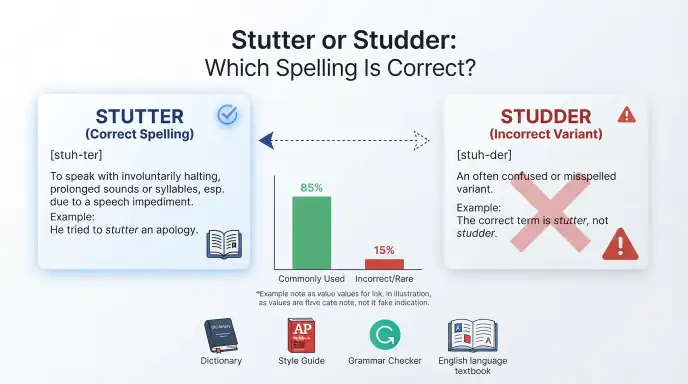
The correct spelling is stutter, not studder, when you mean to repeat or struggle with sounds, syllables, or words while speaking. Stutter is the standard English spelling, while studder is generally a misspelling.
People often search for “stutter or studder” because the two forms look and sound similar. This can make the correct spelling hard to remember. English also has many words whose spelling does not always match their pronunciation, so it is easy to choose the wrong letters.
The word stutter can be used as both a noun and a verb. It can describe repeated sounds in speech, but it can also describe something that stops and starts in an uneven way. For example, a person may stutter while speaking, while a machine or video may also seem to stutter when it repeatedly pauses.
In this guide, you will learn which spelling is correct, what each form means, where the word comes from, how it is used in different types of English, and how to avoid common mistakes.
Featured Snippet: Stutter or Studder?
Stutter is the correct spelling. It means to repeat or hesitate over sounds, syllables, or words while speaking. Studder is generally not the standard spelling for this meaning. Use stutter in American, British, Canadian, Australian, academic, business, and international English.
Stutter or Studder: Quick Answer
Stutter is correct.
Studder is generally incorrect when you mean repeated or interrupted speech.
Examples:
- Correct: He began to stutter during the interview.
- Correct: She sometimes stutters when she feels nervous.
- Incorrect: He began to studder during the interview.
Easy Rule
Remember this simple rule:
Stutter = correct
Studder = incorrect
The correct word contains two T’s:
stu + tt + er = stutter
It does not use dd in the middle.
What Does Stutter or Studder Mean?
What Does “Stutter” Mean?
Stutter means to speak with repeated sounds, syllables, or words, often with pauses or interruptions.
It can be used as a verb:
He began to stutter while answering the question.
It can also be used as a noun:
His stutter became more noticeable when he was nervous.
The meaning depends on how the word is used in a sentence.
Stutter as a Verb
When stutter is a verb, it describes an action.
For example:
She started to stutter during her speech.
Here, stutter describes the way she was speaking.
Other examples include:
He stuttered when he tried to answer quickly.
The child sometimes stutters when speaking to strangers.
Stutter as a Noun
When stutter is a noun, it refers to the speech pattern itself.
For example:
His stutter did not stop him from giving the presentation.
Another example:
She has worked hard to manage her stutter.
Stutter Can Have a Wider Meaning
The word can also describe something that repeatedly stops, pauses, or moves unevenly.
For example:
The video began to stutter.
Here, stutter does not describe human speech. It describes a video that is playing unevenly.
Another example:
The engine started to stutter.
The basic idea remains the same: something is not flowing smoothly.
What Does “Studder” Mean?
Studder is generally not the standard spelling of the word used for repeated or interrupted speech.
If you mean that someone repeats sounds or words while speaking, use:
stutter
Not:
studder
The incorrect spelling can appear because people sometimes spell words according to how they think the sounds are produced.
The Origin of Stutter or Studder
The word stutter has a long history in English.
It is connected to older Germanic forms used to describe broken, hesitant, or interrupted speech. Related forms can also be found in other Germanic languages.
Over time, English settled on stutter as the standard spelling for the modern word.
Why Does “Studder” Appear?
Studder is best understood as a spelling mistake rather than a normal alternative spelling of stutter.
The mistake is easy to make because the two forms look similar:
- stutter
- studder
Only the middle consonant changes, but that small difference makes one form standard and the other nonstandard.
Why the Double T Matters
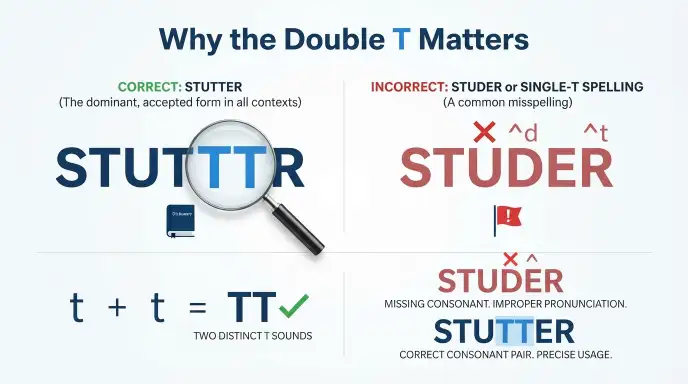
English spelling does not always follow pronunciation exactly.
A word may sound slightly different across accents, but its standard spelling usually stays the same.
That is why hearing a sound that seems closer to d does not make studder correct.
The standard spelling remains:
stutter
Historical Usage
The word has been used in English for many centuries to describe interrupted or hesitant speech.
Modern dictionaries continue to recognize stutter as the standard form.
For normal English writing, there is no need to use studder as an alternative.
British English vs American English
There is no major spelling difference between British and American English for stutter.
Both varieties use stutter as the standard spelling. The form studder is not a normal regional spelling.
| Feature | British English | American English |
| Standard spelling | stutter | stutter |
| Incorrect form | studder | studder |
| Verb | stutter | stutter |
| Noun | stutter | stutter |
| Past tense | stuttered | stuttered |
| Present participle | stuttering | stuttering |
| Example | He began to stutter. | He began to stutter. |
British English
British English uses stutter.
For example:
He began to stutter during the interview.
The spelling does not change because the writer is using British English.
American English
American English also uses stutter.
For example:
She started to stutter when she became nervous.
Again, the spelling remains the same.
What About the Double T?
The spelling becomes especially important when adding endings.
The standard forms are:
- stutter
- stutters
- stuttered
- stuttering
The word does not change to studder in either British or American English.
Which Version Should You Use?
The simple answer is to use stutter.
It is the standard form across the major varieties of English.
United States
Use stutter in:
- School assignments
- Emails
- Articles
- Business writing
- Social media
- Academic writing
Example:
The speaker began to stutter during the presentation.
United Kingdom
Use stutter in the same way.
Example:
He tends to stutter when speaking in front of a large audience.
There is no need to change the spelling to studder.
Canada
Canadian English also uses stutter.
Example:
She sometimes stutters when she is under pressure.
Australia
Australian English uses stutter as well.
Example:
He began to stutter while answering the question.
International Writing
For a global audience, stutter is the clearest choice.
It is widely recognized by English speakers around the world.
If your readers include ESL learners, avoid the incorrect form because it may reinforce the spelling mistake.
Academic Writing
Use stutter in essays, reports, research writing, and educational content.
For example:
The speaker appeared to stutter during the presentation.
If you are writing about speech or communication in an academic or professional setting, use terminology that matches the source or field you are discussing.
Business Writing
Use stutter in professional emails and reports when the word is needed.
For example:
The presenter began to stutter briefly while answering the question.
Common Mistakes with Stutter or Studder
The biggest mistake is simply replacing the tt in stutter with dd.
Mistake 1: Studder
Incorrect:
He began to studder.
Correct:
He began to stutter.
Explanation:
The standard spelling contains tt, not dd.
Memory tip:
Think of the middle as TT:
stu + TT + er
Mistake 2: Studdered
Incorrect:
She studdered while answering.
Correct:
She stuttered while answering.
The correct past tense form is stuttered.
Mistake 3: Studdering
Incorrect:
He was studdering during the interview.
Correct:
He was stuttering during the interview.
The correct present participle is stuttering.
Mistake 4: Assuming “Studder” Is British
Some people assume that studder might be the British spelling of stutter.
That is not correct.
British English uses stutter, just like American English.
Mistake 5: Changing the Spelling Because of Pronunciation
A word can sound different from how it looks.
This is especially true across different accents.
Do not change stutter to studder simply because the pronunciation sounds different from what you expect.
Mistake 6: Using “Stutter” Without Checking Context
The word can describe speech, but it can also describe something that repeatedly stops or pauses.
For example:
The video began to stutter.
This is different from:
He began to stutter.
The first sentence describes a video. The second describes speech.
Stutter or Studder in Everyday Examples
The correct spelling appears in many types of writing.
Emails
I noticed that he began to stutter during the presentation.
This sentence is suitable for a simple workplace or personal email.
Business Writing
The speaker appeared to stutter briefly while answering the question.
This wording is clear and professional.
News Headlines
Speaker Begins to Stutter During Live Interview
News headlines often remove unnecessary words, but the spelling remains stutter.
Blogs
Some people may stutter more when they feel nervous or rushed.
This is a natural way to use the word in an informational article.
Social Media
I always seem to stutter when I have to speak in front of a crowd.
The word works the same way in casual online writing.
Academic Writing
Speech disruptions may include repeated sounds, syllables, or words.
In academic writing, the exact terminology should match the subject and source being discussed.
Daily Conversation
I started to stutter because I was so nervous.
This is a natural everyday use of the verb.
Figurative Use
Stutter can also describe something that does not move or work smoothly.
For example:
The video started to stutter.
Another example:
The engine began to stutter.
In these sentences, stutter means something is stopping and starting or working unevenly.
Stutter or Studder: Common Sentence Comparison
| Incorrect | Correct | Why? |
| He began to studder. | He began to stutter. | Stutter is the standard spelling. |
| She studdered during the speech. | She stuttered during the speech. | The past tense keeps tt. |
| He was studdering. | He was stuttering. | The standard form is stuttering. |
| I sometimes studder when nervous. | I sometimes stutter when nervous. | Use stutter as the verb. |
| The video is studdering. | The video is stuttering. | Stuttering can describe interrupted playback. |
The easiest rule is simple: whenever you mean repeated or interrupted speech, or something that repeatedly stops and starts, use stutter.
Google Trends & Modern Usage
People search for “stutter or studder” because the two spellings look very similar. The confusion is often caused by pronunciation, especially when a speaker hears a sound that seems closer to d than t.
Common searches include:
- stutter or studder
- is it stutter or studder
- stutter spelling
- studder meaning
- how to spell stutter
- stuttered or studdered
- stuttering or studdering
- correct spelling of stutter
The exact level of search interest can change over time and between countries. Without current verified search volume data, it would not be accurate to give specific numbers or claim that one country has a fixed level of interest.
The wider usage pattern is clear: stutter is the established spelling in standard English.
The word also appears in different contexts. It can describe speech, but it can also describe a video, engine, connection, or other process that repeatedly stops and starts.
Quick Comparison Table
| Version | Meaning | Correct? | Region | Example |
| stutter | Speak with repeated sounds or pauses | Yes | US, UK, Canada, Australia, International | He began to stutter. |
| studder | Intended spelling of stutter | No | Not a standard regional form | Avoid this spelling. |
| stuttered | Past tense of stutter | Yes | Major English varieties | He stuttered during the speech. |
| stuttering | Present participle of stutter | Yes | Major English varieties | She is stuttering less now. |
| studdered | Incorrect form of stuttered | No | Not standard | Use stuttered. |
| studdering | Incorrect form of stuttering | No | Not standard | Use stuttering. |
Key Takeaways
- Stutter is the correct standard spelling.
- Studder is generally a misspelling.
- The correct word contains two T’s.
- British English uses stutter.
- American English also uses stutter.
- Stutter can be used as both a noun and a verb.
- Stuttered is the correct past tense form.
- Stuttering is the correct present participle form.
- The word can describe speech or something that repeatedly stops and starts.
FAQs About Stutter or Studder
Is “stutter” or “studder” correct?
Stutter is correct. It is the standard English spelling for speech that includes repeated sounds, syllables, words, or pauses. Studder is generally a misspelling. If you are writing an article, email, essay, or professional document, use stutter.
Is “studder” a real word?
Studder is not the standard spelling for the common word meaning interrupted or repeated speech. If that is the meaning you want, use stutter.
How do you spell “stutter” in the past tense?
The correct past tense is stuttered. For example: “He stuttered while answering the question.” The word keeps its double t when the ed ending is added.
Is “stutter” spelled differently in British English?
No. British English uses stutter, just like American English. There is no standard British spelling studder. Canadian and Australian English also use stutter.
What is the difference between stutter and studder?
Stutter is the standard English word. Studder is generally an incorrect spelling of the same intended word. When you mean repeated or interrupted speech, choose stutter.
Why do people spell stutter as studder?
The mistake may come from pronunciation. In some accents or speech patterns, the sound can make the spelling with d seem natural. However, pronunciation does not make studder a standard spelling.
Is “stuttering” correct?
Yes. Stuttering is the correct form. For example: “He was stuttering during the interview.” Studdering is not the standard spelling.
Can “stutter” describe something other than speech?
Yes. Stutter can describe something that repeatedly stops, pauses, or works unevenly. For example, you can say that a video, engine, or connection is “stuttering.”
Should I use “stutter” in formal writing?
Yes. Stutter is the correct standard form for formal writing. It can be used in academic, professional, educational, and general writing when it accurately expresses the intended meaning.
What is an easy way to remember the spelling?
Remember the two T’s in the middle:
STU + TT + ER = STUTTER
Do not replace the TT with DD.
Conclusion
When choosing between stutter or studder, the correct answer is stutter. It is the standard spelling used in American, British, Canadian, Australian, and international English. Studder is generally a misspelling, not an accepted regional version of the word.
The word stutter can be used as both a noun and a verb. It commonly describes repeated sounds, syllables, words, or pauses in speech. It can also describe something that repeatedly stops and starts, such as a video, engine, or connection.
Discover More English Words!

Hi, I’m Olivia Bennett, an English grammar and spelling content writer. I enjoy exploring confusing words, spelling differences, and everyday language questions. My goal is to share clear, simple, and helpful explanations that make English easier to understand.








2 thoughts on “Stutter or Studder: Learn the Correct Spelling”