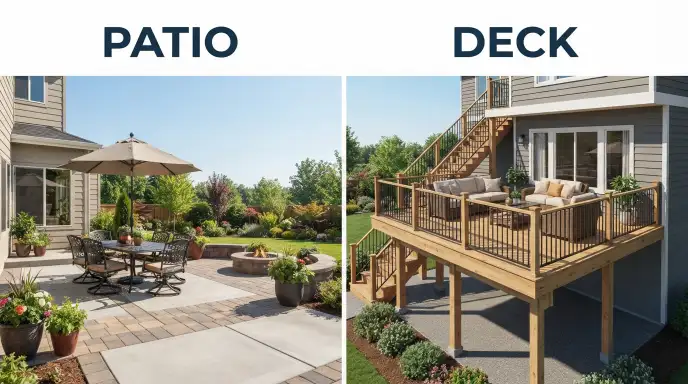
A patio is a ground-level outdoor living area, while a deck is usually a raised platform attached to or near a home. Both can create useful space for relaxing, dining, entertaining, and enjoying the outdoors, but they differ in construction, materials, height, cost, maintenance, and appearance.
People often search for patio or deck because the two terms describe similar outdoor spaces. A patio usually uses concrete, pavers, brick, or stone and rests directly on the ground. A deck typically uses wood, composite boards, or other decking materials and rests on a supporting frame.
The right choice depends on your property, budget, desired look, maintenance preferences, and how you plan to use the space. A patio can work especially well for homes with suitable ground-level space, while a deck can make better use of sloped yards or homes with elevated entrances.
This guide explains the differences clearly, compares their benefits and drawbacks, and helps you decide which option fits your home.
Patio or Deck: Featured Snippet Answer
A patio usually uses concrete, stone, brick, or pavers to create a ground-level outdoor space. A deck typically uses wood or composite materials to create a raised outdoor platform, with a structural frame supporting it.Patios are often easier to maintain, while decks can work well for elevated homes or sloped yards.
Patio or Deck: Quick Answer
The main difference between a patio and a deck comes from their construction and placement.
- Patio: Usually sits directly on the ground.
- Deck: Usually sits above the ground on a supporting structure.
- Patio materials: Concrete, pavers, brick, stone, and tile.
- Deck materials: Wood, composite, PVC, and other decking products.
- Patios: Often need less ongoing maintenance.
- Decks: Can provide useful space when a yard is uneven or sloped.
In short, choose a patio for a ground-level hardscape area and consider a deck when you want a raised outdoor platform.
What Does Patio or Deck Mean?
What Is a Patio?
A patio provides an outdoor area for sitting, eating, relaxing, or entertaining. Builders usually place patios at ground level or just above it.
Common patio materials include:
- Concrete
- Brick
- Natural stone
- Pavers
- Tile
- Gravel
You can attach a patio to your house or place it elsewhere in the yard.They can be simple or highly designed.
For example:
We put a table and chairs on the patio.
Here, the word patio refers to the outdoor area where people can sit and spend time.
What Is a Deck?
You can build a patio next to your house or place it anywhere else in the yard. It normally uses a structural frame, posts, beams, and decking boards.
Common deck materials include:
- Pressure-treated wood
- Cedar
- Redwood
- Composite decking
- PVC decking
A deck can sit slightly above the ground or several feet higher, depending on the house and property.
For example:
We built a deck outside the upstairs bedroom.
Use “deck” when the structure stands above the surrounding ground.
Are Patio and Deck Synonyms?
Not exactly.
Both can describe outdoor living spaces, but they are not interchangeable in every situation. Patio generally suggests a ground-level paved or hard-surfaced area. Deck usually suggests a raised platform with a supporting structure.
That physical difference is the easiest way to remember the terms.
The Origin of Patio and Deck
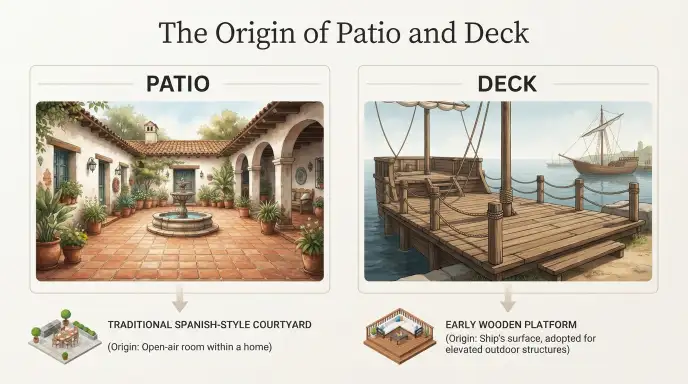
The two words have different linguistic histories.
Origin of Patio
Patio entered English from Spanish. The Spanish word patio referred to a courtyard or enclosed outdoor space.
Over time, English adopted the word to describe an outdoor area connected with or located near a home.
Today, patios can range from small paved sitting areas to large outdoor entertainment spaces.
Origin of Deck
Deck has a much older Germanic history. English has used the word in several senses over time, including the surface or platform of a ship.
The modern home-related meaning developed from the idea of a raised platform or structure.
Today, deck commonly refers to an outdoor platform attached to or near a building.
Although the words have different origins, both eventually became common terms for useful outdoor spaces.
British English vs American English
Both British and American English use the words patio and deck. The main difference often comes from how commonly people use each term and the type of outdoor space it describes.
| British English | American English | Example |
| patio | patio | We sat on the patio. |
| deck | deck | We built a deck behind the house. |
| garden patio | patio | The patio has stone paving. |
| decking | decking | The garden has new decking. |
In American English, patio is a very common term for a ground-level outdoor area. Deck is widely used for a raised structure.
British English also uses both terms, although garden, patio, and decking may appear frequently when discussing outdoor home spaces.
The exact terminology can also vary by region, property type, and building style.
Which Version Should You Use?
Unlike spelling pairs such as color and colour, patio and deck are not competing regional spellings. They describe different types of structures.
United States
Use patio for a ground-level outdoor area and deck for a raised platform.
Example: We are planning a new patio beside the kitchen.
Example: They added a deck to the back of the house.
United Kingdom
Both terms are standard. Use patio for a paved outdoor area and decking or deck for a raised boarded area.
Canada
Both words are commonly understood. Choose based on the structure rather than regional spelling.
Australia
People use both terms, but local building styles and regional vocabulary often influence which word they prefer.
International Writing
For an international audience, explain the structure if there could be confusion.
For example:
We built a raised wooden deck behind the house.
This gives readers a clear picture.
Academic Writing
Use the term that accurately describes the structure. Avoid treating patio and deck as exact synonyms.
Business Writing
For real estate, construction, landscaping, and home-improvement content, precise terminology is especially useful.
For example:
The property features a paved patio and a raised rear deck.
This tells the reader that the home has two different outdoor areas.
Common Mistakes
Mistake 1: Calling Every Outdoor Space a Patio
Incorrect: The house has a wooden patio raised six feet above the yard.
Better: The house has a raised wooden deck.
Explanation: People normally describe a raised wooden platform as a deck.
Memory tip: Think patio = ground, deck = raised.
Mistake 2: Assuming Every Deck Uses Wood
Incorrect idea: A composite outdoor platform cannot be a deck.
Correct idea: Builders commonly use composite materials for decks.
Explanation: The structure and intended use matter more than if the surface is natural wood.
Mistake 3: Treating Patio and Deck as Exact Synonyms
Incorrect: The terms always mean exactly the same thing.
Correct: Both refer to outdoor living spaces, but their construction and position usually differ.
Mistake 4: Using “Deck” for a Ground-Level Paved Area
Incorrect: We installed a stone deck beside the lawn.
Better: We installed a stone patio beside the lawn.
A stone-paved area sitting directly on the ground is generally a patio.
Everyday Examples
Emails
We are considering adding a patio to the backyard this summer.
Business Writing
The property includes a spacious patio and a raised deck overlooking the garden.
News Headlines
New Patio and Deck Trends for Modern Homes
Blogs
A small patio can transform an unused corner of your yard.
Social Media
Our new deck is finally ready for summer gatherings!
Academic Writing
The study examined how homeowners use patios and decks as outdoor living spaces.
Daily Conversation
Do you want to sit on the patio?
Let’s have dinner on the deck.
These examples show why choosing the right term can make your meaning clearer.
Patio vs Deck: Cost, Maintenance, and Design
The practical difference becomes even clearer when you compare their common characteristics.
| Feature | Patio | Deck |
| Typical position | Ground level | Raised |
| Common materials | Concrete, stone, brick, pavers | Wood, composite, PVC |
| Supports needed | Usually minimal structural framing | Posts, beams, and framing often needed |
| Suitable for slopes | May require grading or retaining work | Often useful on sloped yards |
| Maintenance | Often relatively low | Depends heavily on material |
| Design options | Paving patterns, stone, concrete finishes | Railings, stairs, boards, built-in seating |
| Access | Usually easy from ground level | May require stairs |
| Best use | Ground-level outdoor living | Raised outdoor living space |
Actual installation costs vary widely based on size, materials, labor, local conditions, permits, drainage, and site preparation. It is better to compare quotes for your specific property than to rely on a single general price.
Google Trends & Modern Usage
People search for patio or deck for several reasons. Some are trying to choose between the two for a home improvement project. Others want to understand the terminology before searching for contractors, materials, or design ideas.
The terms are also common in real estate and landscaping content.
Searchers may use phrases such as:
- patio vs deck
- deck or patio
- patio versus deck
- deck vs concrete patio
- patio or deck for backyard
- which is better, patio or deck
- deck or patio for a sloped yard
- patio and deck ideas
The growing interest in outdoor living has also made both terms common in home design discussions.
There is no need to invent exact search-volume statistics to understand the basic usage pattern. The central distinction remains consistent: a patio is generally ground-level, while a deck is generally raised.
Quick Comparison Table
| Version | Meaning | Correct? | Region | Example |
| Patio | Ground-level outdoor area | Yes | US, UK, international | We relaxed on the patio. |
| Deck | Raised outdoor platform | Yes | US, UK, international | We built a deck outside. |
| Patio vs deck | Comparison of two outdoor spaces | Yes | All varieties | Which is better for your yard? |
| Decking | Material or surface used for a deck | Yes | Especially common in UK usage | The decking needs cleaning. |
Key Takeaways
- A patio is generally a ground-level outdoor living area.
- A deck is generally a raised outdoor platform.
- Patios commonly use concrete, stone, brick, or pavers.
- Decks commonly use wood, composite, or similar decking materials.
- Both terms are used in British and American English.
- A sloped yard may make a raised deck especially practical.
- A level yard may be well suited to a patio.
- Choose the term that accurately describes the structure.
FAQs
Is a patio or deck better?
Neither is automatically better. A patio may suit a level yard and someone who wants a low-maintenance paved surface. A deck can be a better fit for a sloped property or an elevated part of a home. Your budget, design goals, maintenance preferences, and site conditions should guide the decision.
What is the main difference between a patio and a deck?
The biggest difference is their position and construction. A patio is generally built at ground level using materials such as concrete, stone, or pavers. A deck is generally a raised platform supported by a structural frame and surfaced with wood, composite, or similar decking materials.
Is a deck cheaper than a patio?
There is no universal answer because costs depend on materials, size, labor, site preparation, drainage, height, and local requirements. A simple patio can be relatively straightforward to install, while a raised deck may require more structural work. Compare project-specific estimates before choosing.
Does a patio add more value than a deck?
The effect on property value depends on the home, location, quality of construction, buyer preferences, and overall design. A well-built patio or deck can improve outdoor living space and appeal. However, neither should be viewed as a guaranteed investment with a fixed return.
Can a patio be raised?
Yes. Some patios can be slightly elevated or constructed on a raised base. However, once an outdoor structure becomes significantly elevated and uses a structural frame with posts and beams, it is more commonly described as a deck.
Can a deck be on the ground?
A deck is generally associated with a raised platform, but low-level decking can sit close to the ground. The terminology can vary based on construction and local usage. If the surface is a paved area installed directly on the ground, patio is usually the clearer term.
Is concrete a patio or a deck?
Concrete is commonly used for patios. A concrete outdoor area installed at ground level would normally be called a concrete patio. A deck usually has a framed structure and a surface made from decking materials rather than a solid concrete slab.
Is a wooden patio a deck?
People may casually use the phrase “wooden patio,” but a raised wooden outdoor platform is usually called a deck. The material alone does not determine the name, but the structure and position help distinguish the two.
Which is better for a sloped yard?
A deck can often work well on a sloped yard because its supporting structure can create a level outdoor surface above uneven ground. A patio may require substantial grading, retaining walls, or other site work to create a suitable level area.
Can you have a patio and a deck together?
Yes. A home can have both. For example, a property might have a ground-level stone patio connected to a raised wooden deck. Combining the two can create separate outdoor areas for dining, relaxing, cooking, or entertaining.
Conclusion
Choosing between a patio or deck starts with understanding how each structure works. A patio is generally a ground-level outdoor area made from materials such as concrete, stone, brick, or pavers. A deck is usually a raised platform supported by a structural frame and surfaced with wood, composite, or similar materials.
Neither option is automatically the best choice for every home. A patio can be a practical solution for a level yard and may offer simple maintenance and many paving options. A deck can make excellent use of sloped land or provide an elevated outdoor area connected to an upper level of a home.
The best choice depends on your property, intended use, design preferences, maintenance needs, and project budget. Think about drainage, access, stairs, privacy, shade, and the overall style of your home before making a decision.
Learn Grammar Better!

Hi, I’m Olivia Bennett, an English grammar and spelling content writer. I enjoy exploring confusing words, spelling differences, and everyday language questions. My goal is to share clear, simple, and helpful explanations that make English easier to understand.








3 thoughts on “Patio or Deck: Pros, Cons, and Key Differences”