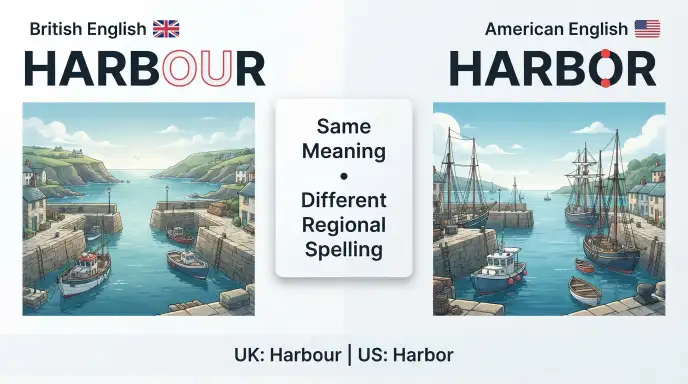
Harbour and harbor are both correct spellings, but “harbour” is standard in British English while “harbor” is standard in American English. The two words have the same meaning and refer to a sheltered place where ships and boats can stay safely. People often search for “harbour or harbor” because the spelling changes between major forms of English.
This difference is easy to miss because both forms sound the same and have the same meaning. The main issue is not grammar or pronunciation. It is regional spelling.
British English usually keeps the -our ending in words such as harbour, colour, and favour. American English often uses the shorter -or ending, as in harbor, color, and favor.
Understanding this pattern can help writers choose the right form for their audience. It also prevents inconsistent spelling in essays, websites, business documents, and published content.
This guide explains the meaning, origin, regional spelling rules, common mistakes, and everyday uses of harbour and harbor, so you can use the correct form with confidence.
Harbour or Harbor : Quick Answer
Harbour and harbor mean the same thing. The difference is regional spelling.
- Harbour = British English
- Harbor = American English
- Harbour is also common in other varieties influenced by British English.
- Harbor is the usual American spelling.
Examples
British English:
The fishing boats returned to the harbour.
American English:
The fishing boats returned to the harbor.
The meaning does not change. Only the spelling differs.
Definition and Meaning of Harbour or Harbor
What Does Harbour or Harbor Mean?
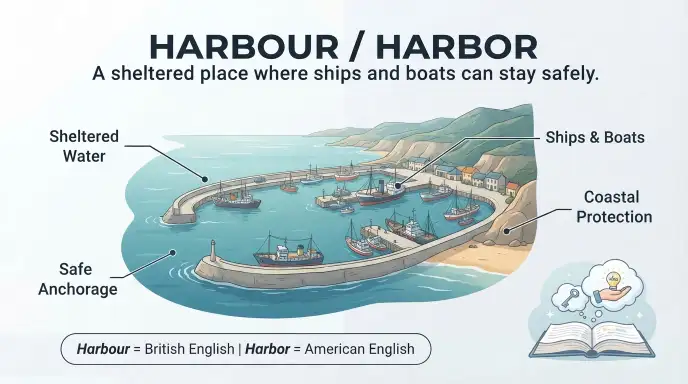
A harbour or harbor is a protected area of water where ships and boats can anchor, dock, or receive protection from rough weather.
For example:
The boats stayed in the harbour during the storm.
The word can refer to both natural and artificial protected areas.
Harbour or Harbor as a Verb
The word can also function as a verb.
In this use, it can mean to keep, hold, or conceal something, especially a thought, feeling, or person.
For example:
She harboured doubts about the plan.
In American English:
She harbored doubts about the plan.
The spelling changes by regional variety, but the meaning remains the same.
Different Contexts
The word can appear in several contexts:
- Maritime: a place where ships are protected
- Weather: a safe place during storms
- Emotions: to harbour or harbor feelings
- Thoughts: to harbour or harbor doubts
- People: to harbour or harbor someone, sometimes secretly
The context determines the exact meaning.
The Origin of Harbour or Harbor
The word has a long history in English.
Harbour comes from older Germanic language forms related to a place of shelter or lodging. Middle English developed forms such as herber and herberwe, which were influenced by Old English and Old Norse vocabulary.
Over time, the word developed into the modern English harbour.
Why Does American English Use Harbor?
The spelling harbor became standard in American English as spelling conventions developed in the United States.
American English often simplified certain words ending in -our by removing the u.
This created pairs such as:
| British English | American English |
| harbour | harbor |
| colour | color |
| favour | favor |
| honour | honor |
| labour | labor |
The pronunciation and basic meanings usually remain the same.
Is One Spelling Older?
The difference is mainly a matter of regional spelling convention. It does not mean that one modern form is grammatically better than the other.
British English vs American English Spelling
The standard regional forms are easy to remember:
| British English | American English | Example |
| harbour | harbor | The ship entered the harbour/harbor. |
| harboured | harbored | He harboured/harbored doubts. |
| harbouring | harboring | They were harbouring/harboring concerns. |
| harbourage | harborage | A place providing shelter for vessels. |
British English generally keeps the u in harbour.
American English normally removes it and uses harbor.
Related British and American Spelling Patterns
The same pattern appears in several common words:
- colour → color
- honour → honor
- favour → favor
- labour → labor
- neighbour → neighbor
However, not every word ending in -our follows exactly the same pattern, so writers should check less common words when unsure.
Which Spelling Should You Use?
The best spelling depends on your audience.
United States
Use harbor.
Example:
The ship entered the harbor before sunset.
This is the standard American form.
United Kingdom
Use harbour.
Example:
The ship entered the harbour before sunset.
Canada
Canadian English often follows British-style spelling for words such as harbour, although usage can vary by context and style guide.
Australia
Harbour is the standard spelling in Australian English.
International Writing
For international audiences, choose one English variety and use it consistently.
If your content follows British English, use harbour.
If it follows American English, use harbor.
Academic Writing
Follow the spelling system required by your institution, instructor, publisher, or style guide.
Consistency is more important than switching between the two forms.
Business Writing
Use the spelling that matches your company’s target market.
For a US audience, use harbor.
For a UK audience, use harbour.
Common Mistakes with Harbour or Harbor
Mistake 1: Thinking One Is Incorrect
Incorrect assumption:
Harbor is always wrong.
Correct:
Harbor is the standard American spelling.
Likewise, harbour is correct in British English and several other varieties.
Mistake 2: Mixing Regional Spellings
A writer may use harbour in one paragraph and harbor in another.
This can make the writing look inconsistent.
Better approach: Choose one regional variety and keep it throughout the document.
Mistake 3: Confusing the Noun and Verb
The word can describe a protected place or the act of keeping something.
Noun:
The fishing boats were safe in the harbour.
Verb:
She harboured doubts about the decision.
Mistake 4: Forgetting Related Forms
The same regional difference appears in related forms.
British:
- harbour
- harboured
- harbouring
American:
- harbor
- harbored
- harboring
Memory Tip
Think:
British English = HARBOUR
American English = HARBOR
The British form keeps the U.
Harbour or Harbor in Everyday Examples
In Emails
British English:
The shipment will arrive at the harbour tomorrow.
American English:
The shipment will arrive at the harbor tomorrow.
In Business Writing
The company operates a shipping facility near the harbor.
Or, for British English:
The company operates a shipping facility near the harbour.
In News Headlines
Storm Forces Boats Into Harbor
A British publication may write:
Storm Forces Boats Into Harbour
In Blogs
The old harbour is one of the most popular tourist attractions in the city.
On Social Media
“The sunset over the harbor was amazing!”
In Academic Writing
“The study examines how the harbour developed as a major trading location.”
As a Verb
“He harboured concerns about the proposed changes.”
In American English:
“He harbored concerns about the proposed changes.”
Harbour or Harbor – Google Trends & Usage Data
Search interest for harbour and harbor varies by country because the two forms are closely connected to regional English.
People in the United States are more likely to search for and write harbor, while users in the United Kingdom, Australia, and other regions that follow British spelling are more likely to use harbour.
Search interest can also depend on the meaning of the word. People may search for the term because they are interested in:
- Ports
- Shipping
- Travel
- Tourism
- Geography
- Weather
- Maritime history
- Grammar and spelling
- British versus American English
Search results can therefore reflect more than spelling questions.
Exact Google Trends numbers also depend on the selected country, time period, and search category. Without a defined date range and region, it is better to discuss the pattern rather than claim specific search-volume figures.
Quick Comparison Table
| Version | Meaning | Correct? | Region | Example |
| Harbour | Protected place for ships | Yes | UK, Australia, and other British English varieties | The boat entered the harbour. |
| Harbor | Protected place for ships | Yes | United States | The boat entered the harbor. |
| Harboured | Kept or held something | Yes | British English | She harboured doubts. |
| Harbored | Kept or held something | Yes | American English | She harbored doubts. |
| Harbouring | Keeping or holding something | Yes | British English | They were harbouring concerns. |
| Harboring | Keeping or holding something | Yes | American English | They were harboring concerns. |
Key Takeaways
- Harbour and harbor have the same meaning.
- Harbour is the standard British English spelling.
- Harbor is the standard American English spelling.
- Australian English generally uses harbour.
- The difference is a regional spelling variation, not a difference in meaning.
- The word can be a noun or a verb.
- Related forms also change: harboured/harbored and harbouring/harboring.
- Choose the spelling that matches your target audience.
- Keep one regional spelling consistent throughout your writing.
FAQs About Harbour or Harbor
Is harbour or harbor correct?
Both are correct. Harbour is the standard British English spelling, while harbor is the standard American English spelling. They have the same meaning and pronunciation.
Is harbor American or British?
Harbor is the standard American English spelling. British English normally uses harbour, with a u.
Do harbour and harbor mean the same thing?
Yes. Both can refer to a protected place where ships and boats stay. They can also be verbs meaning to keep or hold something, such as a feeling, thought, or doubt.
Is harbour used in British English?
Yes. Harbour is the standard British English form. It is also commonly used in Australian English and other varieties influenced by British spelling.
Why does American English spell harbor without a u?
American English simplified several words ending in -our, producing forms such as harbor, color, favor, and honor. The meanings generally stayed the same.
How do you spell harbour in American English?
In American English, the spelling is harbor. The u is removed from the British form.
Which spelling should I use in an international article?
Choose the spelling that matches your site’s preferred English variety. If you use American English, choose harbor. If you use British English, choose harbour, and remain consistent.
Does the pronunciation change?
No. In standard English, harbour and harbor are pronounced the same. The difference is in spelling, not the basic pronunciation.
Conclusion
Harbour and harbor are both correct spellings of the same word. The main difference is regional. British English uses harbour, while American English uses harbor. Australian English and several other varieties that follow British spelling also commonly use harbour.
Both forms can work as a noun for a sheltered place where boats and ships can stay. They can also work as verbs when describing the act of keeping a thought, feeling, doubt, or person. Related forms follow the same regional pattern, such as harboured/harbored and harbouring/harboring.
Explore More Spelling Guides!

Hi, I’m Olivia Bennett, an English grammar and spelling content writer. I enjoy exploring confusing words, spelling differences, and everyday language questions. My goal is to share clear, simple, and helpful explanations that make English easier to understand.








2 thoughts on “Harbour or Harbor: Meaning, Spelling, and Usage”