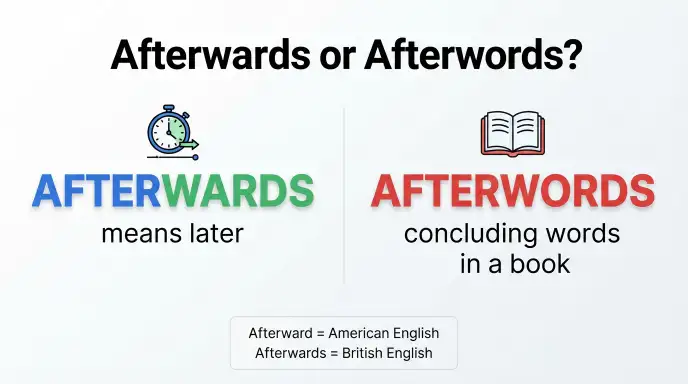
If you mean “later” or “at a later time,” the correct word is afterwards. Afterwords is also a real word, but it has a completely different meaning. It is the plural form of afterword, a concluding section or commentary at the end of a book or other written work.
These two words are easy to confuse because they sound very similar. The spelling difference, however, changes the meaning. Afterwards is an adverb that tells us when something happens, while afterwords refers to written words or sections that appear at the end of a work.
For example, you might say, “We went for coffee afterwards,” because the coffee happened later. But you could say, “The author included two afterwords in the new edition,” when referring to concluding sections of a book.
In this guide, you will learn the meanings, origins, regional differences, common mistakes, and practical ways to remember which form to use.
Afterwards or Afterwords: Featured Snippet Answer
Afterwards means “later” or “after that” and is the correct choice when talking about something that happens later. Afterwords is the plural of afterword, meaning concluding sections or comments at the end of a book or other work. In American English, afterward without the s is also commonly used.
Afterwards or Afterwords: Quick Answer
The choice depends on what you want to say.
- Afterwards = later, after something happens
- Afterword = a section at the end of a book
- Afterwords = more than one afterword
Examples
Correct: We went home afterwards.
Correct: The book contains two afterwords.
Incorrect: We went home afterwords.
The easiest test is to ask if you are talking about time or written words.
If you mean later, use afterwards.
If you mean concluding written sections, use afterwords.
What Does Afterwards Mean?
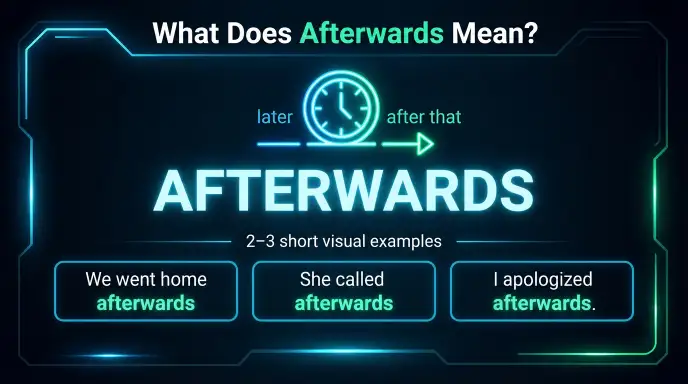
Afterwards is an adverb that means at a later time or after an event that has already been mentioned. It tells the reader or listener when something happens. Cambridge Dictionary lists afterwards as mainly British, while American English usually uses afterward.
For example:
- We had dinner and went for a walk afterwards.
- She called me afterwards.
- I realized my mistake afterwards.
- They moved to another city shortly afterwards.
In each sentence, afterwards refers to a later point in time.
The word can appear at the beginning, middle, or end of a sentence.
Afterwards, we went back to the hotel.
We afterwards discovered that the meeting had been canceled.
We went back to the hotel afterwards.
The last position is especially natural in everyday English.
Afterwards vs. Afterward
There is another spelling you may see: afterward.
The two forms have the same basic meaning. Oxford notes that afterwards is especially British English, while North American English usually uses afterward.
So these sentences have the same meaning:
- We talked afterwards.
- We talked afterward.
The preferred form depends mainly on regional style.
What Does Afterwords Mean?
Afterwords is the plural form of afterword. An afterword is a section at the end of a book that provides additional comments, background, explanation, or reflection about the main text. Oxford defines it as a section at the end of a book that discusses the main text and may be written by a different author.
For example:
- The new edition includes two afterwords.
- The editor added several afterwords to the collection.
- I always read the afterword after finishing a novel.
Here, afterwords has nothing to do with the timing of an event.
It refers to words or sections that come at the end of a written work.
Singular and plural
| Singular | Plural | Meaning |
| afterword | afterwords | A concluding section or commentary |
| afterword | afterwords | One or more sections at the end of a work |
An afterword is somewhat similar to an epilogue, but the terms are not always interchangeable. An afterword generally provides commentary or additional information about the work rather than continuing the story itself.
The Origin of Afterwards and Afterwords
The two forms developed from different word structures.
Afterwards has a long history in English. Oxford traces it to Old English æftewearde, with the modern form developing through the influence of after and the suffix -wards.
The ending -wards appears in several English words that describe direction or movement.
Examples include:
- towards
- forwards
- backwards
- homewards
- afterwards
This helps explain why afterwards ends in -wards, rather than -words.
By contrast, afterword is formed from after + word. The term refers literally to words or commentary that come after the main text. Dictionary sources date the word to the late 19th century.
That distinction provides a useful spelling clue:
after + wards = afterwards → later
after + word = afterword → concluding section
British English vs American English
The main regional difference concerns afterwards and afterward, not the meaning of afterwords.
| British English | American English | Example |
| afterwards | afterward | We talked afterwards/afterward. |
| afterwards | afterward | She left shortly afterwards/afterward. |
| afterword | afterword | The book has an afterword. |
| afterwords | afterwords | The book contains several afterwords. |
Cambridge identifies afterwards as mainly UK usage and afterward as US usage. Collins also notes that afterward is used mainly in American English.
Both afterwards and afterward are standard English forms.
What about afterwords?
Afterwords is a separate noun form. It does not become afterword simply because you are writing in American English.
For example:
British: I read the afterword.
American: I read the afterword.
The noun remains the same.
Which Version Should You Use?
Your choice depends on the meaning and, in the case of afterwards, your preferred variety of English.
United States
Use afterward in most American English writing.
Example: We discussed the problem afterward.
Afterwards is still understood and used, but afterward is the usual American preference.
United Kingdom
Use afterwards.
Example: We went out for dinner afterwards.
This is the standard form commonly associated with British English.
Canada
Both forms can occur. If you are following an American-oriented style, afterward may be a natural choice. If your writing follows British-influenced conventions, afterwards may fit better.
Australia
Afterwards is widely familiar and natural in Australian English. Consistency matters more than trying to change between forms within the same piece.
International Writing
For a global audience, either afterwards or afterward is clear.
If you want a very simple neutral alternative, you can often use later or after that.
Academic Writing
Follow the style guide or regional variety required by your institution.
For example:
The researchers reviewed the results afterwards.
There is nothing informal about the word itself.
Business Writing
Choose one form and use it consistently.
The team met afterward to discuss the proposal.
Or:
The team met afterwards to discuss the proposal.
Both are clear. Regional consistency is the key.
Common Mistakes
Mistake 1: Using “afterwords” to mean “later”
Incorrect: We went home afterwords.
Correct: We went home afterwards.
Why? The sentence describes when the action happened. You need the adverb afterwards.
Mistake 2: Forgetting the meaning of “afterword”
Incorrect: I read the afterword after finishing the novel, and it explained the author’s research.
This sentence is actually correct because afterword refers to a concluding section.
The confusion happens when writers assume afterword means “afterward.”
Mistake 3: Writing “after wards”
Incorrect: We talked after wards.
Correct: We talked afterwards.
Why? The adverb is written as one word.
Mistake 4: Confusing “afterwords” with “afterward”
Incorrect: She apologized afterwords.
Correct: She apologized afterward.
Memory tip: If you can replace the word with later, use afterward or afterwards.
If you are talking about actual words at the end of a book, use afterword or afterwords.
Everyday Examples
Emails
Correct: I will send the documents afterwards.
American English: I will send the documents afterward.
Business Writing
Correct: The manager spoke to the employees afterwards.
American English: The manager spoke to the employees afterward.
News Headlines
Correct: The company issued a statement shortly afterwards.
Here, the word refers to a later event.
Blogs
Correct: I tried the recipe and wrote about my experience afterwards.
Social Media
Correct: We went out for dinner afterwards.
This is a common conversational use.
Academic Writing
Correct: The participants completed the survey and were interviewed afterwards.
Daily Conversation
Correct: Let’s grab coffee afterwards.
Correct: I’ll call you afterward.
These examples show how naturally the word fits into everyday speech.
Examples With Afterword
Correct: The author explains the research in an afterword.
Correct: The revised edition contains two afterwords.
In these sentences, the word refers to material at the end of a book.
Google Trends & Modern Usage
Searches for afterwards or afterwords usually come from a spelling or word-choice confusion. The two forms sound similar, so learners may wonder if afterwords is simply another spelling of afterwards.
It is not.
Modern dictionary usage shows a clear distinction. Afterwards is an adverb meaning “at a later time,” while afterword is a noun referring to a concluding section of a book or similar work.
Regional usage also explains some of the confusion. British English commonly uses afterwards, while American English generally prefers afterward.
Exact search-volume figures can change over time, so no fixed statistics are necessary to understand the language difference.
The practical rule is simple:
Talking about time? Use afterwards or afterward.
Talking about concluding written material? Use afterword or afterwords.
Quick Comparison Table
| Version | Meaning | Correct? | Region | Example |
| afterwards | At a later time | Yes | Especially UK | We left afterwards. |
| afterward | At a later time | Yes | Especially US | We left afterward. |
| afterword | A concluding section | Yes | All major varieties | I read the afterword. |
| afterwords | More than one concluding section | Yes | All major varieties | The book has two afterwords. |
| afterwords | Means “later” | No | None | ❌ We left afterwords. |
Key Takeaways
- Afterwards means “later” or “after that.”
- Afterward has the same meaning and is especially common in American English.
- Afterword is a noun for a concluding section of a book.
- Afterwords is the plural of afterword.
- Do not use afterwords when you mean “later.”
- British English commonly prefers afterwards.
- American English usually prefers afterward.
- Remember -wards = time/direction and word = written material.
FAQs
Is “afterwards” the correct spelling?
Yes. Afterwards is the correct spelling when you mean “later” or “after that.” It is especially common in British English. American English generally uses afterward, which has the same meaning.
Is “afterwords” ever correct?
Yes. Afterwords is a correct word when it is the plural of afterword. It refers to multiple concluding sections or pieces of commentary at the end of books or other works.
Is “afterwards” American or British?
Afterwards is especially associated with British English. American English usually prefers afterward, although Americans do also understand and use afterwards.
Is “afterward” or “afterwards” more correct?
Neither is universally more correct. Both are standard forms meaning “later.” Afterward is more common in American English, while afterwards is especially common in British English.
What does “afterword” mean?
An afterword is a section at the end of a book that discusses or adds information about the main text. It may be written by the original author or another writer.
What is the plural of “afterword”?
The plural is afterwords. For example: “The new edition includes several afterwords.” The word refers to multiple concluding sections or commentaries.
Can “afterwords” mean “afterward”?
No. Afterwords and afterward have different meanings. Use afterward or afterwards when describing something that happens later. Use afterwords for multiple concluding sections of a written work.
How can I remember the difference?
Think about the final letters. Afterwards contains -wards, like towards and forwards. Afterwords contains words, so it can refer to actual words at the end of a book.
Is “afterwards” one word?
Yes. Afterwards is written as one word. Forms such as after wards and after-wards are not the standard spelling when you mean “later.”
Is “afterword” the same as “epilogue”?
Not exactly. An afterword usually provides commentary or additional information about a work, while an epilogue is generally a concluding part of a narrative. They can serve similar purposes, but they are not identical terms.
Conclusion
The difference between afterwards and afterwords is simple once you focus on meaning. Afterwards is an adverb that means “later” or “after that.” It tells us when something happens. Afterwords, on the other hand, is the plural of afterword, a noun referring to concluding sections or commentary at the end of a book or another written work.
There is also a regional spelling difference worth remembering. British English commonly uses afterwards, while American English usually prefers afterward. Both forms are standard and have the same basic meaning.
When writing, ask yourself one quick question: Am I talking about time or words? If you mean “later,” choose afterwards or afterward. If you mean concluding written material, choose afterword or afterwords.
Discover More About Correct Spelling!

I’m Ethan Carter, a grammar-focused writer and English language enthusiast at SpellGrammar. I enjoy explaining confusing words, spelling differences, and grammar rules in clear, simple language. My goal is to help readers write with greater accuracy and confidence in everyday and professional English.








1 thought on “Afterwards or Afterwords: Meaning and Usage”