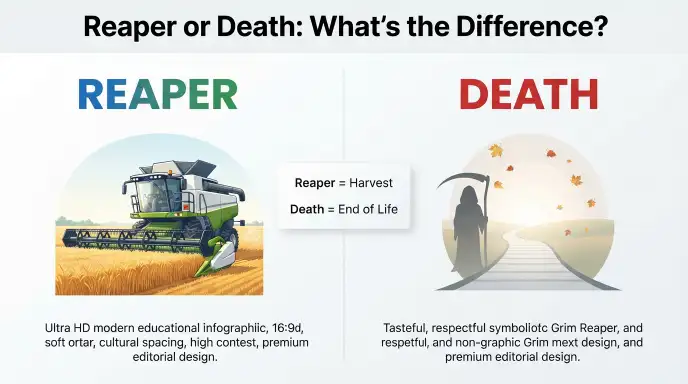
Death is a universal idea, but English gives us more than one way to talk about it. Reaper and death are related, but they do not mean exactly the same thing. The word death refers to the end of life, while reaper can mean a person or machine that harvests crops. In the phrase “Grim Reaper,” however, reaper becomes a personification of death.
People often search for reaper or death because the two words appear together in stories, poems, games, songs, myths, and everyday expressions. The confusion usually comes from the familiar image of the Grim Reaper, a figure traditionally shown carrying a scythe. In that context, reaper represents death, but it is not a general replacement for the word death.
Knowing this difference helps you choose the right word. Death works when you mean the end of life. Reaper works when you mean a harvester or, in literary and cultural contexts, a figure that represents death. The guide below explains their meanings, history, usage, regional spelling, common mistakes, and practical examples.
Reaper or Death: Featured Snippet & AI Overview
Reaper and death are related but different words. Death means the end of life, while reaper normally means a person or machine that harvests crops. In “the Grim Reaper,” the word reaper refers to a personification or symbolic figure of death. Therefore, reaper should not normally replace death in ordinary sentences.
Reaper or Death – Quick Answer
The simplest difference is:
- Death = the end of life.
- Reaper = a person or machine that cuts and gathers crops.
- Grim Reaper = a traditional personification of death.
For example:
“The family was deeply affected by his death.”
Here, death directly describes the end of a person’s life.
“The farmer used a reaper to harvest the grain.”
Here, reaper refers to agricultural equipment.
“The Grim Reaper appeared in the story.”
Here, reaper is part of a symbolic name for death.
So, if you are talking about the actual end of life, death is usually the correct word. If you are talking about a harvester or a symbolic figure, reaper may be appropriate.
What Does Reaper or Death Mean?
What Does Reaper Mean?
Reaper is a noun. In its literal sense, it means a person or machine that cuts and collects crops. Cambridge Dictionary defines a reaper as either a machine or a person that cuts and collects crops.
Examples include:
- a grain reaper
- a mechanical reaper
- a person working as a reaper
- a reaping machine
The word also has a well known figurative use in “the Grim Reaper.”
The Grim Reaper is a personified figure representing death. It is often imagined as a skeletal figure wearing a dark robe and carrying a scythe.
What Does Death Mean?
Death is a noun that means the end of life. It can refer to the death of a person, animal, or other living thing.
For example:
“The doctor confirmed his death.”
The word can also appear in broader expressions.
“The death of the old tradition changed the community.”
Here, death is used figuratively to describe the end of something rather than the death of a person.
Are Reaper and Death Synonyms?
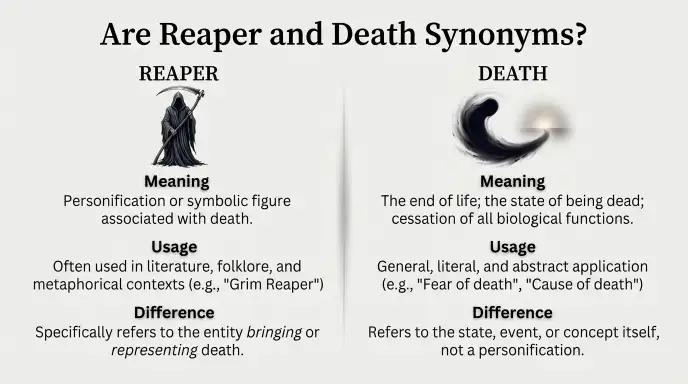
Not exactly.
A dictionary may connect Grim Reaper with the idea of death, but reaper alone has a broader and more literal meaning. A reaper can be an agricultural worker or machine.
This distinction matters in clear writing.
The Origin of Reaper or Death
The Origin of Reaper
The word reaper comes from the verb reap, which means to cut and gather crops. Historical records show reaper in Middle English, with the agricultural sense referring to someone who cuts grain. The word later developed another important meaning as the name of a machine used to cut grain.
The figurative association with death developed later. Etymological records date the use of reaper as a personification of death to the early 19th century, including an attested use from 1818.
This development helps explain the connection between harvesting and death. A harvest involves cutting down crops when they are ready. English speakers could use that image symbolically to represent the end of human life.
The Origin of Death
Death is a much older English word. It has been used for centuries to describe the end of life.
Unlike reaper, it does not need a symbolic figure to express its basic meaning. It directly names the state or event of no longer being alive.
This gives the two words different roles:
reaper → harvester → symbolic figure
death → end of life
British English vs American English
There is no major British American spelling difference between reaper and death. Both words are spelled the same in standard British and American English.
| Term | British English | American English | Example |
| Reaper | reaper | reaper | “The reaper harvested the crop.” |
| Death | death | death | “The death was unexpected.” |
| Grim Reaper | Grim Reaper | Grim Reaper | “The Grim Reaper appeared in the story.” |
| Reaping | reaping | reaping | “The workers began reaping the field.” |
The main difference is therefore meaning and context, not spelling.
British and American writers can use reaper for agricultural machinery and death for the end of life. Both varieties also recognize the Grim Reaper as a cultural image of death.
For publishing, academic writing, and professional content, the same basic distinction applies in both varieties of English.
Which Version Should You Use?
United States
Use death when you mean the end of life.
A reaper refers to harvesting equipment or a person who gathers crops, while Grim Reaper is used for the symbolic figure associated with death.
United Kingdom
The same distinction applies. British readers will understand reaper as a harvester and death as the end of life.
Canada
Canadian English generally follows the same spelling and meaning distinction. Context determines which word is appropriate.
Australia
Australian readers also recognize both words in their standard meanings. Choose reaper for harvesting and death for the end of life.
International Writing
For a global audience, avoid using reaper alone when you mean death. The phrase Grim Reaper is much clearer when referring to the symbolic figure.
Academic Writing
Use death when discussing mortality or the end of life. Use reaper only when the agricultural or symbolic meaning is relevant.
Business Writing
Avoid poetic expressions such as the reaper when writing about serious real world events. Death is clearer and more professional.
Common Mistakes with Reaper or Death
Mistake 1: Using Reaper as a Direct Replacement for Death
Incorrect:
“The man’s reaper was unexpected.”
Correct:
“The man’s death was unexpected.”
Explanation: Reaper does not normally mean the event of dying.
Memory tip: Death is the event. Reaper is the harvester or symbolic figure.
Mistake 2: Forgetting “Grim”
Incorrect:
“The Grim appeared at the end of the story.”
Correct:
“The Grim Reaper appeared at the end of the story.”
Explanation: The traditional expression is Grim Reaper.
Memory tip: Think Grim + Reaper = symbolic death figure.
Mistake 3: Assuming Every Reaper Means Death
Incorrect:
“The farmer saw death working in the field.”
Correct:
“The farmer saw a reaper working in the field.”
Explanation: In an agricultural context, a reaper can simply be a person or machine used to harvest crops.
Mistake 4: Confusing Literal and Figurative Meaning
Incorrect:
“The reaper harvested the farmer’s life.”
Correct:
“The Grim Reaper represents death in the story.”
Explanation: The death related meaning of reaper is normally figurative and connected to the Grim Reaper.
Reaper or Death in Everyday Examples
Emails
Death:
“We are sorry to hear about the death of your colleague.”
This is direct and appropriate for professional communication.
Reaper:
“The equipment includes a modern crop reaper.”
Here, reaper has its literal agricultural meaning.
Business Writing
“The company reported several deaths following the accident.”
The word death is direct and factual.
“The new reaper reduced the time needed to harvest the crop.”
Here, reaper refers to machinery.
News Headlines
“Family Mourns Unexpected Death”
This uses death in its direct meaning.
“Farmers Adopt New Reaper Technology”
This uses reaper in an agricultural context.
Blogs
“The Grim Reaper has appeared in many works of fiction.”
This is appropriate when discussing the cultural image of death.
Social Media
“That movie’s version of the Grim Reaper was terrifying.”
The phrase works naturally in a casual discussion about fiction.
Academic Writing
“The novel uses the Grim Reaper as a symbol of mortality.”
Here, reaper refers to a literary symbol rather than a literal person.
Daily Conversation
“His death was a shock to everyone.”
But:
“The farmer bought a new reaper.”
The surrounding context makes the intended meaning clear.
Google Trends & Modern Usage
Searches involving “reaper or death” can come from several different interests. Some users want a vocabulary comparison. Others may be searching for the meaning of Grim Reaper, literary symbolism, mythology, games, music, or fictional characters.
The word death has a broad everyday use because it directly describes the end of life. Cambridge lists death as the end of life and also records several common expressions built around the word.
The word reaper has a more specialized literal meaning. It is associated with agriculture and harvesting equipment, while its death related use is strongly linked to the phrase Grim Reaper.
Exact search volume comparisons change over time and by country. Without a defined Google Trends date range and dataset, it would be misleading to provide exact percentages or rankings.
The main modern usage pattern is clear: death is the ordinary word for the end of life, while reaper becomes associated with death mainly through the Grim Reaper image.
Quick Comparison Table
| Version | Meaning | Correct? | Region | Example |
| Death | End of life | Yes | Worldwide English | “His death was unexpected.” |
| Reaper | Person or machine that harvests crops | Yes | Worldwide English | “The reaper cut the grain.” |
| Grim Reaper | Personification of death | Yes | Worldwide English | “The Grim Reaper appeared in the tale.” |
| Reaper = death | Direct synonym | Usually no | All regions | Avoid in ordinary writing |
| Death = reaper | Direct synonym | No | All regions | Use only in symbolic contexts |
Key Takeaways
- Death means the end of life.
- Reaper literally means a person or machine that harvests crops.
- The Grim Reaper is a symbolic personification of death.
- Reaper and death are related but are not interchangeable in ordinary writing.
- Both words have the same spelling in British and American English.
- Use death for clear, direct writing about the end of life.
- Use reaper for agricultural contexts.
- Use Grim Reaper when discussing the traditional symbolic figure.
FAQs About Reaper or Death
Is reaper another word for death?
Not usually. Reaper literally refers to someone or something that harvests crops. It becomes associated with death through the expression Grim Reaper, a personification of death. Therefore, reaper should not normally replace death in a sentence about someone dying.
Does the Grim Reaper mean death?
Yes. The Grim Reaper is a traditional personification or symbolic representation of death. The figure is often imagined as a skeletal character carrying a scythe. The word reaper connects this figure to the idea of harvesting, creating a metaphor for the end of human life.
What is the difference between a reaper and the Grim Reaper?
A reaper can be a person or machine that cuts and collects crops. The Grim Reaper is a symbolic figure representing death. The capitalized phrase has a specific cultural meaning, while the lowercase word reaper normally has its agricultural meaning.
Is death a synonym for reaper?
No. Death means the end of life, while reaper normally means a harvester. They become closely connected only when reaper appears in the expression Grim Reaper. In ordinary writing, replacing death with reaper can make the sentence incorrect or confusing.
Why is death called the Grim Reaper?
The image connects death with harvesting. A reaper cuts and gathers crops, while the Grim Reaper symbolically “reaps” human lives. This metaphor developed into the familiar cultural image of a mysterious figure carrying a scythe. The death related use of reaper as a personification is documented from the early 19th century.
Is reaper a British or American word?
Reaper is used in both British and American English. Its spelling does not change between the two varieties. The same is true of death.
Can reaper mean a farmer?
A reaper can refer to a person who cuts and gathers crops, so the word can describe someone performing agricultural work. However, reaper does not simply mean “farmer.”
What does “meet the reaper” mean?
In figurative language, an expression involving the reaper may refer to dying or facing death. The meaning comes from the Grim Reaper image.
Is the Grim Reaper real?
The Grim Reaper is a cultural and symbolic figure, not a literal person. Different cultures have used different images or figures to represent death.
Should I use death or reaper in formal writing?
Use death when you mean the end of life. It is direct and clear. Use reaper only when the agricultural meaning or the symbolic idea of the Grim Reaper is relevant.
Conclusion
Reaper and death are connected, but they are not interchangeable words. Death directly means the end of life, while reaper normally refers to a person or machine that cuts and collects crops. The strong connection between the two comes from the Grim Reaper, a traditional personification of death.
The history of reaper helps explain this connection. The word developed from reap, an agricultural verb, and later gained a figurative association with death. Historical etymological records place the personification of death sense in the early 19th century.
For clear writing, choose death when discussing the end of life. Choose reaper when talking about harvesting, and use Grim Reaper when referring to the symbolic figure. This distinction works in British, American, Canadian, Australian, and international English.
Explore Grammar Topics!

Hi, I’m Olivia Bennett, an English grammar and spelling content writer. I enjoy exploring confusing words, spelling differences, and everyday language questions. My goal is to share clear, simple, and helpful explanations that make English easier to understand.








2 thoughts on “Reaper or Death: Understanding the Difference”