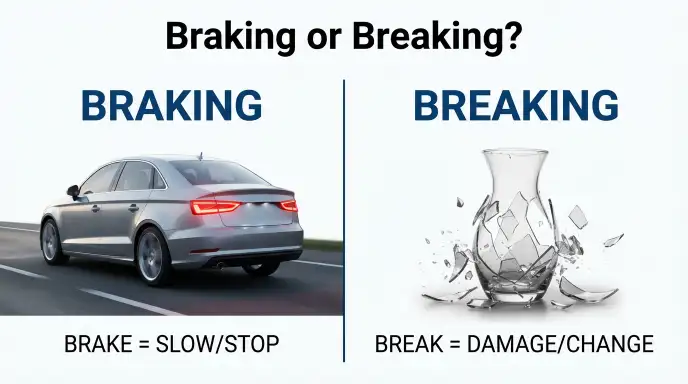
Braking is correct when you mean slowing or stopping with a brake, while breaking is correct when you mean damaging, separating, interrupting, or violating something.
These two words are easy to confuse because they sound the same. They are homophones, but they come from different words and have different meanings. For example, a driver is braking when slowing a car, while a child is breaking a toy when damaging it.
People often search for “braking or breaking” because one small spelling difference can completely change the meaning of a sentence. The confusion is especially common in phrases related to cars, news, rules, records, and everyday actions.
The easiest way to remember the difference is to connect braking with brake and breaking with break. If something is slowing down because a brake is being used, choose braking. If something is being damaged, interrupted, separated, or violated, choose breaking.
This guide explains both words, their meanings, origins, spelling rules, common mistakes, and everyday examples.
Braking or Breaking : Quick Answer
Both braking and breaking are correct words, but they have different meanings.
- Braking = slowing or stopping with a brake.
- Breaking = damaging, separating, interrupting, violating, or changing something.
Examples
- The driver was braking before the sharp turn.
- The child was breaking the old toy.
- The car has excellent braking performance.
- He was breaking the rules.
Easy Memory Trick
Braking → brake → slow or stop
Breaking → break → damage, separate, interrupt, or violate
If you are talking about a car, bicycle, train, or another machine slowing down, use braking.
If you are talking about something being damaged, divided, interrupted, or violated, use breaking.
Definition and Meaning of Braking or Breaking
What Does “Braking” Mean?
Braking is the present participle or gerund form of brake.
To brake means to slow down or stop a vehicle or machine by using a brake.
Simple meaning:
Braking means slowing or stopping movement.
Examples of Braking
- The driver is braking suddenly.
- The bike has a strong braking system.
- Heavy rain can affect braking performance.
- The train began braking near the station.
The word is especially common in transportation, driving, and engineering.
What Does “Breaking” Mean?
Breaking is the present participle or gerund form of break.
The verb break has many meanings. It can mean damaging something, separating something into pieces, interrupting something, violating a rule, or ending something.
Simple meaning:
Breaking can mean damaging, separating, interrupting, or violating something, depending on the context.
Examples of Breaking
- He is breaking the glass.
- She is breaking the rules.
- The news is breaking around the world.
- They are breaking the record.
- The machine is breaking down.
Braking vs Breaking at a Glance
| Word | Comes From | Main Meaning | Example |
| Braking | Brake | Slowing or stopping | The driver is braking. |
| Breaking | Break | Damaging or interrupting | She is breaking the glass. |
| Braking | Brake | Controlling speed | The car needs better braking. |
| Breaking | Break | Violating a rule | He is breaking the law. |
The key difference is the base word:
Brake → Braking
Break → Breaking
The Origin of Braking or Breaking
The words brake and break have different histories and developed into separate words with different meanings.
The word break comes from an old English word meaning to divide or separate something. Over time, it gained many related meanings. Today, break can describe damaging an object, interrupting an activity, violating a rule, ending a connection, or changing a record.
The word brake developed a different meaning connected with controlling movement. A brake is a device used to slow down or stop a moving object, especially a vehicle.
The verb brake comes from this noun. Therefore, braking simply means the action of using a brake.
This difference explains the spelling:
- Brake → braking
- Break → breaking
Although the words sound alike, their spellings help show their different meanings.
English contains many words that sound alike but have different spellings. Braking and breaking are a good example of this pattern.
British English vs American English Spelling
There is no major British American spelling difference between braking and breaking.
Both forms are standard in:
- British English
- American English
- Canadian English
- Australian English
- International English
The difference is based on meaning, not location.
| Meaning | British English | American English |
| Slowing with a brake | Braking | Braking |
| Damaging something | Breaking | Breaking |
| Slowing a vehicle | Braking | Braking |
| Violating a rule | Breaking | Breaking |
| Breaking a record | Breaking | Breaking |
British English Example
The driver was braking before the junction.
American English Example
The driver was braking before the intersection.
The spelling braking stays the same.
Likewise:
She is breaking the rules.
This sentence is correct in both British and American English.
So, unlike words such as colour/color or centre/center, braking and breaking do not change spelling between British and American English.
Which Spelling Should You Use?
Choose the spelling according to the meaning of the sentence, not the country of your audience.
For US English
Use braking when discussing vehicles or slowing movement.
The new car has excellent braking performance.
Use breaking for the different meanings of break.
He was breaking the old box.
For UK and Commonwealth English
The same rule applies.
The cyclist started braking before the corner.
The child was breaking the toy.
For Global Writing
If you write for an international audience, focus on the base word.
Ask yourself:
Does this come from “brake”?
If yes, use braking.
Does this come from “break”?
If yes, use breaking.
This simple test works across different forms of English.
Common Mistakes with Braking or Breaking
1. Using “breaking” for a vehicle
❌ The driver was breaking before the corner.
✅ The driver was braking before the corner.
The driver is using the car’s brakes, so braking is correct.
2. Using “braking” for a damaged object
❌ She is braking the glass.
✅ She is breaking the glass.
The glass is being damaged, so the correct word comes from break.
3. Writing “breaking system”
❌ The vehicle has an advanced breaking system.
✅ The vehicle has an advanced braking system.
A vehicle uses a braking system to slow or stop.
4. Confusing “breaking news”
❌ Braking news
✅ Breaking news
The correct phrase is breaking news because it comes from the verb break.
5. Confusing “breaking the rules”
❌ He was braking the rules.
✅ He was breaking the rules.
The correct expression is breaking the rules.
6. Using “breaking” for slowing down
❌ The driver was breaking hard.
✅ The driver was braking hard.
Here, the driver is using the brakes to reduce speed.
Braking or Breaking in Everyday Examples
The difference becomes easier to understand when you see these words in common situations.
In Emails
Braking:
Please check the vehicle’s braking system before the trip.
Breaking:
The machine keeps breaking down during production.
In News
Braking:
Heavy rain made braking more difficult.
Breaking:
The channel is reporting breaking news from the city.
On Social Media
Braking:
I had to start braking when the car ahead suddenly stopped.
Breaking:
Breaking the record was an unforgettable moment!
In Formal Writing
Braking:
The study examined braking performance under different road conditions.
Breaking:
The report examined the effects of breaking established rules.
In Everyday Conversation
Braking:
Start braking before the traffic light.
Breaking:
Be careful. You’re breaking that box.
In Technical Writing
Braking commonly appears in automotive and engineering terms such as:
- braking distance
- braking force
- braking system
- braking performance
- emergency braking
- automatic braking
Breaking appears in many everyday phrases:
- breaking news
- breaking a rule
- breaking a record
- breaking a habit
- breaking a promise
- breaking a connection
Braking or Breaking – Google Trends & Usage Data
Search interest for braking and breaking can vary greatly because the two words appear in very different contexts.
Breaking has many meanings and appears in phrases related to news, records, rules, habits, promises, and physical objects. Because of this, it can appear in a much wider range of searches.
Braking, on the other hand, is strongly connected with vehicles, transportation, driving, and engineering.
Common searches related to braking include:
- braking system
- braking distance
- emergency braking
- braking performance
- automatic braking
Common searches related to breaking include:
- breaking news
- breaking a record
- breaking rules
- breaking a habit
- breaking down
Search popularity can also change by country and by topic. A person searching about cars may use braking, while someone searching about current events may use breaking.
For that reason, search popularity does not determine which word is correct. Meaning and context determine the correct spelling.
Braking vs Breaking Comparison Table
| Feature | Braking | Breaking |
| Base word | Brake | Break |
| Pronunciation | Same | Same |
| Main meaning | Slowing or stopping | Damaging, separating, interrupting, etc. |
| Vehicle use | Yes | No |
| Engineering use | Common | Different meanings |
| News use | No | Yes |
| Rules | No | Yes |
| Records | No | Yes |
| Common phrase | Braking system | Breaking news |
| British spelling | Braking | Breaking |
| American spelling | Braking | Breaking |
Both words are correct. The important thing is to choose the one that matches your intended meaning.
How to Remember Braking or Breaking
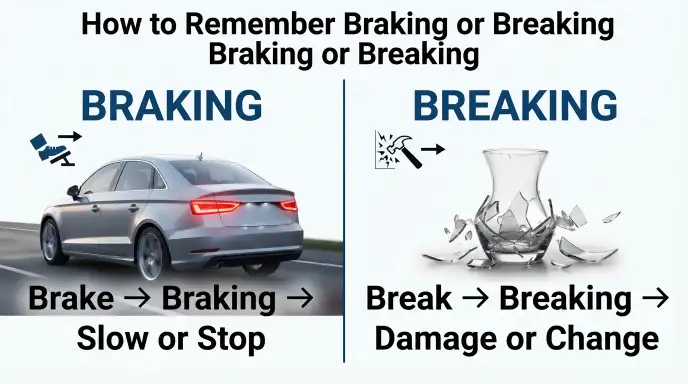
A simple memory trick can help you remember these words.
Brake = Car
Think:
Brake → Braking → Car slows down
Example:
The driver is braking.
Break = Damage or Change
Think:
Break → Breaking → Something is damaged, separated, interrupted, or changed
Example:
The child is breaking the toy.
Another useful test is to replace the word in your mind.
If you can replace it with “slowing down,” use braking.
The driver is slowing down.
→ The driver is braking.
If you can replace it with “damaging,” “violating,” or “interrupting,” use breaking.
He is violating the rules.
→ He is breaking the rules.
FAQs About Braking or Breaking
1. Is it braking or breaking?
Both are correct words. Braking means slowing or stopping with a brake, while breaking has meanings such as damaging, separating, or violating.
2. Is “braking” related to cars?
Yes. Braking usually describes using brakes to slow or stop a vehicle, although it can also apply to other machines.
3. Is it “breaking news” or “braking news”?
The correct phrase is breaking news. It describes important or developing news that is being reported.
4. Is it “braking system” or “breaking system”?
The standard term is braking system because the system uses brakes to slow or stop a vehicle.
5. Are braking and breaking homophones?
Yes. They have the same pronunciation in standard English but different spellings and meanings.
6. Is “breaking the rules” correct?
Yes. Breaking the rules is correct because the verb break can mean violating a rule.
7. How can I remember the difference?
Connect braking with brake and breaking with break. Use braking for slowing down and breaking for the other meanings of break.
Conclusion
Braking and breaking are both correct spellings, but they are used in different situations. The easiest way to tell them apart is to identify their base words. Braking comes from brake and means slowing or stopping something, especially a vehicle. Breaking comes from break and can mean damaging, separating, interrupting, violating, or changing something.
There is no important British American spelling difference between these two words. English speakers in both varieties use braking for the action of using brakes and breaking for the different meanings of break.
When you are unsure, look at the context. If you are talking about a car, bicycle, train, or another vehicle slowing down, use braking. If you are talking about a rule, record, object, promise, habit, or news event, use breaking.
Learn more grammar!

I’m Ethan Carter, a grammar-focused writer and English language enthusiast at SpellGrammar. I enjoy explaining confusing words, spelling differences, and grammar rules in clear, simple language. My goal is to help readers write with greater accuracy and confidence in everyday and professional English.








2 thoughts on “Braking or Breaking: Meaning, Difference, and Correct Usage”