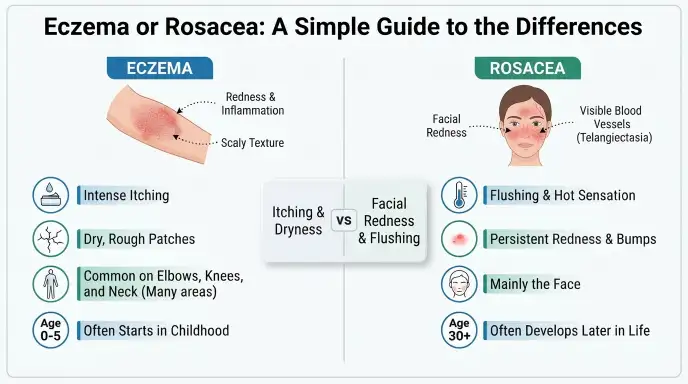
Eczema and rosacea are different skin conditions, although both can cause redness, irritation, and sensitive skin. People often search for “eczema or rosacea” because the symptoms can look similar, especially when the skin becomes red, dry, itchy, or inflamed. The key difference is where and how the symptoms appear.
Eczema often causes itchy, dry, inflamed skin and can affect many parts of the body. Rosacea usually affects the face, especially the cheeks, nose, chin, and forehead, and may cause persistent redness, flushing, visible blood vessels, or small bumps.
Knowing the difference can help you describe your symptoms more clearly and avoid confusing one condition with the other. However, skin conditions can overlap, and a person can have more than one condition at the same time.
This guide explains eczema or rosacea in simple terms. It covers their meanings, origins, spelling, common mistakes, everyday usage, and the main differences between them.
Eczema or Rosacea : Quick Answer
The two conditions affect the skin in different ways. Eczema is commonly linked with dry, itchy, inflamed skin, whereas rosacea usually causes facial redness, flushing, and sometimes bumps or visible blood vessels.
| Condition | Common Features | Typical Area |
| Eczema | Dryness, itching, redness, inflammation | Face, hands, arms, legs, and other areas |
| Rosacea | Facial redness, flushing, bumps, visible blood vessels | Mainly face |
For example:
- Eczema: “My skin is very itchy and dry.”
- Rosacea: “My cheeks become red and flushed.”
These symptoms can overlap, so appearance alone does not always provide a definite diagnosis.
Definition and Meaning of Eczema or Rosacea
What Does Eczema Mean?
Eczema is a general term used for a group of conditions that cause inflamed, irritated, or itchy skin.
Atopic dermatitis is one of the most common forms of eczema.
Common symptoms can include:
- Itching
- Dry skin
- Red or inflamed skin
- Rash
- Cracked skin
- Scaly or rough areas
Eczema can occur on different parts of the body and can affect people of different ages.
What Does Rosacea Mean?
Rosacea is a long-term skin condition that mainly affects the face.
It can cause:
- Facial redness
- Flushing
- Small bumps
- Visible blood vessels
- Burning or stinging
- Eye-related symptoms in some people
Rosacea often affects the central face, including the cheeks and nose.
Eczema vs Rosacea
The simplest distinction is:
Eczema → often itchy, dry, inflamed skin
Rosacea → often facial redness and flushing
However, symptoms are not always identical from person to person.
The Origin of Eczema or Rosacea
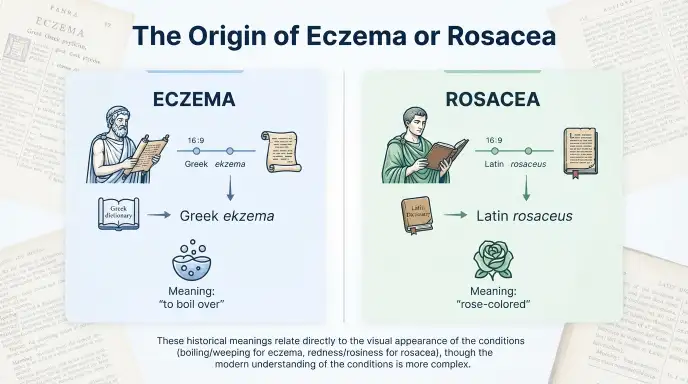
The two words have different histories.
Origin of Eczema
The word eczema comes from Greek. It is related to a Greek word meaning “to boil over” or “bubble up.”
The term reflects the appearance of inflamed or blistered skin described in early medical language.
Over time, eczema became an established medical term for several inflammatory skin conditions.
Origin of Rosacea
The word rosacea comes from Latin rosa, meaning “rose.”
The name relates to the reddish or rose-colored appearance that can occur on the face.
The medical term developed from descriptions of facial redness and related skin changes.
Why Do People Confuse the Two?
The confusion mainly comes from their shared visible symptoms.
Both conditions can involve:
- Redness
- Irritation
- Inflammation
- Sensitive skin
- Facial symptoms
But their typical patterns and symptoms are different.
British English vs American English Spelling
Unlike some common spelling pairs, eczema and rosacea do not normally change spelling between British and American English.
The standard spellings are:
- Eczema
- Rosacea
| British English | American English | Meaning |
| Eczema | Eczema | Inflammatory skin condition |
| Rosacea | Rosacea | Facial skin condition |
| Eczema symptoms | Eczema symptoms | Symptoms associated with eczema |
| Rosacea symptoms | Rosacea symptoms | Symptoms associated with rosacea |
The spelling remains the same in both varieties of English.
Some surrounding words can change.
For example:
British English:
“My skin is very sensitive and irritated.”
American English:
“My skin is very sensitive and irritated.”
There is no spelling change in the key terms themselves.
Which Spelling Should You Use?
Use eczema and rosacea in both British and American English.
For US Readers
Use:
Eczema or rosacea
These are the standard medical terms used in American English.
For UK Readers
Use:
Eczema or rosacea
The spelling is the same in British English.
For Commonwealth Readers
Countries such as Australia, Canada, and New Zealand also commonly use eczema and rosacea.
For Global Writing
If your audience is international, keep the standard spellings:
eczema
rosacea
There is no need to create regional spelling variants.
Common Mistakes with Eczema or Rosacea
Mistake 1: Treating Them as the Same Condition
Incorrect:
Eczema and rosacea are the same skin disease.
Correct:
Eczema and rosacea are different skin conditions.
Mistake 2: Assuming All Facial Redness Is Rosacea
Facial redness can have many causes.
It does not automatically mean a person has rosacea.
Mistake 3: Assuming All Itchy Skin Is Eczema
Itching can occur with many skin conditions.
A persistent rash should be assessed by an appropriate healthcare professional.
Mistake 4: Writing “Rosacia”
Incorrect:
Rosacia
Correct:
Rosacea
The correct spelling contains “sea” near the end:
rosa + cea → rosacea
Mistake 5: Writing “Exzema”
Incorrect:
Exzema
Correct:
Eczema
The correct spelling begins with ec-:
eczema
Eczema or Rosacea in Everyday Examples
In an Email
I have been experiencing facial redness and would like to discuss if it could be rosacea.
In a News Article
Researchers continue to study treatments for inflammatory skin conditions such as eczema and rosacea.
On Social Media
Is this eczema or rosacea? My skin has become red and irritated.
In a Health Blog
Eczema and rosacea can both affect sensitive skin, but their symptoms and typical patterns differ.
In Formal Writing
Eczema and rosacea are distinct inflammatory skin conditions with different clinical features.
In Everyday Conversation
I am not sure if this is eczema or rosacea.
These examples show that eczema and rosacea are normally used as medical terms rather than spelling alternatives.
Eczema or Rosacea : Google Trends & Usage Data
Searches for eczema and rosacea are common because both conditions affect skin appearance and comfort.
People may search for these terms when they notice:
- Red skin
- Itching
- Dryness
- Facial flushing
- Skin bumps
- Burning or stinging
- Repeated irritation
Search interest can vary by country, season, age group, and health concerns.
The exact level of interest also changes over time. A comparison such as “eczema or rosacea” usually reflects a user’s attempt to understand similar-looking symptoms rather than uncertainty about spelling.
Common related searches include:
- eczema or rosacea
- eczema vs rosacea
- rosacea or eczema on face
- eczema and rosacea difference
- how to tell eczema from rosacea
- eczema symptoms
- rosacea symptoms
- facial redness eczema or rosacea
Because search trends change over time, exact popularity numbers should be checked for a specific country and date range rather than presented as permanent figures.
Eczema vs Rosacea Comparison Table
| Feature | Eczema | Rosacea |
| Main condition type | Inflammatory skin condition | Chronic facial skin condition |
| Common symptom | Itching and dryness | Redness and flushing |
| Typical location | Many body areas | Mainly the face |
| Facial involvement | Possible | Very common |
| Dryness | Common | Can occur |
| Itching | Common | Can occur but is not always the main symptom |
| Flushing | Not usually the main feature | Common |
| Visible blood vessels | Not typical | Can occur |
| Small bumps | Some forms may cause them | Can occur |
| Skin sensitivity | Common | Common |
These are general patterns. Individual symptoms can vary, and similar symptoms can occur in other skin conditions.
How to Tell Eczema and Rosacea Apart
A few clues can help explain why the conditions are often confused.
Eczema Often Involves Itching
Eczema commonly causes significant itching along with dry or inflamed skin.
The affected area may feel rough, cracked, or irritated.
Rosacea Often Involves Facial Redness
Rosacea commonly affects the central face.
Redness may become more noticeable during episodes of flushing.
Their Locations Can Differ
Eczema can occur on many parts of the body.
Rosacea mainly affects facial skin.
Symptoms Can Overlap
A person with either condition may experience redness or sensitive skin.
That is why a healthcare professional may need to consider the full symptom pattern rather than one symptom alone.
FAQs About Eczema or Rosacea
Is eczema the same as rosacea?
No. Eczema and rosacea are different skin conditions. Eczema commonly involves itching and dryness, while rosacea often causes facial redness and flushing.
Can you have eczema and rosacea?
Yes. A person can have more than one skin condition. Similar symptoms can also make it difficult to identify the cause without professional assessment.
Which causes more facial redness, eczema or rosacea?
Rosacea commonly causes persistent or recurring facial redness. Eczema can also affect the face and cause redness, especially during a flare.
Is rosacea itchy like eczema?
Rosacea can cause irritation, burning, or sensitivity, but itching is more commonly associated with eczema.
How do you spell rosacea correctly?
The correct spelling is rosacea. A common mistake is writing “rosacia.”
How do you spell eczema correctly?
The correct spelling is eczema. “Exzema” is incorrect.
Can eczema look like rosacea?
Yes. Both can cause redness and irritation, particularly on the face. Their symptoms can overlap, so appearance alone may not identify the condition.
Conclusion
Eczema or rosacea is a common comparison because both conditions can cause red, irritated, sensitive skin. However, they are not the same condition. Eczema commonly causes itching, dryness, and inflammation and can affect many parts of the body. Rosacea mainly affects the face and is often associated with redness, flushing, visible blood vessels, or small bumps.
The spelling is simple because both eczema and rosacea are spelled the same in British and American English. There is no standard US-versus-UK spelling difference for either medical term.
If you are writing about these conditions, use eczema and rosacea consistently and avoid common errors such as “exzema” or “rosacia.” If you are trying to identify a skin condition based on symptoms, remember that several conditions can look alike. Persistent, painful, worsening, or unexplained skin changes should be discussed with a qualified healthcare professional rather than diagnosed from appearance alone.
Discover More About Correct Spelling!

I’m Ethan Carter, a grammar-focused writer and English language enthusiast at SpellGrammar. I enjoy explaining confusing words, spelling differences, and grammar rules in clear, simple language. My goal is to help readers write with greater accuracy and confidence in everyday and professional English.








1 thought on “Eczema or Rosacea: A Simple Guide to the Differences”