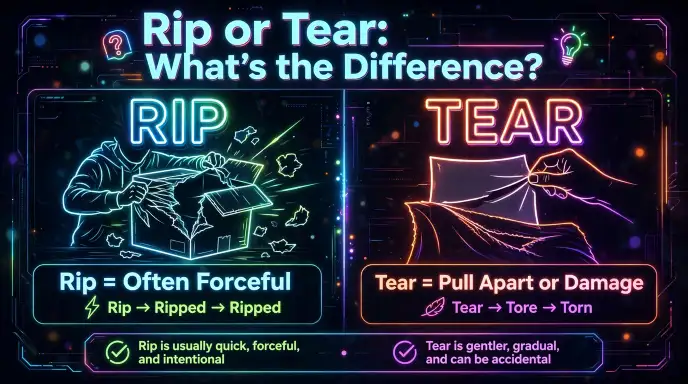
Rip and tear can both mean to pull something apart, but “rip” often suggests a quick or forceful action, while “tear” is broader and common for damaged or separated material. People often search for “rip or tear” because the two words have very similar meanings and can describe the same action. The right choice depends on what you are describing and how the word is used.
Both rip and tear can work as verbs and nouns. You can rip a piece of paper or tear a piece of paper. However, some expressions sound more natural with one word than the other. For example, we normally say “tear a page from a book” and “rip off a label.”
The words can also describe damage. A shirt can have a tear, while a person may rip their shirt during a sudden movement. Understanding this small difference helps you choose the more natural word in everyday, academic, and professional writing.
Rip or Tear – Quick Answer
Both rip and tear can mean pulling or splitting something apart, but they are not always interchangeable. A rip often suggests a sudden, rough, or forceful action.
Rip often suggests a sudden, rough, or forceful action.
Example:
- He ripped the paper in half.
Tear can describe separating material or creating a damaged opening.
Example:
- She tore the page from the notebook.
In many situations, either word is possible. The difference is often about tone, force, and common usage.
Definition and Meaning of Rip or Tear
What Does Rip Mean?
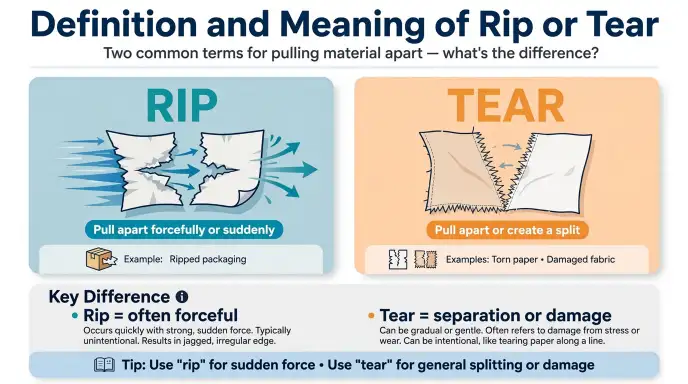
Rip means to pull, cut, or split something apart quickly or forcefully.
Examples include:
- Rip a piece of paper
- Rip open a package
- Rip off a sticker
- Rip a shirt
- Rip a curtain
As a noun, rip can refer to a tear or split in something.
Example:
There is a rip in my jacket.
The word can also have other meanings. For example, rip can describe moving very quickly in informal English.
What Does Tear Mean?
Tear means to pull something apart or cause a split or hole in material.
Examples include:
- Tear a page
- Tear paper
- Tear a letter
- Tear a piece of cloth
- Tear a photograph
As a noun, tear means a hole, split, or damaged area in something.
Example:
There is a tear in the sleeve.
Remember that tear has another pronunciation and meaning when it refers to liquid from the eyes.
- tear = to pull apart
- tear = liquid produced by the eyes
The pronunciation changes depending on the meaning.
The Origin of Rip or Tear
Both rip and tear are old English words with long histories.
Rip has Germanic roots and has been used in English for centuries to describe breaking or splitting something apart. Its meaning developed around the idea of forcefully separating material.
Tear, meaning to pull apart, also comes from Old English and has Germanic roots. It has remained closely connected with the idea of pulling, splitting, or damaging material.
The two words developed similar meanings because both describe physical separation. Over time, however, English speakers developed different common expressions with each word.
For example:
- tear a page
- tear paper
- rip open a package
- rip off a label
- tear a hole
- rip a shirt
This is why dictionaries may give similar definitions for the two words, while everyday usage still favors one in certain situations.
British English vs American English Spelling
There is no major spelling difference between British and American English for rip or tear.
Both varieties use the same spellings:
- rip
- ripped
- ripping
- tear
- tore
- torn
- tearing
| Word | British English | American English |
| Rip | rip | rip |
| Past tense | ripped | ripped |
| ing form | ripping | ripping |
| Tear | tear | tear |
| Past tense | tore | tore |
| Past participle | torn | torn |
The main challenge is not regional spelling. Instead, learners often confuse the meaning, pronunciation, or verb forms of these words.
Which Word Should You Use?
For general writing, both rip and tear are correct. Choose the word that best fits the action and context.
Use Rip When:
- The action is sudden or forceful.
- Something is pulled apart quickly.
- You are opening something roughly.
- You are describing damage caused by force.
Example:
He ripped open the envelope.
Use Tear When:
- You are separating paper or cloth.
- You are describing a split or hole.
- The action is less focused on force.
- The expression commonly uses tear.
Example:
She tore the page from her notebook.
For US English
Both words are standard and widely used.
For UK English
The same distinction applies. Rip and tear are both standard British English words.
For Global English
Use the word that sounds natural in the context. When in doubt, check common expressions rather than relying only on the dictionary definition.
Common Mistakes with Rip or Tear
Mistake 1: Using the Wrong Past Form
The past tense of tear is tore, not teared.
❌ She teared the paper.
✅ She tore the paper.
The past tense of rip is ripped.
❌ He ript the page.
✅ He ripped the page.
Mistake 2: Confusing Tear Pronunciations
Tear has two common pronunciations.
When it means to pull apart, it is pronounced like “tair.”
When it means liquid from the eye, it is pronounced like “teer.”
Mistake 3: Assuming They Are Always Interchangeable
Although both words can describe damaged material, some phrases sound more natural with one word than the other.
For example:
- tear a page sounds very natural.
- rip open a package sounds very natural.
Choosing the usual expression makes your writing sound more fluent.
Rip or Tear in Everyday Examples
In an Email
Please do not rip the documents. We need the original pages.
In Formal Writing
The material may tear if excessive pressure is applied.
In News Writing
Strong winds ripped the roof from the building.
On Social Media
I accidentally ripped my favorite shirt!
In Daily Conversation
Be careful not to tear the paper.
In Instructions
Tear along the dotted line.
Another Common Expression
He ripped the box open.
These examples show how context can influence the choice between rip and tear.
Rip or Tear – Google Trends & Usage Data
Searches for “rip or tear” often come from people trying to understand if the two words have the same meaning. Learners may also search for the correct word when describing damaged clothing, paper, packaging, or other materials.
Both words are widely used in English speaking countries, including the United States, United Kingdom, Canada, and Australia.
Search interest can vary by context. Tear is especially common in questions about paper, fabric, pages, and physical damage. Rip frequently appears with forceful actions, packaging, clothing, labels, and informal expressions.
Common related searches include:
- Rip or tear
- Rip vs tear
- Is it rip or tear?
- Tear a page or rip a page
- Ripped or torn
- Rip meaning
- Tear meaning
Exact search popularity can change over time, but both words remain common parts of everyday English.
Rip or Tear Comparison Table
| Feature | Rip | Tear |
| Basic meaning | Pull or split apart | Pull or split apart |
| Common sense | Often quick or forceful | Often general separation or damage |
| Verb | Yes | Yes |
| Noun | Yes | Yes |
| Past tense | ripped | tore |
| Past participle | ripped | torn |
| Example | Rip open a package | Tear a page |
| British English | Standard | Standard |
| American English | Standard | Standard |
Quick Memory Tip
Rip = often forceful or sudden.
Tear = often general separation or a split.
FAQs About Rip or Tear
1. Are rip and tear the same?
They can have similar meanings, especially when describing damaged material, but common usage differs by context.
2. Is it tear or rip a piece of paper?
Both can be correct. Tear a piece of paper is a very common expression.
3. What is the past tense of tear?
The past tense is tore. The past participle is torn.
4. What is the past tense of rip?
The past tense and past participle are both ripped.
5. Is “ripped” or “torn” correct?
Both are correct. Use ripped with rip and torn with tear.
6. Do British and American English spell rip differently?
No. Rip has the same spelling in both British and American English.
7. What is the difference between tear and tear?
One tear means to pull something apart, while the other tear means liquid produced by the eyes. They have different pronunciations.
Conclusion
Rip and tear are closely related words, and both can describe pulling or splitting something apart. However, they are not always used in exactly the same way. Rip often suggests a quick, rough, or forceful action, while tear commonly describes separating paper, fabric, or other material or creating a split.
The verb forms are also important. The past tense of rip is ripped, while the past tense of tear is tore and its past participle is torn. Learners should also remember that tear has two different pronunciations because it has two different meanings.
There is no important British versus American spelling difference. Both rip and tear are standard in both varieties of English. For natural writing, focus on the context and the expression that English speakers normally use. When describing a page, tear often sounds natural, while rip open works well for forceful actions such as opening a package.
Explore Grammar Topics!

Hi, I’m Olivia Bennett, an English grammar and spelling content writer. I enjoy exploring confusing words, spelling differences, and everyday language questions. My goal is to share clear, simple, and helpful explanations that make English easier to understand.








2 thoughts on “Rip or Tear: Understanding the Key Difference”