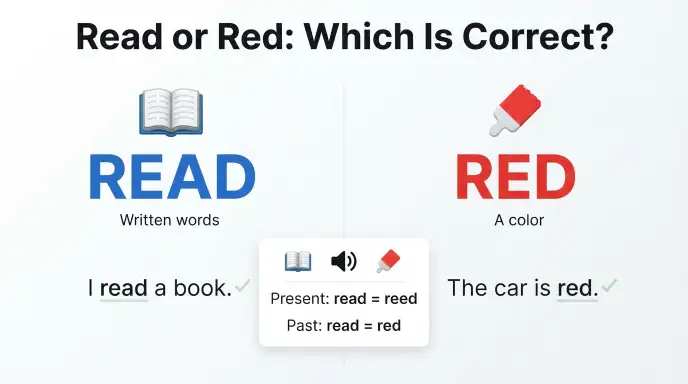
Read and red are both correct English words, but they have different meanings and pronunciations. Read is a verb that means to look at and understand written words, while red is a color. The words look and sound similar in some forms, which makes them a common source of confusion for English learners.
The confusion becomes stronger because read has two pronunciations. In the present tense, it sounds like reed, as in “I read every day.” In the past tense, it sounds like red, as in “I read the book yesterday.” The spelling stays the same, but the pronunciation changes.
This makes read or red a useful topic for students, ESL learners, writers, and anyone improving their English. Understanding the difference will help you choose the right word, pronounce it correctly, and avoid mistakes in writing.
Let’s look at the meanings, pronunciation, usage, and common examples.
Read or Red: Featured Snippet Answer
Read means to look at and understand written words. Red is a color. They are spelled differently, but the past tense of read is pronounced like red. For example, “I read books every day” uses the present form, while “I read the book yesterday” uses the past form.
Read or Red : Quick Answer
The easiest way to remember read vs red is to focus on meaning.
- Read = to look at and understand written words.
- Red = a color.
- Read in the present tense sounds like reed.
- Read in the past tense sounds like red.
Examples
Read as a verb:
I read books every night.
Here, read means to look at and understand written words.
Red as a color:
She wore a red dress.
Here, red describes the color of the dress.
Read in the past tense:
I read that article yesterday.
Here, read is spelled the same as the present form, but it is pronounced like red.
The Key Difference
Read is mainly a verb.
Red is mainly an adjective or noun related to color.
A simple memory tip is:
Read = books and words.
Red = a color.
What Does Read or Red Mean?
Understanding the meaning of each word makes the difference much easier.
What Does “Read” Mean?
Read means to look at written or printed words and understand their meaning.
It can describe reading:
- books
- newspapers
- emails
- messages
- articles
- signs
- instructions
- reports
- websites
Examples of “Read”
I read the newspaper every morning.
Please read the instructions carefully.
She likes to read novels.
Did you read my email?
In each example, read relates to understanding written information.
Read Has Two Pronunciations
One unusual feature of read is that its pronunciation changes with tense.
Present Tense
The present form read is pronounced like reed.
I read books every day.
Pronunciation:
read = reed
Past Tense
The past form read is pronounced like red.
I read the book yesterday.
Pronunciation:
read = red
The spelling does not change.
This is one of the most important points to remember when learning read or red.
What Does “Red” Mean?
Red is a color.
It can describe an object, person, place, or thing that has a red color.
Examples include:
She has a red car.
The apple is red.
He wore a red shirt.
The traffic light turned red.
Red can also be used as a noun:
Red is my favorite color.
In this sentence, red names the color itself.
Read vs Red in a Sentence
Compare these sentences:
I read a book every week.
The book has a red cover.
The first sentence uses read as a verb.
The second uses red as a color.
Now look at this sentence:
I read the red book yesterday.
The first read is the past tense of the verb and sounds like red. The second red describes the color of the book.
This is why context matters.
The Origin of Read or Red
The words read and red have different histories, even though they can sound the same in some situations.
Origin of “Read”
The verb read comes from Old English rǣdan, which was related to interpreting, explaining, or understanding.
Over time, its meaning became closely connected with understanding written language.
The modern English verb kept the spelling read, although its pronunciation developed differently across its forms.
This explains the unusual pattern:
- Present: read, pronounced like reed
- Past: read, pronounced like red
The spelling stayed the same while the pronunciation changed.
Origin of “Red”
The word red is also very old. It comes from Old English rēad, meaning the color red.
It is related to similar words found in other Germanic languages.
Unlike read, the word red refers to a color and does not change pronunciation based on tense.
Why Do Read and Red Sound the Same?
The past tense of read is pronounced red.
This creates a homophone relationship between:
read in the past tense
and
red the color.
They sound the same but have different spellings and meanings.
For example:
I read the letter yesterday.
and
The letter was written in red ink.
The two words sound alike when spoken, but their meanings are completely different.
Why Is “Read” So Confusing?
The main difficulty is that read keeps the same spelling in the present and past tense.
Compare:
| Tense | Spelling | Pronunciation | Example |
| Present | read | like reed | I read every day. |
| Past | read | like red | I read it yesterday. |
This is an example of an irregular verb.
The spelling does not change to show the past tense. The pronunciation changes instead.
That is why English learners may confuse read, red, and the two forms of read.
Read or Red: A Simple Memory Trick

Use this quick rule:
If you are talking about books, words, or written information, use “read.”
I read the article.
If you are talking about a color, use “red.”
The article has a red cover.
And remember:
Present read = reed
Past read = red
Once you connect read with written words and red with color, the difference becomes much easier to remember.
British English vs American English
There is no spelling difference between read and red in British English and American English.
Both varieties use the same spellings and meanings. The important difference is the pronunciation of read, because its sound changes between the present and past forms.
| Word | British English | American English | Example |
| read present | read, like “reed” | read, like “reed” | I read every day. |
| read past | read, like “red” | read, like “red” | I read it yesterday. |
| red color | red | red | She has a red bag. |
Present “Read”
When read means something you do regularly or are doing now, it is pronounced like reed.
I read books every night.
They read the news online.
Past “Read”
When read describes something that happened in the past, it is pronounced like red.
I read that book last week.
She read my message yesterday.
The spelling remains read in both cases.
“Red” in Both Varieties
The color word red has the same spelling and basic pronunciation in British and American English.
He bought a red car.
The warning sign is red.
There is therefore no British-versus-American spelling choice to make with these words.
Which Version Should You Use?
The correct choice depends on what you mean, not where your reader lives.
In the United States
Use read when you mean the action of looking at and understanding written words.
I read the report every morning.
Use red when you mean the color.
The report has a red cover.
In the United Kingdom
The same rule applies.
She reads books at night.
She wore a red coat.
British English does not use a different spelling for either word.
In Canada
Canadian English also uses read and red with the same spellings.
I read the article yesterday.
The headline was printed in red.
In Australia
Australian English follows the same basic distinction.
I read the instructions carefully.
The warning label is red.
For International Writing
For international readers, context is especially helpful because read can have two pronunciations.
If pronunciation matters, you can explain the difference directly:
- read in the present = sounds like reed
- read in the past = sounds like red
Academic Writing
Use read when describing reading or reviewing written material.
Students should read the assigned chapter.
For past actions:
The students read the assigned chapter before class.
Use red only when the color itself is relevant.
The researcher marked the errors in red.
Business Writing
Use the word that matches the intended meaning.
Please read the attached report.
The figures highlighted in red require attention.
The context makes the difference clear.
Common Mistakes
The biggest mistakes with read or red happen when writers confuse meaning or forget that read has two pronunciations.
Mistake 1: Using “Red” for Reading
❌ I red the book yesterday.
✅ I read the book yesterday.
Why?
The sentence describes an action involving a book. The correct spelling is read.
Memory tip:
If you mean “look at and understand words,” use read.
Mistake 2: Using “Read” for the Color
❌ She bought a read dress.
✅ She bought a red dress.
Why?
The sentence describes a color, so the correct word is red.
Memory tip:
Think of red as the color of an apple, rose, or traffic light.
Mistake 3: Pronouncing Past “Read” Like “Reed”
❌ “I reed the book yesterday.”
✅ “I read the book yesterday.”
The spelling is read, but the past-tense pronunciation is like red.
Memory tip:
Present: reed
Past: red
Mistake 4: Thinking Past “Read” Is Spelled “Red”
This is one of the most common errors.
❌ I red the email yesterday.
✅ I read the email yesterday.
Even though past read sounds exactly like red, its spelling remains read.
Mistake 5: Changing “Read” to “Red” in Writing
Because the two words can sound the same, people sometimes write the word they hear.
For example:
❌ I red your message.
✅ I read your message.
English spelling does not always match pronunciation. This is a good example of why listening and writing can require different skills.
Read or Red in Everyday Examples
The difference becomes easier when you see the words in real situations.
In Emails
Read:
Please read the attached document before the meeting.
Red:
The important sections are marked in red.
Both words can appear in the same email.
In Business Writing
I read the quarterly report this morning.
Here, read is a verb.
The red figures show areas that need attention.
Here, red describes a color.
In News Headlines
Read:
Local Residents Read New Safety Rules
Here, read relates to written information.
Red:
Red Warning Issued for Severe Weather
Here, red describes the warning level or color.
The exact use of red in a headline depends on the topic and the publication’s wording.
In Blogs
I read several books about grammar while writing this guide.
Here, read describes the action of reading.
The author used a red heading to highlight the main point.
Here, red describes a color.
On Social Media
I read your comment this morning.
The red heart emoji was everywhere.
The first sentence uses read as a verb. The second uses red as a color.
In Academic Writing
Students were asked to read three research papers.
The results highlighted in red require further review.
Academic writing often uses read when discussing sources and red when describing visual information.
In Daily Conversation
Person A: “Did you read my message?”
Person B: “Yes, I read it this morning.”
Notice that both instances of read are spelled the same.
In the question, the form is connected with the past action because the context is understood. The same spelling is used in the answer.
Google Trends & Modern Usage
Read and red are both common English words, but search interest for them can have many different meanings.
People may search for read because they want help with:
- pronunciation
- past and present forms
- irregular verbs
- English grammar
- reading skills
- spelling
People may search for red because they want information about:
- the color
- color names
- design
- fashion
- symbolism
- pronunciation
This makes broad search data for the individual words difficult to interpret. A search for read does not necessarily mean someone is confused about the word red, and a search for red does not necessarily relate to the grammar question.
More specific searches show clearer intent, such as:
- read or red
- read vs red
- read and red difference
- read pronunciation
- past tense of read
- how to pronounce read
- read meaning
- red meaning
- read or red in a sentence
The most common reason people search read or red is the unusual relationship between spelling and pronunciation.
The two words can sound identical when read is used in the past tense, but they have different spellings and meanings.
For example:
I read the book yesterday.
The book has a red cover.
The pronunciation alone cannot tell you which spelling is correct. You must use the meaning and context.
Quick Comparison Table
| Version | Meaning | Correct? | Region | Example |
| read | To look at and understand written words | Yes | All English varieties | I read books every day. |
| read | Past form of the verb “read” | Yes | All English varieties | I read the book yesterday. |
| red | A color | Yes | All English varieties | She wore a red dress. |
| red | Past form of “read” | No | None | ❌ I red the book yesterday. |
| reed | A tall grass or plant | Yes | All English varieties | A reed grew beside the water. |
| read / “reed” | Present pronunciation of “read” | Yes | All English varieties | I read every morning. |
| read / “red” | Past pronunciation of “read” | Yes | All English varieties | I read it yesterday. |
Key Takeaways
- Read means to look at and understand written words.
- Red is a color.
- Present-tense read sounds like reed.
- Past-tense read sounds like red.
- The spelling of read stays the same in the present and past tense.
- Never write red when you mean the past tense of read.
- Use red when you are talking about the color.
- British and American English use the same spellings.
- Context helps you understand which meaning of read is intended.
- Remember: read books, red color.
FAQs About Read or Red
1. What is the difference between read and red?
Read is a verb connected with looking at and understanding written words. Red is a color. They can sound the same when read is used in the past tense, but they have different spellings and meanings.
2. Is “I red a book” correct?
No. The correct sentence is “I read a book.” If you are talking about reading in the past, it is still spelled read, even though it sounds like red.
3. Is the past tense of read spelled red?
No. The past tense is spelled read. However, it is pronounced like red. For example, “I read the book yesterday” uses the past form of read.
4. Why does read sound like red?
English has many words whose pronunciation does not directly match their spelling. The past form of read is pronounced like red, although its spelling remains read.
5. How do you pronounce read?
The present form read is pronounced like reed. The past form read is pronounced like red. The sentence usually makes the intended tense clear.
6. When should I use red?
Use red when you are talking about the color. For example, “The car is red” and “She wore a red shirt” both use red correctly.
7. Is read an irregular verb?
Yes. Read is an irregular verb because its past form does not follow the usual spelling pattern for regular verbs. Its spelling stays the same, but its pronunciation changes.
8. Are read and red homophones?
They can be homophones when read is used in the past tense. Past read and red have the same pronunciation but different spellings and meanings.
9. Is “I have read it” pronounced like red?
Yes. In “I have read it,” the word read is pronounced like red because it is the past participle form.
10. How can I remember read vs red?
Use a simple memory rule: read is about words, while red is about color. Also remember that present read sounds like “reed,” while past read sounds like “red.”
Conclusion
Read and red are both correct English words, but they have completely different meanings. Read is a verb used when talking about understanding written words, while red is a word for a color. The main challenge comes from the fact that the past tense of read is pronounced exactly like red.
In the present tense, read sounds like reed:
“I read every day.”
In the past tense, the spelling stays read, but the pronunciation changes:
“I read the book yesterday.”
This is why writing red as the past tense of read is incorrect.
There is also no British or American spelling difference. Both varieties use read and red in the same way.
When you are unsure, focus on the meaning. If you are talking about books, messages, articles, or written words, choose read. If you are describing a color, choose red.
Discover More Grammar Tips!

Hi, I’m Olivia Bennett, an English grammar and spelling content writer. I enjoy exploring confusing words, spelling differences, and everyday language questions. My goal is to share clear, simple, and helpful explanations that make English easier to understand.







2 thoughts on “Read or Red: Meaning, Usage, and Examples”