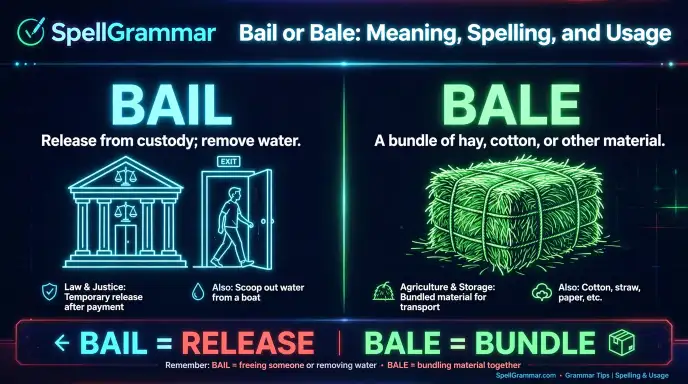
The words bail and bale are both correct, but they have very different meanings. Bail often refers to money or a legal promise that allows someone to leave jail while awaiting trial. It can also mean removing water from a boat or helping someone escape a difficult situation. Bale usually means a large bundle of goods, such as hay, cotton, or paper, tied together for storage or transport.
People often search for “bail or bale” because the words sound alike. This can make it hard to choose the right spelling when writing an email, school assignment, news story, or social media post. One letter changes the meaning completely.
For example, a court may grant bail to a person accused of a crime, while a farmer may stack a bale of hay in a barn. Writing the wrong word can confuse readers and change the meaning of a sentence.
This guide explains the definitions, origins, and everyday uses of both words. You will also learn how British and American English use them, how to avoid common mistakes, and which spelling fits your sentence.
Bail or Bale: The Short Answer
Bail usually refers to temporary release from custody, money pledged for that release, or the act of removing water from a boat. Bale means a large, tightly bound bundle of material, such as hay, cotton, or paper. Both spellings are correct, but they are not interchangeable.
- The judge agreed to bail the defendant out.
- The farmer loaded a bale of hay onto the truck.
- The sailor used a bucket to bail water out of the boat.
Remember: bail is linked to release or removing water; bale is linked to a bundle.
Bail or Bale: Quick Answer
Choose the word that matches your meaning.
| Word | Main meaning | Example |
| Bail | Release from custody, often under legal conditions | The court granted him bail. |
| Bail | Remove water from a boat | We had to bail water out of the boat. |
| Bail | Leave or withdraw from a situation | She decided to bail on the plan. |
| Bale | A large bundle tied for storage or transport | They moved a bale of cotton. |
When Should You Use Bail?
Use bail when you write about a court, release from jail, removing water, or leaving a situation.
- The family paid for his bail.
- We used a cup to bail out the canoe.
- He decided to bail on the meeting.
When Should You Use Bale?
Use bale when you mean a bundle of material packed for storage or transport.
- The farmer stacked a bale of hay.
- The factory shipped a bale of cotton.
- Workers tied the paper into a bale.
What Does Bail Mean?
Bail has several meanings. The correct meaning depends on the sentence.
1. Bail in Law
In law, bail refers to the release of an accused person from custody while a case moves forward. A court may set conditions for that release. Depending on the legal system and the case, those conditions may include paying money, providing a guarantee, or following other rules.
For example:
- The judge granted bail to the accused.
- Her family helped her pay the bail amount.
- The court refused bail because of the circumstances of the case.
Bail does not mean that a person has been found innocent. The legal case may continue after release.
2. Bail as a Verb
As a verb, bail can mean to secure someone’s release from custody by arranging bail.
Example: His parents worked to bail him out of jail.
The phrase bail someone out also has a broader meaning. It can mean helping someone who faces trouble, often by giving money or support.
Example: Her brother bailed her out when she could not pay the bill.
3. Bail in Boating
The verb bail also means to remove water from a boat or another place where water has collected.
Example: The sailors used buckets to bail water out of the boat.
This use often appears in outdoor activities, boating stories, and emergency situations.
4. Bail in Everyday Speech
In informal English, bail can mean to leave, cancel plans, or stop taking part in something.
Examples:
- I had to bail on dinner because I felt tired.
- They bailed out of the project before it started.
- She did not want to bail on her friends.
This informal use is common in conversation. In formal writing, words such as withdraw, leave, or cancel may be clearer.
The Origin of Bail or Bale
Although bail and bale sound alike, they developed from different word histories.
Where Does Bail Come From?
The legal word bail entered English through Anglo-French and Old French forms linked to the idea of custody, guardianship, or handing over responsibility. Over time, English used the word for the release of a person held in custody under an agreed guarantee or condition.
The verb bail also developed a separate use related to removing water from a boat. This meaning has its own historical development and is not the same as the legal meaning.
Modern English also uses bail out in figurative ways. Someone might bail out a business by giving it financial help or bail on a plan by leaving it behind.
Where Does Bale Come From?
The word bale has Germanic roots and has long referred to a bundle or package of goods. English uses it for materials that people tie, wrap, or press together for storage and transport.
Farmers have used the term for bundles of hay and straw. Modern industries also use it for cotton, paper, cardboard, and recycled materials.
Why Do People Confuse These Words?
The main reason is pronunciation. In many English accents, bail and bale sound the same. When people write by sound alone, they may choose the wrong spelling.
The best way to remember them is to connect each word with a familiar image:
- Bail: A courtroom, a person leaving custody, or water being removed from a boat.
- Bale: A tied bundle of hay, cotton, or paper.
British English vs American English
British and American English use bail and bale with the same standard spellings and core meanings. Neither word needs a regional spelling change.
The main differences relate to legal systems, local expressions, and the context in which people use the words.
| Context | British English | American English | Example |
| Legal release | Bail | Bail | The court granted bail. |
| Removing water | Bail | Bail | They bailed water out of the boat. |
| Leaving a plan | Bail, often informal | Bail, often informal | She bailed on the event. |
| Bundle of hay | Bale | Bale | A bale of hay stood in the barn. |
| Bundle of cotton | Bale | Bale | The factory shipped a bale of cotton. |
British English Usage
British writers use bail in legal contexts and in phrases such as bail out. The word bale appears in farming, transport, and recycling.
Examples:
- The defendant applied for bail.
- The farmer moved a bale of straw.
- We had to bail water out of the small boat.
American English Usage
American writers use the same spellings. Informal expressions such as bail on someone are familiar in everyday conversation.
Examples:
- The judge set bail.
- The farmer stacked a bale of hay.
- He decided to bail on the trip.
What About Canada and Australia?
Canadian and Australian English also use bail and bale. Local legal rules may affect how bail works in practice, but they do not change the spelling.
When writing for an international audience, use the standard forms and make the intended meaning clear from the sentence.
Which Version Should You Use?
The choice depends on what you want to say, not where your readers live. Both words are standard in the United States, the United Kingdom, Canada, Australia, and international English.
- United States: Use bail for legal release, water removal, or leaving a plan. Use bale for a bundle of material.
- United Kingdom: Follow the same spelling rule. Legal procedures may differ from those in the United States.
- Canada: Use bail and bale according to their meanings. Do not change the spelling for Canadian readers.
- Australia: Use bail for release or removing water and bale for a bundle.
- International writing: Add context if readers may not know if you mean a legal term, an action, or a bundle.
- Academic writing: Choose the word that fits the definition and explain technical terms when needed.
- Business writing: Use precise wording, especially in legal documents, financial reports, shipping records, and agricultural reports.
A Simple Rule to Remember
If the sentence involves a court, a boat, or leaving a situation, you probably need bail. If it describes a tied bundle of material, you need bale.
Common Mistakes with Bail or Bale
These mistakes are easy to make because both words sound alike. Use the examples below to check your spelling.
1. Writing Bale Instead of Bail in a Legal Sentence
Incorrect: The judge granted bale to the accused.
Correct: The judge granted bail to the accused.
Why: The sentence refers to legal release, not a bundle of material.
Memory tip: Think of bail as a way to leave custody under legal conditions.
2. Writing Bail Instead of Bale for Hay
Incorrect: The farmer stacked a bail of hay.
Correct: The farmer stacked a bale of hay.
Why: A bundle of hay is called a bale.
Memory tip: Picture a large bale sitting in a barn.
3. Confusing Bail Out with Bale Out
Incorrect: The company received help to bale it out of debt.
Correct: The company received help to bail it out of debt.
Why: Bail out means to rescue someone or something from trouble, often by providing money or support.
4. Using Bail When You Mean a Bundle
Incorrect: The warehouse received a bail of cotton.
Correct: The warehouse received a bale of cotton.
Why: Cotton is packed into bales for storage and transport.
5. Using Bale When You Mean Leaving
Incorrect: I had to bale on the meeting.
Correct: I had to bail on the meeting.
Why: In informal English, bail on means to leave or withdraw from a plan or event.
6. Assuming One Spelling Is British and the Other Is American
Incorrect assumption: Bail is American, while bale is British.
Correct explanation: Both spellings are used in British and American English, but their meanings differ.
Memory tip: Focus on meaning, not the country.
Bail or Bale in Everyday Examples
The following examples show how both words work in different settings.
In Emails
Bail:
“Please confirm if the court has granted bail before we arrange the next steps.”
Bale:
“Please confirm the number of cotton bales ready for shipment.”
The first email concerns a legal matter. The second concerns goods being transported.
In Business Writing
Bail:
“The company sought financial support to bail out its struggling division.”
Bale:
“The supplier packed the recycled paper into a compact bale.”
Business writers should use the correct word to avoid confusion in financial and shipping documents.
In News Headlines
Bail:
“Court Grants Bail to Defendant as Trial Continues”
Bale:
“Farmers Prepare Hay Bales Ahead of Winter”
The words point to two very different news topics.
In Blogs
Bail:
“Learn what happens when a court grants bail and which conditions may apply.”
Bale:
“Discover how farmers store hay bales to protect feed from bad weather.”
On Social Media
Bail:
“I might bail on tonight’s plans and stay home.”
Bale:
“The golden hay bales made the farm look beautiful.”
The first example uses informal speech. The second describes a physical object.
In Academic Writing
Bail:
“The report examines how courts make decisions about bail in criminal cases.”
Bale:
“The study measured the weight and moisture content of each hay bale.”
Academic writing needs clear terms because the words may describe legal processes or physical materials.
In Daily Conversation
Bail:
“I need to bail out this boat before we leave.”
Bale:
“Can you help me move that bale of straw?”
The surrounding words make the meaning clear.
Bail or Bale: Google Trends and Modern Usage
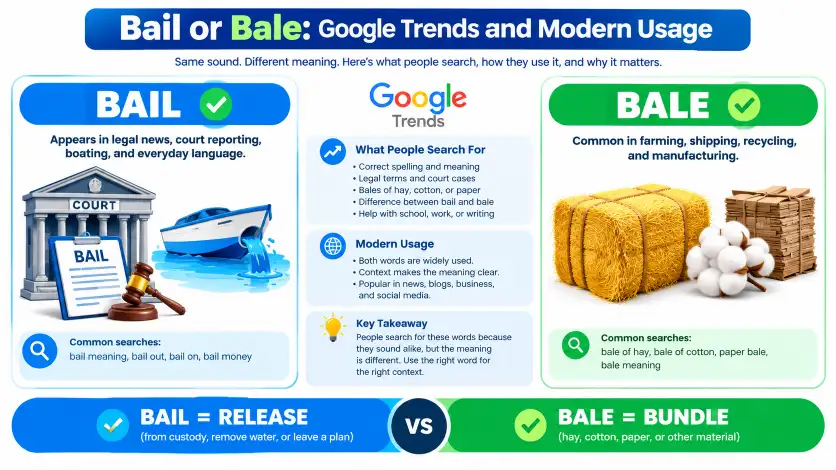
People search for “bail or bale” because the words are homophones in many accents. They sound alike but have different meanings and spellings. This makes them a common source of spelling mistakes.
Which Word Is More Popular?
The words appear in different contexts, so a direct search comparison may not tell the whole story. Bail appears in legal news, court reporting, everyday expressions, and boating contexts. Bale often appears in farming, textiles, recycling, and shipping.
Without a verified, current Google Trends comparison, it would be misleading to give exact search volumes or claim that one spelling is more popular in a particular country.
Why Do People Search for These Words?
Common reasons include:
- Checking the correct spelling for a legal article.
- Writing about a bale of hay or cotton.
- Learning the difference between bail out and bale.
- Improving English spelling and vocabulary.
- Editing schoolwork, emails, or business documents.
Modern Usage Advice
Both words remain useful in modern English. The best choice depends on the meaning you want to express.
Use bail when discussing release from custody, removing water, or leaving a situation. Use bale when discussing a bundle of goods. Context helps readers understand the word, but correct spelling makes the meaning clear from the start.
Quick Comparison Table: Bail vs Bale
| Version | Meaning | Correct? | Region | Example |
| Bail | Release from custody | Yes | US, UK, and other regions | The court granted bail. |
| Bail | Remove water | Yes | US, UK, and other regions | We bailed water out of the boat. |
| Bail out | Rescue or provide help | Yes | US, UK, and other regions | They helped bail out the business. |
| Bail on | Leave or cancel a plan | Yes, informal | Common in conversational English | He bailed on the party. |
| Bale | A tied or compressed bundle | Yes | US, UK, and other regions | The farmer moved a bale of hay. |
| Bale | Pack material into a bundle | Yes | Farming and industry | Workers bale the straw. |
Key Takeaways
- Bail and bale are both correct English words.
- Bail can refer to legal release from custody.
- Bail can also mean removing water or leaving a plan.
- Bale means a large bundle of material, such as hay, cotton, or paper.
- Both words use the same spelling in British and American English.
- The phrase bail out often means to rescue someone or something from trouble.
- Check the meaning of the sentence before choosing a spelling.
Frequently Asked Questions
1. What is the difference between bail and bale?
Bail usually refers to release from custody, removing water, or leaving a situation. Bale means a large bundle of material, such as hay or cotton. Both words sound alike in many accents, but they have different meanings. Use the sentence’s meaning to decide which spelling fits.
2. Is it bail out or bale out?
The correct phrase is usually bail out. It can mean helping someone escape trouble, often through financial support, or removing water from a boat. For example, “The investors helped bail out the company.” Bale refers to a bundle, so it does not fit this expression.
3. Is bail a legal term?
Yes. In law, bail refers to the release of an accused person from custody under specific conditions while the case continues. Depending on the legal system, bail may involve money or another form of guarantee. Bail does not mean the court has found the person innocent.
4. How do you spell a bale of hay?
The correct spelling is bale of hay. A bale is a bundle of hay or straw that people tie or compress for storage and transport. For example, “The farmer placed a bale of hay in the barn.” Do not use bail when describing this bundle.
5. Are bail and bale pronounced the same?
In many English accents, yes. They are homophones, which means they sound alike but have different meanings and spellings. This is why writers sometimes mix them up. Reading the full sentence and identifying the intended meaning will help you choose the right word.
6. Can bail mean to leave a party?
Yes. In informal English, bail on means to leave, withdraw from, or cancel a plan. For example, “She decided to bail on the party.” This expression is common in conversation and casual messages. In formal writing, leave or withdraw may be a better choice.
7. What does a bale of cotton mean?
A bale of cotton is a large bundle of cotton pressed or tied together for storage and transport. Cotton producers and textile businesses use bales to handle raw cotton more efficiently. For example, “The factory received a bale of cotton from the supplier.”
8. Do British and American English use different spellings?
No. Both British and American English use bail and bale with the same spellings and core meanings. Regional differences may affect legal procedures or informal expressions, but they do not change which spelling refers to a bundle or to bail.
9. Is it bail money or bale money?
The correct phrase is bail money when referring to money paid or pledged in connection with a person’s release from custody. Bale money does not have that meaning. For example, “His family helped arrange the bail money before the hearing.”
10. What is an easy way to remember bail and bale?
Link bail with a courtroom, a boat, or leaving a plan. Link bale with a bundle of hay, cotton, or paper. These simple mental pictures help you remember the difference whenever the words sound alike.
Conclusion
When choosing between bail or bale, remember that both spellings are correct, but each serves a different purpose. Bail commonly refers to legal release from custody. It can also mean removing water from a boat or leaving a plan in informal English. Bale, by contrast, means a large bundle of material, such as hay, cotton, or paper.
The spelling stays the same in British, American, Canadian, and Australian English. You do not need to choose one form based on your audience’s location. Instead, focus on the meaning of your sentence.
For legal writing, use bail when discussing release from custody. For farming, recycling, and shipping, use bale when describing a bundle. Remember that bail out can also mean helping someone or something escape trouble.
If you are unsure, read your sentence aloud and picture what it describes. A court or a boat points to bail. A tied bundle points to bale.
Master Grammar Basics!

I’m Ethan Carter, a grammar-focused writer and English language enthusiast at SpellGrammar. I enjoy explaining confusing words, spelling differences, and grammar rules in clear, simple language. My goal is to help readers write with greater accuracy and confidence in everyday and professional English.








2 thoughts on “Bail or Bale: Meaning, Spelling, and Usage”