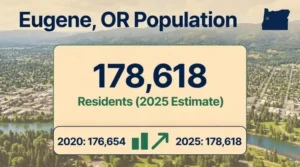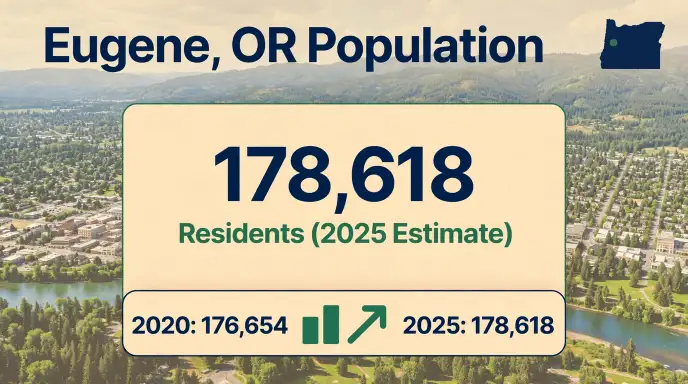
The Eugene OR population is about 178,618 people, according to the 2025 estimate. Eugene is a well-known city in Oregon, USA. It is famous for the University of Oregon, outdoor activities, and a lively local culture.
Many people search for this topic to learn how many people live in Eugene, if the city is growing, and how it compares with other places in Oregon. Some also want to understand the difference between the city’s population and that of the larger metropolitan area.
These figures can be confusing because the city and metro area cover different locations. Population numbers also change over time as new estimates become available.
This guide explains Eugene’s population, its growth, and the difference between city and metro figures. It also covers common search terms and shows how to use population information correctly.
Eugene, OR Population – Quick Answer
Eugene, Oregon, had an estimated population of 178,618 in 2025. It is one of the major cities in Oregon and serves as the county seat of Lane County.
The number depends on the area being measured:
- Eugene city: People living within the city’s boundaries.
- Eugene metro area: People living in Eugene and nearby communities.
- Lane County: People living throughout the county.
These areas have different population totals, so always check which figure you are using.
Definition and Meaning of Eugene, OR Population
The phrase Eugene, OR population means the total number of people living in Eugene, Oregon.
Each part has a simple meaning:
- Eugene: A city in the state of Oregon.
- OR: The official postal abbreviation for Oregon.
- Population: The number of people who live in a particular place.
People use this phrase when researching the city, comparing locations, studying population growth, or planning a move.
City Population vs. Metro Population
A city population includes only people who live within the city’s official boundaries.
A metro population covers a larger region. It includes the main city and nearby communities that are connected through work, travel, and daily activities.
For example, Eugene’s city population is smaller than the population of the Eugene-Springfield metropolitan area.
The Origin of Eugene, OR Population
The phrase combines a city name, a state abbreviation, and the word population. It is a search term rather than a traditional expression.
The name Eugene comes from Eugene Skinner, an early settler who established a trading post in the area during the 1840s. The settlement later developed into the city we know today.
The abbreviation OR stands for Oregon. People commonly use it in US addresses and online searches to identify the state.
The word population comes from the Latin word populatio. It refers to the people living in a particular place.
Together, these words help users find information about the number of residents in Eugene, Oregon.
British English vs. American English Spelling
There is no spelling difference between British and American English in this phrase. The words Eugene and population have the same spelling in both forms of English.
However, the abbreviation OR is mainly used in the United States. International readers may understand the full state name more easily.
| Version | Usage | Example |
| Eugene, OR | US abbreviation | Eugene, OR population |
| Eugene, Oregon | Full state name | Population of Eugene, Oregon |
| Eugene city population | City-level figure | Eugene city population in 2025 |
| Eugene metro population | Regional figure | Eugene metro area population |
For international writing, Eugene, Oregon is usually the clearest choice.
Which Spelling Should You Use?
The spelling stays the same, but your wording can change depending on your audience.
- US readers: Use “Eugene, OR” or “Eugene, Oregon.”
- UK readers: Use “Eugene, Oregon” to make the location clear.
- International readers: Write the full state name when mentioning the city for the first time.
- Academic writing: Include the year and source of every population figure.
For example:
“According to the 2025 estimate, Eugene, Oregon, had 178,618 residents.”
This sentence gives readers the location, year, and population figure in a clear way.
Common Mistakes with Eugene, OR Population
People often confuse city figures with regional figures. Other mistakes can also make population information unclear.
| Common Mistake | Correct Approach |
| Mixing city and metro figures | Identify the area being measured |
| Using an old figure as current | Include the correct year |
| Calling an estimate an exact count | Use the phrase “estimated population” |
| Using OR without explaining it | Write Oregon for international readers |
| Comparing figures from different years | Check the dates first |
| Including nearby towns in the city total | Follow official city boundaries |
Helpful tip: Always mention the year and area when sharing a population figure. This makes your information easier to understand.
Eugene, OR Population in Everyday Examples
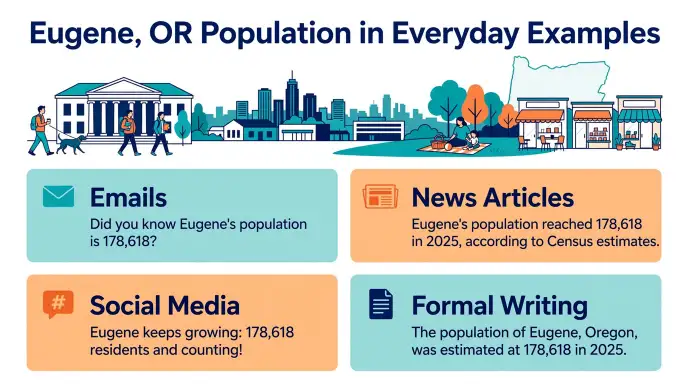
This topic appears in emails, news reports, social media posts, and formal documents. Here are some simple examples.
In Emails
“Could you send me the latest population estimate for Eugene, Oregon?”
“Our report needs the city figure rather than the metro-area total.”
In News Articles
“Eugene’s estimated population reached 178,618 in July 2025.”
“New estimates offer an updated view of population changes across Oregon.”
On Social Media
“Have you ever wondered how many people live in Eugene, Oregon?”
“Eugene is home to more than 178,000 residents, based on the 2025 estimate.”
In Formal Writing
“The 2025 estimate placed Eugene’s population at 178,618.”
“The Eugene-Springfield metropolitan area had an estimated population of 381,584 in 2025.”
These examples show why it is important to identify the correct area when sharing demographic information.
Eugene, OR Population – Google Trends and Usage Data
People search for this topic for different reasons. Some want to compare Oregon cities, while others research housing, local growth, or the area before moving there.
Common search variations include:
- Eugene Oregon population
- How many people live in Eugene?
- Eugene population 2025
- Eugene metro area population
- Eugene demographics
- Population of Eugene, Oregon
These searches have similar goals, but they may lead to different figures. A city-level search focuses on residents within Eugene’s boundaries. A metro-area search covers a wider region.
Population by Year
Population estimates help show how a city changes over time. The following figures provide a simple comparison.
| Year | Population | Data Type |
| 2010 | 156,185 | Census count |
| 2020 | 176,654 | Census count |
| 2025 | 178,618 | Census estimate |
The figures show that Eugene gained residents between 2010 and 2020. The 2025 estimate also indicates a smaller increase after the 2020 Census.
Population by Country and Region
Eugene is located in the United States, so its official population figures describe people living within its city boundaries.
People from other countries may also search for this information when researching Oregon or comparing US cities. However, online search interest does not show how many people live in a place.
Google Trends measures relative search interest. It does not provide an official population count. For accurate demographic information, use government population data.
Eugene City vs. Eugene-Springfield Metro Area
The city and metropolitan area have different totals because they cover different geographic boundaries.
| Area | Population | Year |
| Eugene city | 178,618 | 2025 |
| Eugene-Springfield metro area | 381,584 | 2025 |
The metro area includes Eugene, Springfield, and nearby communities. Its population is therefore much larger than the city total.
When comparing these figures, make sure both numbers refer to the same type of area.
Key Facts About Eugene, Oregon
- Eugene is located in western Oregon.
- It is the county seat of Lane County.
- The University of Oregon is based in the city.
- The 2020 Census counted 176,654 residents.
- The 2025 estimate placed the city population at 178,618.
- The Eugene-Springfield metro area had an estimated 381,584 residents in 2025.
FAQs About Eugene, OR Population
1. What is the population of Eugene, OR?
Eugene had an estimated population of 178,618 in 2025.
2. What was Eugene’s population in 2020?
The 2020 Census counted 176,654 residents.
3. What is the Eugene metro area population?
The Eugene-Springfield metropolitan area had an estimated 381,584 residents in 2025.
4. Is Eugene’s population growing?
Yes. The 2025 estimate is higher than the 2020 Census count, showing a modest increase.
5. Why do population figures differ across websites?
Websites may use different years, sources, geographic boundaries, or estimation methods.
6. Is Eugene bigger than Springfield?
Eugene has a larger city population than Springfield. Both cities are part of the same metropolitan area.
7. Where can I find official population figures?
The US Census Bureau provides official counts and annual population estimates for Eugene.
Conclusion
Eugene, Oregon, had an estimated population of 178,618 in 2025. This figure shows a modest increase from the 2020 Census count of 176,654 residents. The city remains an important part of Oregon, with the University of Oregon, local businesses, and outdoor attractions contributing to its identity.
When researching population figures, remember that the city and metropolitan area are not the same. Eugene’s city total includes people within its official boundaries, while the metro figure also covers nearby communities such as Springfield.
For accurate information, check the year and geographic area before using a number. Government estimates are useful for research, reports, and city comparisons. If you are writing for readers outside the United States, use the full name Eugene, Oregon instead of only the abbreviation OR.
Clear wording and reliable figures help readers understand the city’s size and growth without confusion.
Explore More Grammar Tips!

Hi, I’m Olivia Bennett, an English grammar and spelling content writer. I enjoy exploring confusing words, spelling differences, and everyday language questions. My goal is to share clear, simple, and helpful explanations that make English easier to understand.