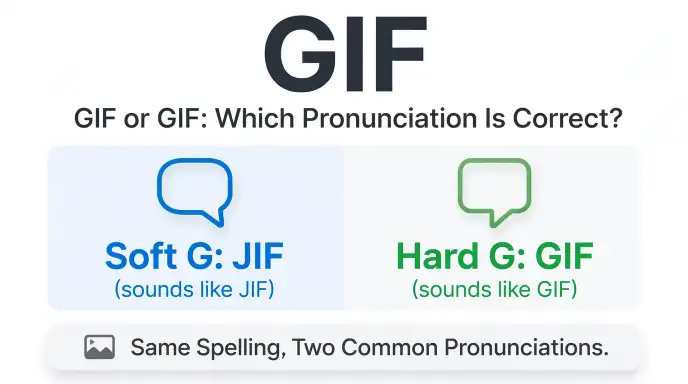
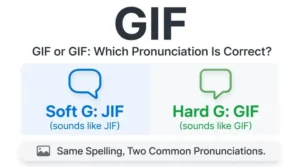
The word GIF has one standard spelling but two common pronunciations. Some people say it with a soft G, like “jif,” while others use a hard G, like the one in “give.” Both forms are widely used in everyday English.
GIF stands for Graphics Interchange Format, a digital image format used for still pictures and simple animations. People often share animated GIFs in messages, on social media, and in online articles. Although the format is common, its pronunciation remains a popular topic of debate.
The confusion comes from the different sounds the letter G can make in English. Words such as “giant” use a soft G, while “game” uses a hard G. This leaves speakers wondering which sound fits the abbreviation.
Quick Answer
GIF stands for Graphics Interchange Format. People commonly pronounce it in two ways:
- Soft G: “Jif,” which rhymes with “if.”
- Hard G: “Gif,” with the same starting sound as “give.”
Both pronunciations are widely understood. The spelling does not change, regardless of which sound you choose.
Examples:
- “Send me a funny GIF.”
- “This GIF explains the process.”
- “I added an animated image to the presentation.”
What Does GIF Mean?
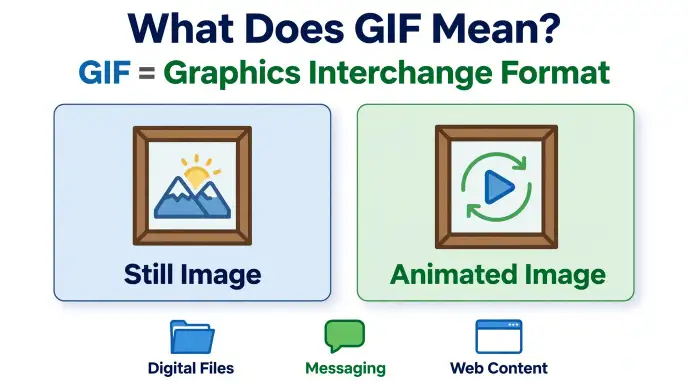
Graphics Interchange Format is a digital image format introduced for sharing images across computer systems. It can display a single image or a series of frames that create an animation.
People often use animated images to share jokes, reactions, short demonstrations, and memorable moments. For example, someone might send a clapping animation to show approval or use a looping image to explain a simple task.
How Is the Term Used?
In everyday English, people usually use the term as a noun.
- “That image made me laugh.”
- “Please add a GIF to the presentation.”
- “The website uses an animation to demonstrate the feature.”
The word can refer to the image itself or the digital file that contains it.
Although many people associate the format with moving images, it can also contain a still picture. It supports up to 256 colors per frame, which can limit its usefulness for detailed photographs.
In casual speech, people sometimes use it as a verb, as in “I GIFed that moment.” In formal writing, phrases such as “created an animated image” are usually clearer.
The Origin of GIF
The format first appeared in 1987, when CompuServe introduced it as a way to share color images online. At the time, a format that worked across different computer systems was useful for online services and websites.
Its name comes from the words Graphics Interchange Format. The abbreviation became familiar as people began using the format for web graphics and, later, animated reactions.
The pronunciation debate developed because English does not always give readers a clear guide to a letter’s sound. The letter G can sound different in words such as “get” and “giant.”
Steve Wilhite, who led the team that created the format, supported the soft-G pronunciation. Many speakers still prefer the hard-G version, however. Both forms remain in use.
The key distinction is simple: the written name stays the same, even when people say it differently.
British English vs. American English
Unlike words such as color and colour, this term does not have separate British and American spellings. Both varieties use the same written form.
| British English | American English | Example |
| GIF | GIF | “I sent a GIF.” |
| Soft-G pronunciation | Soft-G pronunciation | Both are used. |
| Hard-G pronunciation | Hard-G pronunciation | Both are used. |
| .gif file extension | .gif file extension | animation.gif |
There is no strict rule that assigns one pronunciation to British English and the other to American English. A speaker’s choice often depends on personal preference and the pronunciation they learned first.
For technical writing, introduce the full term on first use if readers may not know it:
“Graphics Interchange Format is a digital image format.”
After that, the abbreviation is usually enough.
Which Pronunciation Should You Use?
You can use either common pronunciation. Your choice does not affect the spelling or meaning.
- United States: Both pronunciations are common.
- United Kingdom: Both forms are understood.
- Canada: Either pronunciation works in everyday conversation.
- Australia: Speakers may use either form.
- International writing: Use the standard spelling, GIF.
- Academic writing: Introduce the full name when needed.
- Business writing: Explain the format if your audience may be unfamiliar with it.
In a meeting or presentation, choose the pronunciation that feels natural and use it consistently. You do not need to change your speech to match someone else’s preference.
Clear communication matters more than winning a pronunciation debate.
Common Mistakes
The disagreement about pronunciation can lead to confusion about spelling and meaning.
| Common mistake | Correct information | Explanation |
| Writing “JIF” as the file format’s name | GIF | GIF is the standard spelling. |
| Assuming only the hard G is correct | Both pronunciations are used | The spoken form varies. |
| Believing British English uses a different spelling | GIF | The spelling is the same in both varieties. |
| Assuming every file must be animated | GIF files can also be still images | Animation is not required. |
| Treating .gif as a pronunciation | It is a file extension | The extension identifies the file type. |
Memory tip: One spelling, two common pronunciations.
if you say “jif” or “gif,” write the format’s name as GIF. Use .gif when referring to a file name or extension.
Everyday Examples
Here are natural examples of the term in different settings.
Emails
- “I have attached an animation that explains the process.”
- “Could you send me the image from yesterday’s presentation?”
In professional emails, describe the image’s purpose when the recipient may not recognize the format.
Business Writing
- “The marketing team used an animated image to demonstrate the new feature.”
- “Please check that the file displays correctly on the product page.”
The phrase animated image can be more accessible to readers who are unfamiliar with technical terms.
News Headlines
- “Viral Animation Sparks Debate Online”
- “How Animated Images Became Popular Online”
A publication may use its own capitalization style, but the standard abbreviation remains unchanged.
Blogs
- “This animation shows how to complete the task.”
- “Add a short visual example to make the tutorial easier to follow.”
Define the term when it first appears if your article is aimed at beginners.
Social Media
- “That animation perfectly describes my mood.”
- “Reply with an image that matches your reaction.”
People often share these files to express humor, surprise, excitement, or frustration.
Academic Writing
- “The researchers included an animated image to illustrate the sequence.”
- “Graphics Interchange Format (GIF) supports frame-based animation.”
Follow your institution’s style guide and explain technical terms when necessary.
Daily Conversation
- “Did you see that funny GIF?”
- “Do you pronounce it with a soft G or a hard G?”
- “I use animated images to reply to messages.”
These examples show how the term appears in everyday speech without requiring a discussion of its pronunciation.
Google Trends and Modern Usage
People search for the pronunciation because the spelling does not make the intended sound obvious. Common related searches include:
- How do you pronounce GIF?
- Is it pronounced “jif” or “gif”?
- What does GIF stand for?
- Why are there two pronunciations?
The debate combines language, technology, and internet culture. People may defend the pronunciation they learned first, while others prefer the sound they associate with the word’s letters.
Online jokes, memes, videos, and social posts have also helped keep the discussion alive.
Regional Search Interest
Search interest can vary by country and change over time. Without a current, verified comparison from Google Trends, it would be misleading to claim that one pronunciation dominates a particular region or to provide exact percentages.
Google Trends can compare searches such as “GIF pronunciation” and “how to pronounce GIF.” Its interest scores measure relative search interest, not the total number of searches or how people say the word in conversation.
The available general usage pattern supports a straightforward conclusion: both pronunciations are familiar, and neither changes the standard spelling.
Quick Comparison Table
| Form | Meaning | Correct? | Example |
| GIF with a soft G | Graphics Interchange Format | Yes | “Send me a GIF.” |
| GIF with a hard G | Graphics Interchange Format | Yes | “I saved the GIF.” |
| JIF as a written format name | An attempt to show the soft-G sound | No, not the standard spelling | Write GIF in normal text. |
| .gif | File extension | Yes | funny.gif |
Key Takeaways
- GIF stands for Graphics Interchange Format.
- The standard spelling is always GIF.
- People use both soft-G and hard-G pronunciations.
- Neither pronunciation belongs exclusively to British or American English.
- The format can store still images and animations.
- The .gif extension identifies files in this format.
- Explain the full term when writing for readers who may not know it.
- Choose the pronunciation that feels natural to you.
Frequently Asked Questions
1. Is it pronounced “jif” or “gif”?
Both pronunciations are common. The soft-G version rhymes with “if,” while the hard-G version begins with the sound in “give.” The written form remains the same.
2. Which pronunciation is correct?
Both forms are widely used. The format’s creator supported the soft-G pronunciation, but many speakers prefer the hard G. Either form is understood in everyday conversation.
3. What does GIF stand for?
GIF stands for Graphics Interchange Format. It is a digital image format used for still pictures and simple animations on websites, in messages, and across social media.
4. Is “JIF” a correct spelling?
No. GIF is the standard spelling for the image format. People may write “jif” informally to show how they pronounce it, but that is not the official file name.
5. Do British and American speakers pronounce it differently?
There is no fixed regional rule. Speakers in both countries use the soft-G and hard-G versions. The written form is identical in British and American English.
6. Why do people disagree about its pronunciation?
The letter G can make different sounds in English. Some speakers favor the soft G, while others use the hard G. Personal preference and online culture have helped keep the debate going.
7. Can a GIF be a still image?
Yes. The format can store a single still image or multiple frames that create an animation. People often associate it with moving images because animated examples are popular online.
8. Should I write GIF or gif?
Use GIF when referring to the format in ordinary prose, unless your publication follows a different style. Use .gif when showing a file extension, such as image.gif.
9. Is GIF an abbreviation?
Yes. It comes from Graphics Interchange Format. People also use the term as an everyday noun when discussing digital images and animations.
10. Is one pronunciation more popular online?
Popularity may vary between communities, but search data alone cannot prove how people pronounce the word. Both forms are widely recognized, and no spelling change is needed.
Conclusion
The debate over this digital image format is about pronunciation, not spelling. GIF stands for Graphics Interchange Format and can contain a still picture or a simple animation.
Some people say “jif,” using a soft G. Others use a hard G, as in “give.” Both pronunciations are common, and neither changes the written form. British, American, Canadian, and Australian English all use GIF.
For emails, blogs, technical documents, and everyday messages, use the standard spelling. Write .gif when referring to a file extension. In academic or technical writing, introduce the full name if your readers need more context.
You do not need to settle the debate to communicate clearly. Choose the pronunciation you prefer and use it naturally.
Explore More Grammar Tips!

Hi, I’m Olivia Bennett, an English grammar and spelling content writer. I enjoy exploring confusing words, spelling differences, and everyday language questions. My goal is to share clear, simple, and helpful explanations that make English easier to understand.

2 thoughts on “GIF or GIF: Meaning, Pronunciation, and Usage”