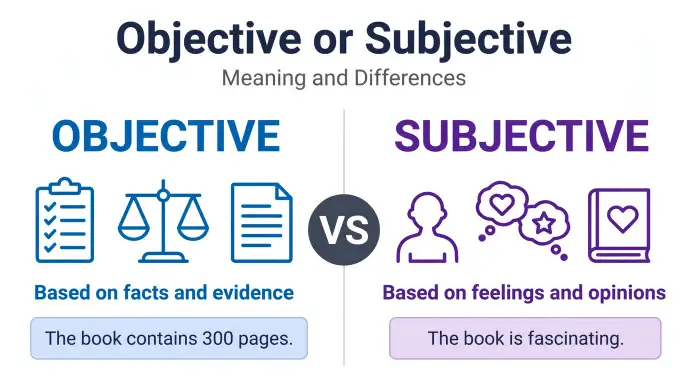
Objective and subjective describe two different ways of understanding information. Objective means based on facts and evidence, while subjective means based on personal opinions, feelings, or experiences. For example, “The temperature is 25°C” is objective because a thermometer can verify it. However, “The weather is pleasant” is subjective because people may have different opinions about the same temperature.
People often search for objective or subjective to understand the difference between these words in writing, education, research, news, and everyday conversations. Knowing how to use them correctly helps readers distinguish facts from personal judgments.
Although both terms describe perspectives or types of information, they serve different purposes. Objective statements focus on evidence that others can check, while subjective statements express individual interpretations. Recognizing this distinction can make your writing clearer, more accurate, and easier to understand.
Objective or Subjective – Quick Answer
Objective refers to information based on facts, evidence, or measurable details. Subjective refers to opinions, emotions, or personal experiences.
- Objective example: The book contains 300 pages.
- Subjective example: The book is fascinating.
The first statement can be verified by counting the pages. The second expresses a personal judgment that may differ from one reader to another.
Definition and Meaning of Objective and Subjective
What Does Objective Mean?
Objective describes information that relies on facts, evidence, and observable details rather than personal feelings or opinions.
Objective statements aim to remain fair and impartial. Readers can often verify them using measurements, records, or reliable evidence.
Examples:
- The meeting starts at 10 a.m.
- Water freezes at 0°C under standard atmospheric pressure.
- The store closes at 9 p.m.
These statements provide details that people can check.
What Does Subjective Mean?
Subjective describes something influenced by personal feelings, opinions, preferences, or experiences.
Subjective statements may be meaningful and reasonable, but different people can disagree because they have different perspectives.
Examples:
- The meeting was boring.
- Chocolate ice cream tastes better than vanilla.
- The store has a beautiful interior.
These statements express personal judgments rather than universally verifiable facts.
The Origin of Objective and Subjective
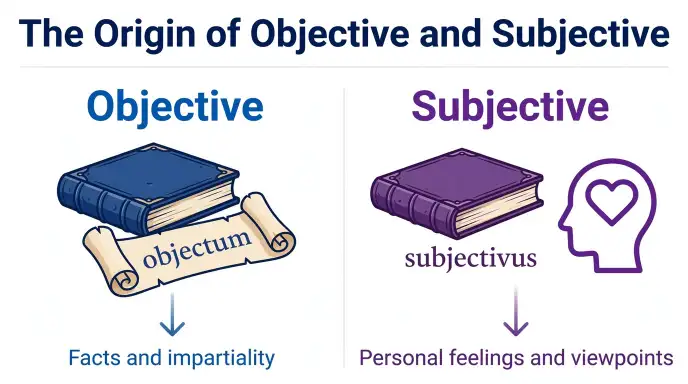
The word objective comes from the Latin objectum, meaning something placed before or presented to the mind. Over time, it developed the sense of considering things independently of personal feelings.
Subjective comes from the Latin subjectivus, relating to a subject or individual experience. Its modern meaning emphasizes personal perception, feelings, and viewpoints.
Both words became important in discussions of philosophy, knowledge, and how people understand the world.
British English vs. American English Spelling
| Word | British English | American English |
| Objective | Objective | Objective |
| Subjective | Subjective | Subjective |
Both words use the same spelling in British and American English. Their meanings also remain the same across these varieties.
Which Word Should You Use?
Choose the word that matches the information you want to describe.
- Use objective when discussing facts, evidence, measurements, or impartial assessments.
- Use subjective when describing opinions, emotions, preferences, or individual interpretations.
For academic writing, objective language can help present evidence clearly. Subjective language may be appropriate when analyzing literature, reviewing products, or expressing personal experiences.
Remember that a statement can contain both elements. For example, “The film lasts two hours and is excellent” includes an objective detail about its length and a subjective opinion about its quality.
Common Mistakes
Writers sometimes confuse objective and subjective because both describe ways of presenting information.
- Mistake: Calling every opinion objective.
- Correction: An opinion is subjective unless it is being presented as a claim supported by evidence.
- Mistake: Assuming subjective statements are always wrong.
- Correction: Subjective statements can accurately express someone’s feelings or preferences.
- Mistake: Treating objective information as automatically unbiased.
- Correction: Evidence-based reporting can still reflect bias through the selection or presentation of facts.
Everyday Examples of Objective and Subjective
| Objective Statement | Subjective Statement |
| The bag weighs two kilograms. | The bag feels heavy. |
| The restaurant opens at noon. | The restaurant is wonderful. |
| The test contains 20 questions. | The test is difficult. |
| The room measures five meters wide. | The room looks spacious. |
| The movie lasts 120 minutes. | The movie is entertaining. |
The objective examples describe measurable or verifiable details. The subjective examples express personal reactions or judgments.
Google Trends and Usage Data
People use objective and subjective in education, philosophy, psychology, journalism, research, and everyday communication. Searches for these terms often relate to understanding facts versus opinions.
Search interest can change depending on educational needs, current events, and popular discussions. Specific popularity claims should be checked against current Google Trends data rather than assumed.
Objective vs. Subjective: Quick Comparison
| Feature | Objective | Subjective |
| Meaning | Based on facts | Based on opinions |
| Focus | Evidence and measurements | Feelings and experiences |
| Verification | Often independently verifiable | Depends on personal perspective |
| Example | The box weighs 5 kg. | The box is too heavy. |
| Common use | Reports and research | Reviews and personal reflections |
Key Takeaways
- Objective means based on facts, evidence, or measurable details.
- Subjective means influenced by personal opinions, feelings, or experiences.
- Both words have the same spelling in British and American English.
- Objective information can be checked, while subjective judgments may vary between people.
- A sentence can contain both objective facts and subjective opinions.
Frequently Asked Questions
1. What is the main difference between objective and subjective?
Objective refers to facts and evidence, while subjective refers to personal opinions and feelings.
2. Is an opinion objective or subjective?
An opinion is generally subjective because it reflects someone’s personal judgment.
3. Can a statement be both objective and subjective?
Yes. A statement can combine a verifiable fact with a personal opinion.
4. Is objective the same as unbiased?
Not always. Objective writing uses evidence, but bias can still affect how information is selected or presented.
5. Which word is used in academic writing?
Both words are used. Objective suits evidence-based claims, while subjective describes personal interpretations.
6. Do British and American English spell these words differently?
No. Both varieties use objective and subjective.
Conclusion
Understanding objective or subjective helps you distinguish facts from personal opinions. Objective statements rely on evidence and verifiable details, whereas subjective statements express feelings, preferences, or individual interpretations. Using these terms correctly improves clarity in academic writing, professional communication, and everyday conversations.
Explore Grammar Guides!

I’m Ethan Carter, a grammar-focused writer and English language enthusiast at SpellGrammar. I enjoy explaining confusing words, spelling differences, and grammar rules in clear, simple language. My goal is to help readers write with greater accuracy and confidence in everyday and professional English.







1 thought on “Objective or Subjective: Meaning and Differences”