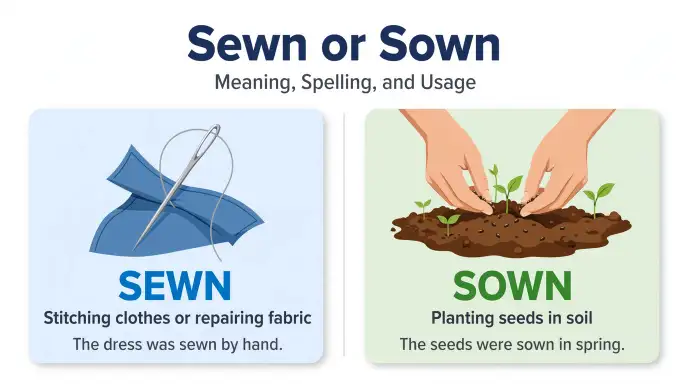
The correct choice between sewn or sown depends on what you want to say. Sewn is related to sewing, such as joining pieces of cloth with a needle and thread. Sown is the past participle of sow, which means to plant seeds in the ground.
These words sound alike in many accents, but they have different meanings and uses. This can make them easy to mix up in writing.For example, you might sew a button onto a shirt, while a farmer sows seeds in a garden.
Knowing the difference helps you avoid common spelling mistakes in schoolwork, emails, articles, and everyday writing. It also makes your meaning clear to readers.
In this guide, you will learn what each word means, where the words came from, how to use them in sentences, and which mistakes to avoid. You will also find a quick comparison table, practical examples, and answers to common questions.
Sewn or Sown: Featured Snippet Answer
Sewn means joined or repaired with a needle and thread. Sown means planted as seeds in soil. Both words are correct, but people use them in different contexts. For example, “She has sewn a dress” refers to making clothing, while “He has sown the seeds” refers to planting seeds.
Sewn or Sown: Quick Answer
Choose sewn for stitches, fabric, clothes, or repairs. Use sown when discussing seeds, planting, or spreading something that may grow or develop.
- Sown: The farmer sown the field with wheat.
- Corrected example: The farmer sowed the field with wheat.
Use sowed for the simple past tense, and use sown with has, have, or had.
What Does Sewn or Sown Mean?
What Does Sewn Mean?
Sewn is the past participle of sew. It means someone has made, joined, or repaired something with a needle and thread.
People use this word when talking about clothes, bags, fabric, buttons, and other items made from material.
Examples:
- The tailor has sewn a new suit.
- My mother sewn the tear in my shirt.
Correct: My mother has sewn the tear in my shirt.
Someone sewed the label inside the jacket.
Use sewed for the simple past.
You can use sewed or sewn as the past participle, but people commonly use sewn after “has” or in sentences where someone sews something, such as “She has sewn the dress.”
What Does Sown Mean?
Sown is the past participle of sow.
It means that someone has planted seeds in the soil so that plants can grow.
People also use the word figuratively. For example, a person may “sow doubt” by making others feel unsure about something.
Examples:
Someone has sown the seeds in the garden.
Farmers sowed wheat before the rainy season.
- His careless words sowed doubt among the team.
- Use sowed for the simple past tense. Writers usually use sown as the past participle after “has” or “had.”
The Main Difference
The easiest way to remember these words is to connect each one with an action:
- Sewn = stitches
- Sown = seeds
Use sewn when someone works with a needle and thread, and use sown when someone plants seeds.
The Origin of Sewn and Sown
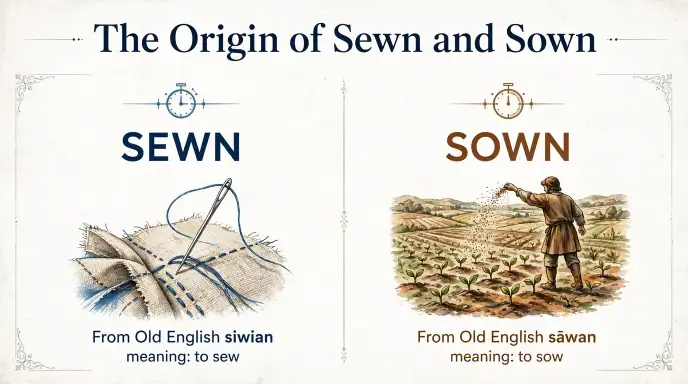
Although sewn and sown sound similar, they come from different verbs. Their spelling reflects their separate histories and meanings.
Origin of Sewn
Sewn comes from the verb sew, which has roots in Old English. The older form was siwian, meaning to sew or join with stitches.
Over time, English spelling and verb forms changed. The forms sewed and sewn developed as past forms of sew.
Today, people can use both words as past participles, but they commonly use sewn to describe something they have made or repaired with stitches.
For example, “Someone sewed the patch onto the sleeve” describes a person attaching a piece of fabric with thread.
Origin of Sown
Sown comes from sow, an old English verb meaning to scatter or plant seeds. Its roots go back to Old English sāwan.
The verb has kept its link to farming and growing plants. Farmers sow seeds in fields, while gardeners sow seeds in pots or garden beds.
The word also appears in expressions such as “you reap what you sow.” This saying means that a person’s actions often lead to certain results.
Why Are They Confused?
People often confuse these words because they sound alike. This is an example of a homophone-like spelling problem: words can sound the same or very similar while having different meanings and spellings.
Their past forms add to the confusion. Sew becomes sewed or sewn, while sow becomes sowed or sown. Remembering the base verb helps you choose the right form.
British English vs American English
There is no British and American spelling difference between sewn and sown.
British and American English speakers use both forms with the same meanings.
| British English | American English | Example |
| Sewn | Sewn | The button was sewn onto the coat. |
| Sown | Sown | The seeds were sown in spring. |
| Sewed | Sewed | She sewed a small bag. |
| Sowed | Sowed | The farmer sowed the field. |
The choice depends on meaning and grammar, not location. A British writer and an American writer should both use sewn for stitching and sown for planting seeds.
Style guides may differ in small matters of punctuation or house style, but they do not change the basic distinction between these words.
Which Version Should You Use?
Use the word that matches the action. Regional spelling rules do not affect this choice.
United States
American English uses both sewn and sown. Use sewn for clothing and repairs, and sown for seeds.
- The costume was sewn by hand.
- Someone sowed wildflower seeds in the garden.
United Kingdom
British English follows the same rule. Both words are standard, and neither is limited to one region.
- The curtains were sewn at home.
- Barley was sown in the field.
Canada
Canadian English also uses sewn and sown according to their meanings. Choose the word that fits the sentence rather than trying to apply a US or UK spelling rule.
Australia
Australian English follows the same distinction. Sewn relates to stitches, while sown relates to planting or scattering seeds.
International Writing
For an international audience, use simple context to make your meaning clear. If the topic is clothing, sewn is likely the right choice. If the topic is gardening or farming, sown is likely the right choice.
Academic Writing
In academic work, use the correct form and make sure the verb fits the sentence.
- Correct: The samples were sewn into separate fabric bags.
- Correct: The seeds were sown under controlled conditions.
In scientific writing, the surrounding details should make the action clear.
Business Writing
Use sewn when describing textiles, uniforms, upholstery, or products made with stitches. Use sown when writing about crops, gardening, or figurative ideas such as “sowing the seeds of change.”
- The logo was sewn onto each uniform.
- The project sowed the seeds for future growth.
Common Mistakes
These errors often happen when writers focus on how a word sounds instead of what it means.
Mistake 1: Using Sown for Clothing
Incorrect: The tailor has sown the dress.
Correct: The tailor has sewn the dress.
Why: The tailor joined fabric with stitches, so the correct word is sewn.
Mistake 2: Using Sewn for Seeds
Incorrect: The farmer has sewn the seeds.
Correct: The farmer has sown the seeds.
Why: The farmer planted seeds, so the correct word is sown.
Mistake 3: Confusing Sowed and Sown
Incorrect: She has sowed the seeds yesterday.
Better: She sowed the seeds yesterday.
Also correct: She has sown the seeds.
Why: Use the simple past sowed with a finished past-time reference such as yesterday. Use has sown when the present perfect form fits the meaning and time context.
Mistake 4: Using Sewn Without the Right Verb Form
Incorrect: She sewn the button on Monday.
Correct: She sewed the button on Monday.
Also correct: She has sewn the button on.
Why: Sewn usually needs a helping verb when it acts as the past participle. The simple past form is sewed.
Mistake 5: Assuming One Word Is British and the Other Is American
Incorrect: “Sewn” is British, but “sown” is American.
Correct: Both words are used in British and American English.
Why: They have different meanings, not different regional spellings.
Memory Tip
Think of the “e” in sewn as part of sew, and connect it with thread. Think of “sown” as the word for seeds sown in soil.
A short reminder is: Sew with thread; sow with seeds.
Everyday Examples of Sewn and Sown
These examples show how both words appear in different types of writing.
Emails
Sewn:
Hi Sarah,
The loose button has been sewn back onto your jacket. You can collect it tomorrow.
Sown:
Hello Mark,
The flower seeds have been sown, so we should see new growth when the weather is suitable.
Business Writing
Sewn:
The company logo is sewn onto the front of each uniform to ensure a neat, lasting finish.
Sown:
The new program has sown the seeds for better teamwork across the department.
News Headlines
- Sewn: “Hand-Sewn Costumes Feature in New Museum Exhibit”
- Sown: “Wildflower Seeds Sown Across Local Park”
Blogs
- Sewn: “How to Care for a Hand-Sewn Cotton Bag”
- Sown: “When Should You Have Spring Seeds Sown?”
Social Media
- “I finally finished the dress I sewed myself!”
- “The first seeds have been sown in my garden.”
The first sentence uses sewed as the simple past form. The second uses sown as a past participle after have been.
Academic Writing
- The fabric samples were sewn together before testing.
- The researchers sowed the seeds in separate containers.
- The seeds had been sown two weeks before the first measurements.
These sentences show how the correct form changes with both meaning and sentence structure.
Daily Conversation
- “Who sewed this button onto your shirt?”
- “Have you sown the vegetable seeds yet?”
- “The torn seam has been sewn up.”
- “The farmer sowed the field last week.”
Use the word that describes the action, and then choose the verb form that fits the sentence.
Google Trends and Modern Usage
People search for “sewn or sown” because the words sound alike and share similar verb forms. The confusion is common in writing about clothes, gardening, farming, and figurative expressions.
Searches may also come from students checking homework, writers editing sentences, or English learners studying irregular verbs.
Regional Popularity
Both spellings are standard in the United States, the United Kingdom, Canada, and Australia. There is no reliable basis here for claiming that one word is more popular in a particular country without checking current search data.
Modern Usage
Both words remain in everyday use:
- Sewn appears in discussions about clothing, crafts, repairs, upholstery, and textiles.
- Sown appears in gardening, farming, plant care, and expressions about creating the start of something.
For example, “The seeds of an idea were sown” uses sown figuratively. It means that an idea began to develop.
Why Do People Search for This Keyword?
The main reason is that the words are easy to mix up. A person may know what they want to say but feel unsure about which spelling matches the meaning.
Google Trends can help compare interest in search terms over a selected time and region. However, no exact search figures are included here, so this section describes general usage patterns rather than claiming specific popularity rankings.
Quick Comparison Table
| Version | Meaning | Correct? | Region | Example |
| Sewn | Joined with stitches | Yes | All major English varieties | The pocket was sewn shut. |
| Sown | Planted as seeds | Yes | All major English varieties | The seeds were sown in April. |
| Sewed | Simple past of sew | Yes | All major English varieties | She sewed a patch onto the bag. |
| Sowed | Simple past of sow | Yes | All major English varieties | He sowed the lawn with grass seed. |
| Sown used for clothing | Incorrect word choice | No | All major English varieties | Use sewn for a stitched garment. |
| Sewn used for planting | Incorrect word choice | No | All major English varieties | Use sown for planted seeds. |
The table shows that both sewn and sown are correct words. Their meanings and the grammar of the sentence determine which one to use.
Key Takeaways
- Sewn means joined or repaired with a needle and thread.
- Sown means planted or scattered as seeds.
- Sewed is the simple past form of sew.
- Sowed is the simple past form of sow.
- Sewn and sown can both act as past participles.
- British and American English use the same spellings and meanings.
- The phrase “sow the seeds” can be literal or figurative.
- Remember: sew with thread, sow with seeds.
Frequently Asked Questions
1. Is it sewn or sown?
Both are correct, but they have different meanings. Use sewn when something is joined with stitches, such as a dress or a button. Use sown when seeds are planted in soil. The sentence’s meaning tells you which word to choose.
2. What is the difference between sewn and sown?
Sewn comes from sew and relates to stitching fabric or other materials. Sown comes from sow and relates to planting seeds. For example, a torn shirt is sewn, while a garden is sown with seeds. The words sound similar but describe different actions.
3. Is it “sewn seeds” or “sown seeds”?
The correct phrase is sown seeds when you mean seeds that have been planted. For example, “The sown seeds need water and sunlight.” You would not normally use sewn for planting because it refers to stitching with thread.
4. Is “sewed” a real word?
Yes. Sewed is the simple past form of sew. You can write, “She sewed a patch onto the coat.” The word sewn is also used as a past participle, as in “She has sewn a patch onto the coat.”
5. Is “sowed” correct English?
Yes. Sowed is the simple past form of sow. For example, “The gardener sowed the seeds last week.” The past participle is usually sown, as in “The gardener has sown the seeds.” Both forms are correct when used in the right grammatical context.
6. Are sewn and sown pronounced the same?
In many English accents, sewn and sown sound the same or very similar. This is why people often confuse them in writing. Their spelling and meaning are different, so it helps to check if the sentence describes stitching or planting.
7. Is sewn British or American English?
Sewn is used in both British and American English. The same is true of sown. Neither word belongs to only one region. Choose sewn for stitching and sown for seeds, regardless of which variety of English you use.
8. Can “sown” have a figurative meaning?
Yes. Sown can describe the start of an idea, feeling, or problem. For example, “Her comments had sown doubt among the team.” This does not mean that actual seeds were planted. It means her comments caused doubt to begin or grow.
9. How can I remember sewn vs. sown?
Connect sewn with sew, which involves a needle and thread. Connect sown with sow, which involves planting seeds. The memory phrase “sew with thread, sow with seeds” is a simple way to remember the difference when writing.
Conclusion
The difference between sewn or sown is simple once you know what each word means. Sewn relates to sewing, stitching, and repairing materials. Sown relates to planting seeds and can also describe the beginning of an idea, feeling, or problem.
Both words are correct in English, and both are used in British and American English. The main point is to match the word to the action. Use sewed for the simple past of sew and sowed for the simple past of sow. Use sewn and sown as past participles when the sentence calls for them.
When you are unsure, look at the sentence and ask yourself what happened. Was something joined with a needle and thread, or were seeds planted in the ground? That small check can help you avoid the most common mistake.
Remember: sew with thread, sow with seeds. Keep this rule in mind, and you can choose the right word with confidence. Explore more word comparisons to improve your spelling and everyday writing.
Learn Correct Spelling!

I’m Ethan Carter, a grammar-focused writer and English language enthusiast at SpellGrammar. I enjoy explaining confusing words, spelling differences, and grammar rules in clear, simple language. My goal is to help readers write with greater accuracy and confidence in everyday and professional English.



2 thoughts on “Sewn or Sown: Meaning, Spelling, and Usage”