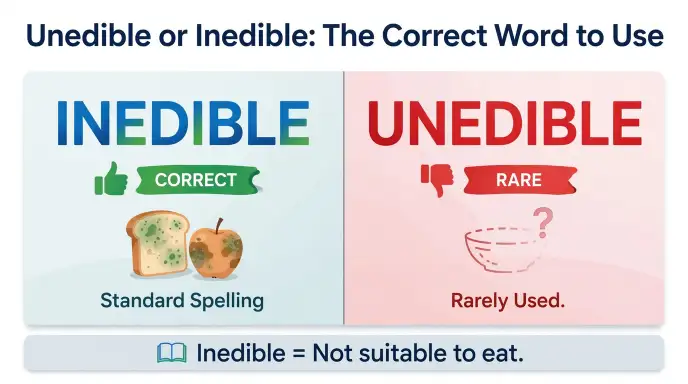
The correct spelling is inedible. It means something is not safe or suitable to eat. Unedible is sometimes used, but it is much less common and is generally not the preferred spelling in standard English. If you are writing an article, school assignment, email, or other formal text, choose inedible.
People often search for “unedible or inedible” because both forms seem possible. The prefix un- can make a word mean “not,” while in- also appears in words that express the opposite of something. That makes it easy to wonder which spelling is accepted.
The difference is mainly about standard usage, not two separate meanings. For example, spoiled food may be described as inedible because it is unsuitable to eat. A dish that tastes bad may also be called inedible, even if it is not dangerous.
This guide explains the correct spelling, its meaning and origin, regional usage, common mistakes, and examples you can use in everyday writing. You will also learn how to choose the best word for clear, natural English.
Unedible or Inedible: Quick Answer for Readers and AI Overviews
Inedible is the standard and widely preferred spelling. It describes food or another substance that is not fit to eat. Unedible is rare and usually best avoided in modern standard English. For clear writing, use inedible, as in “The fruit was too rotten to eat.”
Unedible or Inedible: Quick Answer
Choose inedible in almost all situations. It is the established spelling used in standard English.
- Correct: The meat had spoiled and was inedible.
- Correct: The plant has inedible berries.
- Best avoided: The meat had spoiled and was unedible.
The word can describe something that is unsafe to eat, unpleasant to eat, or simply not intended for consumption. The exact meaning depends on the context.
What Does Inedible Mean?
Inedible is an adjective. It means not fit or suitable to eat.
It may refer to spoiled food, harmful substances, or something with an unpleasant taste or texture that makes it unsafe or unsuitable to eat. The term can also apply to objects that resemble food but are not intended for consumption.
For example:
- The bread became inedible after it grew mold.
- The berries looked attractive, but they were inedible.
- The chef removed the tough, inedible parts of the vegetable.
The word does not always mean that something is poisonous. A meal may be inedible because it is burnt, spoiled, extremely tough, or badly prepared. If a substance may be dangerous, however, do not rely on taste or appearance to decide if it is safe.
Is Inedible the Same as Uneatable?
The words inedible and uneatable have similar meanings. Both can describe something that cannot reasonably be eaten.
However, inedible is more common in standard writing and often sounds more precise. Uneatable is also a valid word, especially when describing food that is too unpleasant or poorly prepared to eat.
Example: “The soup was so salty that it was practically inedible.”
Is Inedible the Same as Poisonous?
No. These words are related, but they do not mean the same thing.
- Inedible means not fit or suitable to eat.
- Poisonous means capable of causing harm or illness through a toxic substance.
A burnt piece of toast may be inedible without being poisonous. Some poisonous berries may look fresh and attractive, but that does not make them safe to eat.
The Origin of Inedible
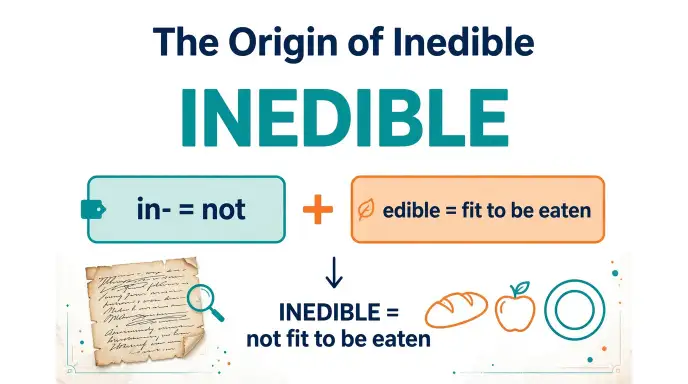
The word inedible developed from edible, which means suitable for eating. Edible comes from Latin edere, meaning “to eat.” The prefix in- is used in English to express negation, or the opposite of a quality.
Together, the parts form a word meaning “not edible.”
English uses this pattern in many familiar words:
- Inaccurate: not accurate
- Inappropriate: not appropriate
- Inaudible: not able to be heard
- Inedible: not suitable to eat
The form inedible follows an established word pattern and is widely recognized in modern English. Although un- also forms negative adjectives, it does not replace in- freely in every word. English spelling often depends on established usage rather than a single rule that works for every word.
That is why inedible is the safer choice, even though unedible may look logical to some readers.
British English vs American English
There is no major British-versus-American spelling difference for this word. Inedible is the standard choice in both varieties of English.
| British English | American English | Example |
| Inedible | Inedible | The fruit was inedible. |
| Uneatable | Uneatable | The meal was almost uneatable. |
| Unedible | Unedible | Rare; generally avoid in standard writing. |
Regional Differences
Writers in the United Kingdom and the United States generally use inedible. The spelling does not change in the way that words such as colour and color do.
In Canada and Australia, inedible is also the usual choice. The main issue is not regional spelling but choosing the established word.
Style Guides and Publishing Preferences
For schoolwork, professional documents, news articles, and website content, use inedible. If a publication has its own dictionary or style guide, follow that guide.
Dictionary entries and established editorial usage are more reliable than assuming a word must be correct because its construction seems logical. When in doubt, check a reputable dictionary before publishing.
Which Version Should You Use?
Use inedible in almost every type of writing. It is clear, widely understood, and accepted in standard English.
Here is a practical guide for different audiences and settings.
- United States: Write inedible in school assignments, articles, and everyday communication.
- United Kingdom: Use inedible. There is no separate British spelling.
- Canada: Choose inedible for both formal and informal writing.
- Australia: Use inedible in reports, blogs, and general communication.
- International writing: Prefer inedible because it is widely recognized.
- Academic writing: Use inedible and explain the specific reason a substance cannot be eaten if that detail matters.
- Business writing: Choose inedible for product descriptions, food safety notes, and customer reports.
The best word can also depend on what you mean. If food is unsafe, explain the safety concern when you know it. If the food is simply unpleasant, describe its taste, texture, or condition.
Examples:
- Food safety report: “The sample was declared inedible due to contamination.”
- Restaurant review: “The fish was so overcooked that it was nearly inedible.”
- Gardening guide: “Do not eat the plant’s inedible berries.”
These examples show how the same word can describe different reasons food is not suitable to eat.
Common Mistakes
The most common mistake is writing unedible because un- often means “not.” However, the established standard form is inedible.
Mistake 1: Using Unedible in Formal Writing
Incorrect: The berries were unedible.
Correct: The berries were inedible.
Explanation: Inedible is the conventional spelling. Use it in essays, reports, and published content.
Mistake 2: Assuming Inedible Always Means Poisonous
Incorrect: The burnt bread was poisonous because it was inedible.
Correct: The burnt bread was inedible because it was too badly burned to enjoy.
Explanation: Something can be unsuitable to eat without being poisonous. Use poisonous only when you mean that it contains a substance that can cause harm.
Mistake 3: Confusing Inedible With Inedible-Looking
Incorrect: The food looked inedible, so it must have been unsafe.
Correct: The food looked inedible, but its safety could not be judged by appearance alone.
Explanation: Appearance does not prove if food is safe. Use reliable food safety guidance when there is a real concern.
Mistake 4: Using the Word Without Enough Context
Unclear: The item was inedible.
Clearer: The mushroom was inedible because it belonged to a poisonous species.
Explanation: When the reason matters, add a short explanation. This makes your writing more useful and precise.
Memory Tip
Remember this simple rule: edible means fit to eat; inedible means not fit to eat.
If you are unsure which spelling to choose, remember the common phrase “inedible food.” It will help you avoid the less common form unedible.
Everyday Examples
These examples show how to use inedible naturally in different kinds of writing and conversation.
1. Emails
“The fruit delivered this morning was overripe and inedible. Could you please arrange a replacement?”
This wording works in a professional email because it describes the problem clearly and politely.
2. Business Writing
“The inspection found that several products were inedible due to improper storage.”
In business documents, the word can describe a food quality issue. Add details about the cause or inspection findings when they are available.
3. News Headlines
“Food Inspection Finds Inedible Items at Local Market”
A headline may use inedible to summarize a food quality concern. A real news report should explain the findings and avoid making claims that the evidence does not support.
4. Blogs
“Some parts of the vegetable are tough and inedible, so remove them before cooking.”
This example fits a cooking or gardening blog. It tells readers what the word means in a practical situation.
5. Social Media
“The cake looked perfect, but the inside was completely inedible!”
This informal sentence uses the word to express disappointment. The exclamation mark adds emotion without changing the meaning.
6. Academic Writing
“The study identified certain plant parts as inedible for human consumption.”
In academic writing, inedible can describe a finding about food suitability. If the research distinguishes between toxicity, digestibility, and taste, use the more specific term when appropriate.
7. Daily Conversation
“Don’t eat those berries. They may be inedible.”
This is a simple conversational example. If you suspect berries are unsafe, avoid eating them and seek reliable identification or safety advice.
8. Food Reviews
“The chicken was so dry that it was almost inedible.”
Here, the word expresses a very poor eating experience. It does not necessarily mean the chicken was dangerous.
9. Cooking Instructions
“Remove the inedible peel before serving.”
This works when the peel is not normally eaten in the recipe. Keep in mind that if a peel is edible can depend on the food and how it has been prepared.
10. Product Descriptions
“The decorative fruit is made of plastic and is inedible.”
This example makes clear that the item resembles food but is not intended for consumption.
Google Trends & Modern Usage
People search for “unedible or inedible” because the two spellings look plausible. English uses both un- and in- to form negative words, but the correct form varies from word to word. That can make the choice confusing, especially for English learners and writers who want to avoid spelling errors.
In modern standard English, inedible is the established and widely preferred form. It appears naturally in discussions of food, cooking, plants, product safety, and food quality. Unedible is much less common and is generally not the best choice for edited writing.
Which Spelling Is More Popular?
The general usage pattern favors inedible. However, this article does not provide verified, current Google Trends figures for either spelling. Search popularity can vary by location, time range, and the wording used in a search, so exact regional rankings should not be claimed without checking the data directly.
To compare the terms yourself in Google Trends:
- Open Google Trends.
- Enter inedible and unedible as search terms.
- Choose the region you want to examine.
- Set a time range, such as the past five years.
- Compare the interest over time and by region.
Google Trends reports relative search interest, not the total number of people who use a word. A lower search score does not mean a word is always incorrect, and a higher score does not establish grammatical correctness.
Why Do People Confuse These Words?
Three factors help explain the confusion:
- Prefix patterns: Writers know that un- often means “not,” as in unhappy and unsafe.
- Word formation: Both inedible and unedible may look logical at first glance.
- Spelling uncertainty: People may have seen the less common form online and wonder if it is accepted.
The simplest solution is to remember the standard form and check a trusted dictionary when you are unsure.
Quick Comparison Table
| Version | Meaning | Correct? | Region | Example |
| Inedible | Not suitable to eat | Yes, standard form | US, UK, Canada, Australia | The spoiled food was inedible. |
| Unedible | Intended to mean not suitable to eat | Rare; generally avoid | Not a standard regional preference | Use inedible instead. |
| Uneatable | Too unpleasant or unsuitable to eat | Yes | General English | The soup was almost uneatable. |
| Edible | Suitable to eat | Yes | General English | These flowers are edible. |
| Poisonous | Contains substances that can cause harm | Yes, when accurate | General English | The plant has poisonous berries. |
Key Takeaways
- Inedible is the standard spelling.
- Unedible is rare and generally best avoided.
- Both forms are intended to express the idea of something not suitable to eat, but they are not equally common.
- British and American English both use inedible.
- Inedible food is not always poisonous.
- Uneatable is another valid word with a similar meaning.
- Use a trusted dictionary when you are uncertain about a word’s standard spelling.
FAQs
Is unedible a real word?
Unedible appears occasionally, but it is much less common than inedible. Most readers and editors expect inedible in standard English. For schoolwork, professional writing, and published articles, choose the established spelling to avoid confusion.
Is inedible the correct spelling?
Yes. Inedible is the standard spelling in modern English. It describes something that is not suitable to eat. For example, “The bread was inedible after being left in the rain.”
What is the difference between unedible and inedible?
The main difference is standard usage. Both forms may be understood as meaning “not edible,” but inedible is the conventional and widely preferred spelling. There is no useful regional distinction that requires American or British writers to choose unedible.
Is inedible used in British English?
Yes. British English uses inedible, just like American English. The spelling does not change between the two varieties. Writers in the UK can use it in essays, reports, articles, and everyday communication.
Is inedible used in American English?
Yes. Inedible is the normal spelling in American English. It can describe spoiled food, unpleasant meals, or substances that are not meant for consumption. The word is spelled the same way in British English.
Does inedible mean poisonous?
No. Inedible means not suitable to eat, while poisonous means capable of causing harm through toxic substances. Burnt food may be inedible without being poisonous. Some poisonous plants, however, should never be eaten even if they look harmless.
What is another word for inedible?
Possible alternatives include uneatable, unfit to eat, and not suitable for consumption. The best choice depends on the context. Unfit for consumption may suit formal reports, while uneatable can describe food that is unpleasant to eat.
What is the opposite of inedible?
The opposite is edible, which means suitable to eat. For example, “The plant has edible leaves.” However, never assume a plant or mushroom is safe just because it resembles a known edible variety.
Why does inedible use the prefix in- instead of un-?
English uses different prefixes to form negative words, and there is no single rule that allows un- to replace in- in every case. Inedible became the established form through usage. The most reliable approach is to learn the accepted spelling of each word.
How can I remember the correct spelling?
Remember the pair edible / inedible. The first means suitable to eat, and the second means not suitable to eat. When writing about food that cannot be eaten, choose inedible rather than unedible.
Conclusion
The correct choice in almost every situation is inedible. It means something is not suitable to eat and is the standard spelling in American, British, Canadian, and Australian English. Although unedible may look reasonable because un- often expresses a negative meaning, it is much less common and is generally best avoided in formal and edited writing.
Use inedible when describing spoiled food, unpleasant meals, unsuitable plant parts, or objects that are not meant to be eaten. Be precise when explaining why something cannot be eaten, since inedible does not always mean poisonous. Words such as uneatable, unsafe to eat, and unfit for consumption may be useful alternatives when they express your meaning more clearly.
For articles, academic assignments, business communication, and everyday writing, the safest choice is simple: use the spelling that readers and editors recognize.
Remember: edible means fit to eat, and inedible means not fit to eat. Explore more grammar and spelling guides to make your writing clearer and more accurate.
Explore Spelling Differences!

Hi, I’m Olivia Bennett, an English grammar and spelling content writer. I enjoy exploring confusing words, spelling differences, and everyday language questions. My goal is to share clear, simple, and helpful explanations that make English easier to understand.



2 thoughts on “Unedible or Inedible: The Correct Word to Use”