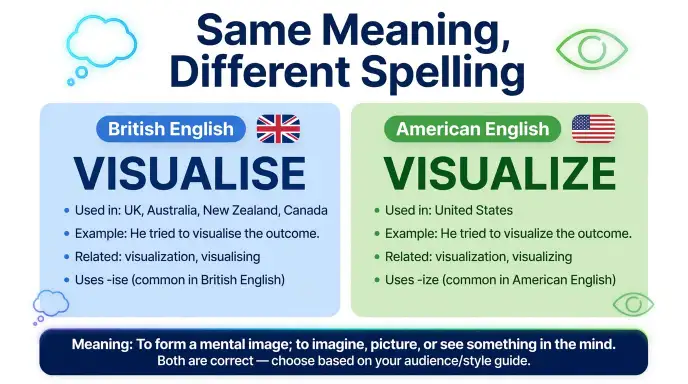
The main difference between visualise and visualize is regional spelling. Both words mean to form a picture in your mind or imagine something. Visualise is common in British English, while visualize is the standard American English spelling.
People often search for these spellings when writing essays, emails, blog posts, or professional documents. Spell-checkers may also suggest different versions depending on their language settings. This can make writers wonder if one spelling is incorrect.
The good news is that both forms are correct. The best choice depends on your audience and the style guide you follow. Some British publishers also prefer visualize, so the difference is not always strictly British versus American.
This guide explains the meaning, origin, regional spelling preferences, and everyday use of both forms. You will also find practical examples, common mistakes, and tips for choosing the right spelling for your writing.
Featured Snippet: Is It Visualise or Visualize?
Visualise is common in British English, while visualize is the standard American spelling. Both words mean to imagine something or form a mental picture. For example, a British writer might say, “Visualise your goal,” while an American writer would write, “Visualize your goal.” The meaning remains the same.
Visualise or Visualize: Quick Answer
Both spellings are correct. Choose the version that matches your audience or publication guidelines.
- Visualise: Common in British English.
- Visualize: Standard in American English and also accepted by some British style guides.
- Meaning: To imagine something or represent it visually.
Examples:
- British English: Try to visualise the finished design.
- American English: Try to visualize the finished design.
- Technical writing: The software helps users visualize complex data.
Neither spelling changes the meaning or pronunciation of the word.
What Does Visualise or Visualize Mean?
Both words mean to form a picture in your mind, imagine a situation, or present information in a visual form.
1. To Imagine Something
Use the word when you picture something that is not physically present.
Example: “She tried to visualise her new home before construction began.”
This meaning often appears in planning, sports, creative work, and personal development.
2. To Represent Information Visually
The word can also describe turning information into charts, diagrams, maps, or other visual formats.
Example: “The report uses graphs to visualize changes in sales.”
This use is common in business, education, science, and technology.
3. To Picture a Future Event
People also use the word when imagining a possible result or outcome.
Example: “The team visualised a successful product launch.”
In each context, visualise and visualize have the same meaning. Only the spelling changes.
The Origin of Visualise or Visualize
Both spellings come from visual, a word related to sight and seeing. The verb combines visual with the ending -ise or -ize to describe forming a mental image or making something visible.
The verb visualize dates back to the early nineteenth century. Etymological references record its use around 1817, including in the work of writer Samuel Taylor Coleridge.
The spelling difference reflects English language traditions. American English generally favors -ize, while many British publications use -ise in words such as visualise, organise, and recognise.
However, British spelling rules are not always uniform. Some British dictionaries and style guides accept or prefer visualize. The preferred form can depend on the publisher’s chosen convention.
This is why both spellings may appear in British books, newspapers, and academic writing. Rather than assuming one form is always wrong, check the spelling rules that apply to your work.
British English vs American English
The usual pattern is visualise in British-style writing and visualize in American English. Both are correct, but you should follow one spelling convention throughout a document.
| British English | American English | Example |
| Visualise | Visualize | Visualise the final result. |
| Visualised | Visualized | She visualised the room. |
| Visualising | Visualizing | He is visualising the design. |
| Visualisation | Visualization | Visualisation helps with planning. |
| Visualiser | Visualizer | The visualiser created a diagram. |
Why Do the Spellings Differ?
British English often uses -ise, while American English usually favors -ize. Similar differences appear in words such as:
- British: organise, realise, recognise
- American: organize, realize, recognize
However, some British style guides prefer -ize. This means visualize is not automatically incorrect in British English.
What About Publishing Preferences?
Schools, publishers, and businesses may follow different dictionaries or style guides. One British publisher may prefer visualise, while another may use visualize.
If you are writing for a specific publication, follow its rules instead of relying only on regional spelling habits.
Which Version Should You Use?
Choose the spelling that suits your readers and keep it consistent.
- United States: Use visualize. It is the standard American spelling.
- United Kingdom: Visualise is common, but check if your publisher prefers visualize.
- Canada: Follow your school, employer, or publisher’s style guide.
- Australia: Visualise is a common choice.
- International writing: Choose a spelling convention based on your main audience.
- Academic writing: Follow the university or journal’s style guide.
- Business writing: Match the spelling used in company documents and client communications.
For a US-focused blog, visualize is usually the best option. For a British audience, visualise is a natural choice.
The key is consistency. Readers can understand both spellings, but switching between them without a reason can make your writing look unedited.
Common Mistakes With Visualise or Visualize
Writers often assume that one spelling must be wrong. In most cases, the difference comes down to regional preferences or a style guide.
Mistake 1: Calling Visualise Incorrect
Incorrect claim: “Visualise” is always a spelling mistake.
Correct explanation: Visualise is a recognized spelling and is common in British English.
Mistake 2: Calling Visualize Incorrect in British English
Incorrect claim: British writers must never use “visualize.”
Correct explanation: Some British dictionaries and style guides accept visualize. Check the rules you need to follow.
Mistake 3: Mixing Both Spellings
Inconsistent: “Visualise the design, then visualize the final result.”
Better: “Visualise the design, then visualise the final result.”
An American version would use visualize in both places. The goal is to follow one convention throughout the document.
Mistake 4: Assuming the Meaning Changes
Incorrect assumption: The s spelling has a different meaning from the z spelling.
Correct explanation: Both forms mean to imagine something or represent it visually.
Memory tip: Remember visualise as a common British spelling and visualize as the standard American spelling.
Everyday Examples of Visualise or Visualize
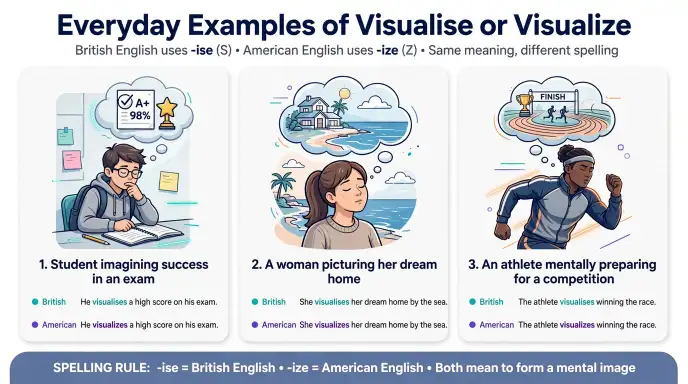
These examples show how the word appears in different situations. The spelling changes according to the chosen English convention, but the meaning stays the same.
Emails
British: “Please visualise how the new layout will look before our meeting.”
American: “Please visualize how the new layout will look before our meeting.”
Business Writing
British: “The chart helps managers visualise monthly sales patterns.”
American: “The chart helps managers visualize monthly sales patterns.”
News Headlines
British: “Scientists Visualise the Future of Clean Energy”
American: “Scientists Visualize the Future of Clean Energy”
Blogs
British: “Learn how to visualise your goals before making a plan.”
American: “Learn how to visualize your goals before making a plan.”
Social Media
British: “Take a moment to visualise your next big achievement.”
American: “Take a moment to visualize your next big achievement.”
Academic Writing
British: “The diagram helps readers visualise the relationship between the variables.”
American: “The diagram helps readers visualize the relationship between the variables.”
Daily Conversation
British: “Can you visualise what the garden will look like in spring?”
American: “Can you visualize what the garden will look like in spring?”
Google Trends and Modern Usage
Both spellings remain in modern use, but their popularity can vary by country, audience, and context. American publications generally favor visualize, while visualise is common in British-style writing.
People search for this spelling comparison when checking school assignments, proofreading articles, writing for international readers, or correcting spell-checker suggestions.
The word also appears in several fields. In everyday conversation, it often means imagining a person, place, or outcome. In science and technology, it can mean presenting information through charts, diagrams, or other visual methods.
Exact popularity figures should not be claimed without checking current data. Google Trends can compare relative search interest across regions and time periods, but its figures are not total search counts.
Search interest alone cannot determine which spelling is correct. Dictionaries and style guides provide better guidance for choosing the appropriate form.
Quick Comparison Table
| Version | Meaning | Correct? | Region | Example |
| Visualise | Imagine or form a mental picture | Yes | Common in British English | Visualise the result. |
| Visualize | Imagine or form a mental picture | Yes | Standard in American English | Visualize the result. |
| Visualised | Past tense of visualise | Yes | British-style spelling | She visualised the room. |
| Visualized | Past tense of visualize | Yes | American-style spelling | She visualized the room. |
| Visualising | Present participle of visualise | Yes | British-style spelling | He is visualising the design. |
| Visualizing | Present participle of visualize | Yes | American-style spelling | He is visualizing the design. |
Key Takeaways
- Visualise and visualize have the same meaning.
- Visualise is common in British English.
- Visualize is the standard American spelling.
- Some British dictionaries and style guides also accept visualize.
- Neither spelling is universally wrong.
- Choose the version that suits your readers or publication.
- Keep your spelling consistent throughout each document.
FAQs
Is visualise or visualize correct?
Both spellings are correct. Visualise is common in British English, while visualize is standard in American English. Some British style guides also prefer the -ize ending, so check the rules used by your publisher or institution.
Is visualize American or British English?
Visualize is the standard American spelling, but it is also accepted in British English by some dictionaries and style guides. For writing aimed at a US audience, it is the usual choice.
Is visualise British English?
Yes. Visualise is a common British English spelling. It is widely understood and accepted in British-style writing, although some British publications prefer visualize under their chosen spelling conventions.
Do visualise and visualize mean the same thing?
Yes. Both mean to form a picture in your mind or represent information visually. The difference is spelling, not meaning or grammatical use.
Which spelling should I use in an essay?
Follow the spelling rules requested by your teacher, university, or style guide. If no rules are provided, choose the version that matches your preferred variety of English and use it consistently.
Is visualise wrong in American English?
It is not the usual American spelling, but readers can understand it. For standard American writing, use visualize to match common US spelling conventions and keep your work consistent.
Does Oxford English use visualise or visualize?
Oxford spelling conventions commonly use -ize in words such as visualize, while recognizing visualise as an alternative. Other British publishers may use -ise, so the preferred form depends on the style guide.
What is the past tense of visualize?
The past tense is visualized. In British-style spelling that uses visualise, the past tense is visualised. For example, “She visualized the room” and “She visualised the room” are both correct.
Is visualization or visualisation correct?
Both forms are used. Visualization is standard in American English and also appears in Oxford-style British English. Visualisation is common in British-style writing that prefers -ise spellings.
Conclusion
The choice between visualise or visualize comes down to spelling preference, not meaning. Both words describe imagining something or representing it visually. The main difference is that visualise is common in British English, while visualize is standard in American English.
For US readers, visualize is usually the best choice. For British readers, visualise is a familiar option, although some British dictionaries and publishers prefer visualize. Canadian and Australian writers should follow local conventions or the style guide used by their school, workplace, or publication.
When writing an essay, email, report, or blog post, avoid switching between the two forms without a clear reason. Consistent spelling makes your work easier to read and gives it a polished appearance.
Explore Word Differences!

I’m Ethan Carter, a grammar-focused writer and English language enthusiast at SpellGrammar. I enjoy explaining confusing words, spelling differences, and grammar rules in clear, simple language. My goal is to help readers write with greater accuracy and confidence in everyday and professional English.




1 thought on “Visualise or Visualize: Meaning, Spelling, and Usage”