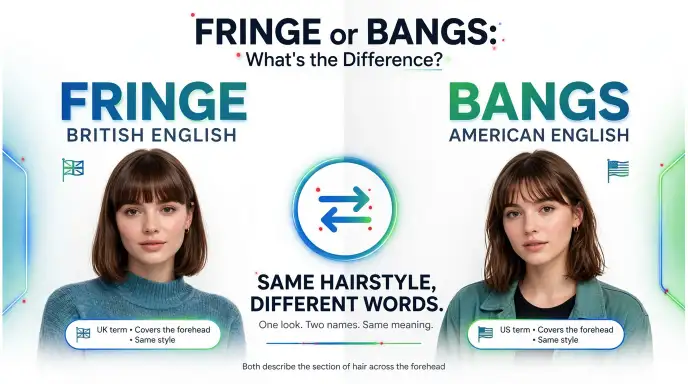
Choosing between fringe or bangs can be confusing because both words describe hair that falls over the forehead. The main difference is regional: “fringe” is the usual term in British English, while “bangs” is the usual term in American English. Both words are correct and describe the same basic hairstyle.
You may see “fringe” in a British hair salon or an Australian beauty magazine. In the United States, people usually say “bangs” when talking about the same haircut. Both terms can describe several styles, including blunt cuts, curtain bangs, side-swept hair, and wispy layers.
Understanding this difference can help you choose the right word for your audience. It is especially useful when writing about hairstyles, creating beauty content, booking a salon appointment, or communicating with readers from different countries.
In this guide, you will learn what each word means, where the terms came from, how different English-speaking regions use them, and which word to choose for your writing. You will also find practical examples, common mistakes, and answers to frequently asked questions.
Fringe or Bangs: The Difference Explained
In British English, fringe refers to hair cut to hang over the forehead, while Americans usually call the same hairstyle bangs. Both terms are correct, so choose the one that best suits your audience.
Fringe or Bangs: Quick Answer
- Fringe: The common British English term for hair that hangs over the forehead.
- Bangs: The common American English term for the same hairstyle.
- Both: Correct words that differ mainly by region.
Examples:
- British English: “I want a short fringe.”
- American English: “I want short bangs.”
- International English: “Curtain bangs, also called a curtain fringe, frame both sides of the face.”
What Does Fringe or Bangs Mean?
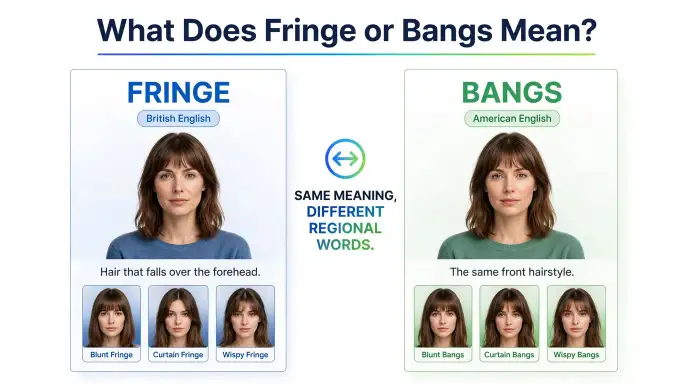
Both words describe the front section of hair that falls over the forehead. A stylist cuts this section shorter than the surrounding hair to create a particular shape or look.
What Does Fringe Mean?
A fringe is the British English word for hair that hangs over the forehead. It can be short, long, thick, thin, straight, or swept to one side.
Common styles include:
- Blunt fringe: Hair cut in a straight line across the forehead.
- Curtain fringe: Hair parted in the middle and swept to both sides.
- Wispy fringe: Thin, light strands that create a soft look.
- Side fringe: Hair brushed diagonally across the forehead.
Example: “She asked her hairdresser to trim her fringe before the wedding.”
The word fringe also has other meanings. It can describe hanging threads on fabric or something at the edge of an area. The context makes the intended meaning clear.
What Do Bangs Mean?
Bangs is the common American English term for the same front section of hair. Americans use it when discussing haircuts, styling choices, and beauty trends.
Common styles include:
- Blunt bangs: A straight, even cut across the forehead.
- Curtain bangs: Longer strands that frame the face.
- Wispy bangs: Soft, lightly cut hair.
- Side-swept bangs: Hair brushed toward one side.
Example: “She decided to get bangs before starting her new job.”
In American English, bangs is normally plural when referring to this hairstyle. You would usually say “My bangs are too long,” not “My bang is too long.”
The Origin of Fringe and Bangs
The two words developed through different paths. Their histories help explain why English speakers use different terms for the same hairstyle.
The History of Fringe
The word fringe dates back to Middle English and came through Old French frenge, which referred to a border or edge made from threads. Its deeper roots trace back to Latin words associated with fibers and threads.
Over time, the word gained broader meanings. It came to describe the outer edge of something, decorative threads on fabric, and hair hanging over the forehead.
The hairstyle meaning fits the idea of hair forming a border along the top of the face. British English eventually established fringe as the usual everyday term for this haircut.
The History of Bangs
The hairstyle meaning of bangs developed in American English. Historical records show the hair-related term in the nineteenth century, with earlier use of bang associated with horses’ tails cut short. The exact connection between these uses is not completely certain.
The term became established in American vocabulary and remains the standard everyday word for this hairstyle in the United States.
Why Are There Two Different Words?
English has many regional vocabulary differences. For example, British speakers often say lift, while Americans say elevator. Similarly, British speakers tend to say fringe, while Americans tend to say bangs.
Neither term is a newer or more correct version of the other. They are established regional choices for the same hairstyle.
British English vs American English
The main difference is regional preference, not meaning or spelling accuracy.
| British English | American English | Example |
| Fringe | Bangs | My fringe needs trimming. / My bangs need trimming. |
| Curtain fringe | Curtain bangs | She chose a curtain fringe. / She chose curtain bangs. |
| Side fringe | Side-swept bangs | He likes a side fringe. / He likes side-swept bangs. |
| Wispy fringe | Wispy bangs | A wispy fringe softens the look. / Wispy bangs soften the look. |
| Blunt fringe | Blunt bangs | She prefers a blunt fringe. / She prefers blunt bangs. |
What About Canada?
Canadian English commonly uses bangs, particularly in everyday conversation and hair styling. However, usage can vary with personal preference and exposure to British English.
What About Australia?
Fringe is widely used in Australian English, in line with British usage. You may still encounter bangs in international beauty content, especially when discussing American trends.
Do Style Guides Prefer One Word?
Style guides generally focus on consistency and audience. A publication using American English should usually choose bangs, while a British English publication should normally use fringe.
Neither word is inherently more formal. Both work in everyday writing, professional beauty articles, and salon descriptions when they suit the intended audience.
Which Version Should You Use?
Choose the word your readers are most likely to recognize.
- United States: Use bangs. Example: “How to style curtain bangs.”
- United Kingdom: Use fringe. Example: “How to style a curtain fringe.”
- Canada: Bangs is a common choice, though either term may be understood.
- Australia: Prefer fringe for writing aimed at a local audience.
- International writing: Introduce both terms when readers come from different English-speaking regions.
- Academic writing: Follow the required English variety and use the chosen term consistently.
- Business writing: Match the vocabulary of your customers, publication, or brand.
What Should Beauty Bloggers Use?
If your blog targets US readers, use bangs in your title, headings, and main text. If your audience is mainly in the UK or Australia, fringe is usually the better choice.
For international readers, introduce both terms once:
“Fringe, also called bangs in American English, is the front section of hair cut to fall over the forehead.”
After that, choose one main term and use it consistently. This keeps the article clear without repeating both words in every sentence.
What Should You Say at a Hair Salon?
Use the local term, but describe the style you want as well. A stylist can better understand your request when you mention the length, shape, and parting.
For example:
- In London: “I’d like a soft, curtain-style fringe.”
- In New York: “I’d like soft curtain bangs.”
- In an international salon: “I’d like face-framing hair at the front, parted in the middle.”
A photo can also help you communicate the desired result.
Common Mistakes
Although fringe and bangs mean the same thing in this context, writers sometimes confuse their regional use, grammar, or meaning.
Mistake 1: Treating One Word as Incorrect
Incorrect claim: “Bangs is wrong because fringe is the proper English word.”
Correct explanation: Both are correct. Fringe is standard in British English, while bangs is standard in American English.
Memory tip: Think of the country first, then choose the word.
Mistake 2: Using the Wrong Verb With Bangs
Incorrect: “My bangs is too long.”
Correct: “My bangs are too long.”
The hairstyle noun bangs is normally plural in American English, so it takes a plural verb.
With fringe, the noun is usually singular:
- Correct: “My fringe is too long.”
- Correct: “My bangs are too long.”
Memory tip: One fringe, but a pair of bangs in ordinary American usage.
Mistake 3: Confusing Bangs With a Loud Noise
The word bangs can also refer to loud, sudden noises. The meaning depends on the sentence.
- Hairstyle: “She brushed her bangs away from her eyes.”
- Noise: “We heard loud bangs outside.”
Memory tip: If the sentence mentions hair, a forehead, or a haircut, bangs probably refers to the hairstyle.
Mistake 4: Switching Terms Without a Reason
Less consistent: “This guide explains how to trim your fringe. These bangs look great with long hair.”
Better: “This guide explains how to trim your fringe. This style looks great with long hair.”
The second version avoids an unnecessary shift in terminology. You can still explain the regional alternative once at the beginning.
Mistake 5: Assuming Every Fringe Has the Same Shape
A fringe can be straight, curved, wispy, or swept to the side. Bangs can have these styles, too.
Better: Describe the specific cut, such as a blunt fringe, curtain bangs, or a side-swept fringe.
This makes your writing more useful to readers looking for a particular hairstyle.
Everyday Examples
The following examples show how to use both terms in different situations.
1. Emails
British English: “Hi Emma, could you recommend a salon that trims fringes?”
American English: “Hi Emma, could you recommend a salon that trims bangs?”
Both sentences are correct. The difference is regional vocabulary.
2. Business Writing
British English: “Our salon now offers fringe trimming and styling.”
American English: “Our salon now offers bang trims and styling.”
Businesses should use the terminology their customers recognize.
3. News Headlines
British English: “Curtain Fringe Styles Return to Fashion”
American English: “Curtain Bangs Are Back in Style”
Both headlines communicate the same trend.
4. Blogs
British English: “Five Ways to Style a Wispy Fringe”
American English: “Five Ways to Style Wispy Bangs”
These titles target readers who use different regional terms.
5. Social Media
British English: “Thinking about getting a new fringe!”
American English: “Thinking about getting new bangs!”
Both sound natural for their respective audiences.
6. Academic Writing
British English: “The character’s fringe partly covered her forehead.”
American English: “The character’s bangs partly covered her forehead.”
Either sentence is suitable for discussing a character’s appearance.
7. Daily Conversation
British English: “Do you think I should get a fringe?”
American English: “Do you think I should get bangs?”
The question is the same. Only the preferred regional word changes.
Google Trends and Modern Usage
People search for fringe or bangs because they want to know which word is correct, which term to use in a particular country, or how to describe a haircut when speaking to a stylist.
The topic also appears in beauty searches involving curtain styles, face-framing cuts, short hairstyles, and salon appointments.
Which Word Is More Popular?
The answer depends on the region and search period. In general, fringe is associated with British English, while bangs is associated with American English.
These patterns do not establish exact search volumes. Without checking a specific Google Trends comparison, it would be misleading to claim that one term receives a particular percentage more searches than the other.
How to Check Google Trends
You can compare fringe and bangs by selecting a country and time range in Google Trends. The results show relative search interest rather than exact total search counts.
Why Do People Search for This Difference?
Common reasons include:
- Learning British and American English.
- Choosing the right wording for a beauty blog.
- Understanding salon menus in another country.
- Comparing haircut names on social media.
- Improving vocabulary as an English learner.
For grammar and vocabulary websites, this is a useful example of regional English variation. Two different words can describe exactly the same thing.
Quick Comparison Table
| Version | Meaning | Correct? | Region | Example |
| Fringe | Hair that hangs over the forehead | Yes | Mainly UK and Australia | She trimmed her fringe. |
| Bangs | Hair that hangs over the forehead | Yes | Mainly US and common in Canada | She trimmed her bangs. |
| Curtain fringe | Front hair parted and swept to both sides | Yes | Common in British usage | She chose a curtain fringe. |
| Curtain bangs | Front hair parted and swept to both sides | Yes | Common in American usage | She chose curtain bangs. |
| Side fringe | Front hair swept to one side | Yes | Common in British usage | He prefers a side fringe. |
| Side-swept bangs | Front hair swept to one side | Yes | Common in American usage | He prefers side-swept bangs. |
Key Takeaways
- Fringe and bangs describe the same basic hairstyle.
- Fringe is the usual term in British English.
- Bangs is the usual term in American English.
- Both words are correct; neither is universally better.
- Canadian English commonly uses bangs, while fringe is widely used in Australia.
- Use the term that matches your readers and keep it consistent.
- Describe the cut’s length and shape when giving salon instructions.
- Check Google Trends for regional search comparisons rather than guessing statistics.
Frequently Asked Questions
1. Is fringe or bangs correct?
Both are correct. Fringe is common in British English, while bangs is common in American English. Both describe hair that hangs over the forehead.
2. Do British people say fringe or bangs?
British people generally say fringe. For example, “I need to get my fringe trimmed.” The word bangs is also understood by many British speakers.
3. Do Americans say fringe or bangs?
Americans usually say bangs. They use this word when discussing haircuts, styling, and salon appointments.
4. Are fringe and bangs the same hairstyle?
Yes. Both describe hair cut to fall over the forehead. The difference is mainly regional, not the hairstyle itself.
5. Is fringe singular and bangs plural?
Usually, yes. You say “My fringe is long” in British English and “My bangs are long” in American English.
6. Do Canadians say fringe or bangs?
Bangs is commonly used in Canada, although some speakers also use fringe. Both terms may be understood.
7. Do Australians say fringe or bangs?
Australians widely use fringe. The word bangs is also familiar through American media and international beauty content.
8. What are curtain bangs called in the UK?
They are commonly called a curtain fringe in the UK. The style features a middle part, with hair swept to both sides of the face.
9. Which word should I use in an article?
Use bangs for a US audience and fringe for a UK or Australian audience. For international readers, explain both terms near the beginning.
Conclusion
The choice between fringe or bangs comes down to regional English, not correctness. Both words describe hair that hangs over the forehead, but British English generally favors fringe, while American English usually favors bangs. Canadian speakers commonly use bangs, and fringe is widely used in Australia.
When writing an article, select the term that best fits your audience. American beauty blogs will usually benefit from using bangs, while British publications should generally use fringe. For international readers, explain both words once so everyone understands the meaning.
The same advice applies to everyday conversations and salon appointments. Use the familiar local term and describe the style you want, if it is blunt, wispy, curtain-shaped, or swept to one side. If you are unsure, a photo can help you communicate your preference clearly.
For English learners, this is a useful reminder that regional vocabulary can differ without either version being wrong. Remember: fringe in British English, bangs in American English, and the same hairstyle in both.
Explore more grammar and vocabulary guides to build your confidence in everyday writing.
Learn More About English Grammar!

Hi, I’m Olivia Bennett, an English grammar and spelling content writer. I enjoy exploring confusing words, spelling differences, and everyday language questions. My goal is to share clear, simple, and helpful explanations that make English easier to understand.



1 thought on “Bangs or Fringe: Meaning, Usage, and Examples”