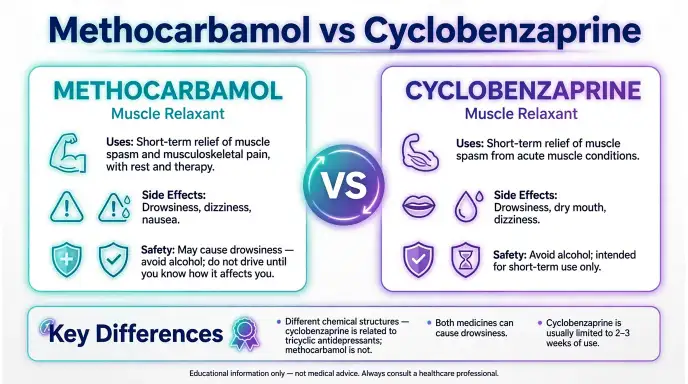
Methocarbamol and cyclobenzaprine are both prescription muscle relaxants, but they are different medicines with different side effects and safety concerns. Doctors may prescribe either drug to help relieve muscle spasms and discomfort, often alongside rest and physical therapy.
People search for methocarbamol or cyclobenzaprine because they want to know which medicine works better, which causes less drowsiness, or which may be safer for their needs. Although both drugs can help with certain painful muscle conditions, they are not interchangeable for everyone.
Methocarbamol works on the central nervous system to help reduce muscle spasms. Cyclobenzaprine also acts on the central nervous system and is commonly used for short,term relief of muscle spasms. Neither medicine directly repairs an injured muscle, and both can cause unwanted effects.
The best choice depends on your symptoms, medical history, other medicines, and response to treatment. This guide explains the main differences, common uses, side effects, and safety precautions.
Methocarbamol or Cyclobenzaprine: Quick Answer
Methocarbamol and cyclobenzaprine are prescription muscle relaxants used to relieve muscle spasms. Neither is universally better. Cyclobenzaprine commonly causes drowsiness and dry mouth, while methocarbamol can also cause sleepiness, dizziness, and reduced alertness. A healthcare professional should choose between them based on your condition, health history, and other medicines.
Examples:
- A person with an acute muscle strain may be prescribed either medicine.
- Someone who experiences strong side effects may need a different treatment.
- A person taking other sedating medicines needs a careful safety review before using either drug.
Definition and Meaning of Methocarbamol or Cyclobenzaprine
What Is Methocarbamol?
Methocarbamol is a prescription medicine used to relieve discomfort from acute, painful muscle conditions. It works on the central nervous system, which includes the brain and spinal cord, to help reduce muscle spasms.
Doctors may prescribe it as part of a treatment plan that includes rest, physical therapy, and other measures.
Common side effects include:
- Drowsiness
- Dizziness
- Lightheadedness
- Nausea or stomach discomfort
Methocarbamol may affect your ability to drive or operate machinery. Alcohol and other medicines that cause sleepiness can increase these risks.
What Is Cyclobenzaprine?
Cyclobenzaprine is a prescription muscle relaxant used for short,term relief of muscle spasms associated with acute musculoskeletal conditions. It acts on the central nervous system and is structurally related to certain antidepressants, but it is not used as an antidepressant.
Common side effects include:
- Drowsiness
- Dry mouth
- Dizziness
- Fatigue
Cyclobenzaprine may not be suitable for people with certain heart conditions, some thyroid conditions, or specific medication interactions. It also has important restrictions for people taking certain antidepressants and other drugs that affect serotonin.
What Is the Main Difference?
Both medicines can relieve muscle spasms, but their side,effect profiles, drug interactions, and restrictions differ.
| Feature | Methocarbamol | Cyclobenzaprine |
| Drug type | Muscle relaxant | Muscle relaxant |
| Main use | Relief of acute muscle discomfort and spasms | Short,term relief of acute muscle spasms |
| Common side effects | Drowsiness, dizziness | Drowsiness, dry mouth, dizziness |
| Driving concerns | Can reduce alertness | Can reduce alertness |
| Alcohol | Can increase sedation | Can increase sedation |
| Treatment duration | Depends on the condition and prescription | Generally intended for short,term use |
| Best choice | Depends on individual factors | Depends on individual factors |
The Origin of Methocarbamol and Cyclobenzaprine
The names methocarbamol and cyclobenzaprine are generic drug names, not alternative spellings of the same word.
The History of Methocarbamol
Methocarbamol is the generic name of a centrally acting muscle relaxant. Its name identifies a specific chemical medicine. It is not a regional spelling variation of another drug.
The History of Cyclobenzaprine
Cyclobenzaprine is also a generic drug name. It identifies a different medicine with its own chemical structure, prescribing information, and safety profile.
Why Are the Names Different?
Each medicine has a distinct chemical identity. Their names reflect different drug compounds rather than differences between British and American English.
Both names are generally spelled the same way in US and UK medical writing. Brand names may differ by country, but the generic names identify the medicines themselves.
British English vs American English Spelling
Unlike common word pairs such as color and colour, methocarbamol and cyclobenzaprine do not have standard British and American spelling variants.
| Term | American English | British English | Difference |
| Methocarbamol | Methocarbamol | Methocarbamol | No spelling difference |
| Cyclobenzaprine | Cyclobenzaprine | Cyclobenzaprine | No spelling difference |
| Muscle relaxant | Muscle relaxant | Muscle relaxant | Same spelling |
| Prescription | Prescription | Prescription | Same spelling |
Are the Medicines Available Under Different Brand Names?
Brand names and product availability can vary by country. Generic names remain the clearest way to identify the active medicine.
When reading a prescription or medicine label, check the active ingredient rather than relying only on a brand name. If a label is unclear, ask a pharmacist to confirm the product.
Which Medicine Should You Use?
There is no single choice that is right for everyone. A healthcare professional should consider the cause of your muscle pain, your other health conditions, your current medicines, and your risk of side effects.
- United States: Follow the prescription and product information provided by your clinician or pharmacist.
- United Kingdom: Check local prescribing guidance and the specific product information.
- Other countries: Confirm that the medicine is approved and available locally.
- People who drive or operate machinery: Discuss the risk of drowsiness before taking either drug.
- Older adults: Ask about added risks, especially with cyclobenzaprine, which can be problematic for some older people.
- People taking several medicines: Have a pharmacist review possible interactions before starting treatment.
Which One Causes Less Drowsiness?
Both medicines can cause drowsiness, dizziness, and reduced alertness. Individual reactions vary, and it is not reliable to assume that methocarbamol will always cause less sleepiness than cyclobenzaprine.
Do not drive until you know how your prescribed medicine affects you. Avoid alcohol and ask your pharmacist about other medicines that may increase sedation.
Can You Take Them Together?
Do not combine methocarbamol and cyclobenzaprine unless your prescriber specifically directs you to do so. Both affect the central nervous system, and taking them together may increase drowsiness, dizziness, and other adverse effects.
Tell your clinician about all prescription medicines, over,the,counter products, and supplements you use.
How Long Should You Take Them?
Cyclobenzaprine is generally prescribed for short,term use, commonly no longer than two to three weeks for acute muscle spasms. The appropriate duration for methocarbamol depends on the condition and the prescriber’s instructions.
Do not increase the dose or extend treatment without checking with your clinician or pharmacist.
Common Mistakes With Methocarbamol or Cyclobenzaprine
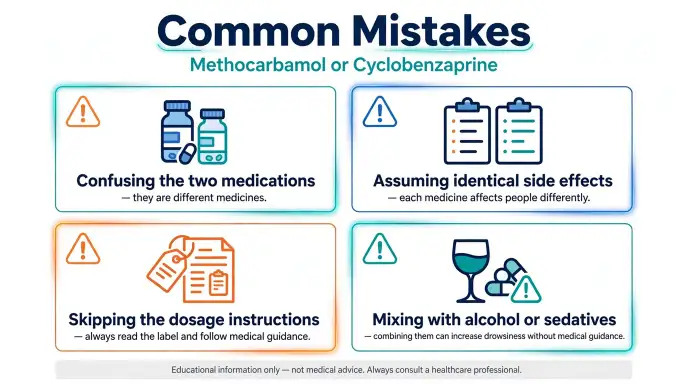
Mistake 1: Assuming Both Drugs Are the Same
Incorrect: “Methocarbamol and cyclobenzaprine are the same medicine.”
Correct: They are different medicines that belong to the muscle relaxant category.
Why it matters: Their doses, interactions, and precautions differ.
Mistake 2: Choosing Based Only on Drowsiness
Incorrect: “Methocarbamol never causes sleepiness.”
Correct: Both drugs can cause drowsiness and dizziness.
Why it matters: Your response depends on several factors, including other medicines and your health.
Mistake 3: Taking Both Without Medical Advice
Incorrect: “Taking both will always relieve spasms faster.”
Correct: Combining them can increase side effects and should only happen under specific medical direction.
Memory tip: Two muscle relaxants do not automatically provide better relief.
Mistake 4: Ignoring Drug Interactions
Both medicines can interact with alcohol and other drugs that cause sedation. Cyclobenzaprine also has important interactions with certain antidepressants and other medicines.
Better approach: Give your pharmacist a complete list of the medicines and supplements you take.
Mistake 5: Treating Muscle Pain Without Checking Its Cause
Muscle pain can result from strains, injuries, nerve problems, or other conditions. Muscle relaxants do not treat every cause of pain.
Seek medical advice if pain is severe, persistent, or getting worse. Get urgent care for symptoms such as new weakness, loss of bladder or bowel control, or difficulty breathing.
Methocarbamol or Cyclobenzaprine in Everyday Examples
These examples show how the medicine names may appear in common situations. They are educational examples, not individual treatment instructions.
1. Emails
Example: “Could you explain the differences between methocarbamol and cyclobenzaprine before my appointment?”
This question helps a patient prepare for a discussion with a healthcare professional.
2. Medical Writing
Example: “The clinician reviewed the potential benefits, side effects, and interactions of both muscle relaxants.”
Medical writing should distinguish the drugs clearly and avoid claiming that one is safer for every patient.
3. Health News
Example: “Patients Should Review Muscle Relaxant Risks With Their Clinicians.”
A responsible headline focuses on safety and informed decisions rather than promising a cure.
4. Health Blogs
Example: “Understanding Methocarbamol and Cyclobenzaprine: Uses and Side Effects.”
A useful article explains what each medicine does, how their risks differ, and when professional advice is needed.
5. Social Media
Example: “Muscle relaxants can cause drowsiness. Follow your prescription and ask a pharmacist about possible interactions.”
Short health messages should provide safe, practical advice without recommending a particular drug to everyone.
6. Academic Writing
Example: “Methocarbamol and cyclobenzaprine are centrally acting muscle relaxants with different safety considerations.”
Formal writing should rely on clinical evidence and current prescribing information.
7. Daily Conversation
Example: “My doctor prescribed a muscle relaxant. I want to understand its side effects.”
Patients should know the medicine’s name, prescribed dose, possible interactions, and warning signs before starting treatment.
Methocarbamol or Cyclobenzaprine: Google Trends and Usage Data
People search for these medicine names to compare effectiveness, side effects, drowsiness, cost, and treatment options for muscle spasms.
Which Medicine Is More Popular?
Search interest can change by country and over time. Prescription patterns, brand availability, and public awareness may affect which name people search for more often.
Without checking a specific time period and region, it would be misleading to claim that one drug receives more searches or prescriptions than the other.
Why Do People Compare These Medicines?
Common reasons include:
- Understanding differences in side effects.
- Learning about short,term muscle spasm treatment.
- Asking if one medicine causes less drowsiness.
- Checking possible interactions with other drugs.
- Preparing questions for a medical appointment.
How to Check Search Interest
You can compare the two medicine names in Google Trends by selecting your country and a time range. The results show relative search interest rather than exact total search counts.
Remember that search interest does not prove that a drug works better, is safer, or is prescribed more often. Those questions require reliable clinical evidence.
Quick Comparison Table
| Feature | Methocarbamol | Cyclobenzaprine |
| Main purpose | Relief of acute muscle spasms | Short,term relief of acute muscle spasms |
| Common side effects | Drowsiness, dizziness | Drowsiness, dry mouth, dizziness |
| Alcohol concerns | Can increase sedation | Can increase sedation |
| Important precautions | Sedation and drug interactions | Sedation, heart,related restrictions, drug interactions |
| British vs American spelling | Same | Same |
| Suitable for everyone? | No | No |
| Who chooses the treatment? | A qualified healthcare professional | A qualified healthcare professional |
Frequently Asked Questions
1. Is methocarbamol the same as cyclobenzaprine?
No. They are different prescription muscle relaxants. Both can relieve muscle spasms, but their side effects, interactions, and precautions differ.
2. Which works better for muscle spasms?
Neither is best for everyone. The right choice depends on your symptoms, medical history, other medicines, and response to treatment.
3. Which causes more drowsiness?
Both can cause drowsiness and dizziness. Individual responses vary, so do not assume one will always cause fewer side effects.
4. Can you take both medicines together?
Do not combine them unless your prescriber specifically directs you to. Taking both may increase sedation and other side effects.
5. Can you drink alcohol with either medicine?
Avoid alcohol unless your healthcare professional confirms otherwise. Alcohol can increase drowsiness and impaired coordination when combined with these medicines.
6. Are these medicines used for back pain?
They may be prescribed for muscle spasms associated with some acute back pain conditions. They do not treat every cause of back pain.
7. Are methocarbamol and cyclobenzaprine spelled differently in the UK?
No. Their generic names use the same standard spellings in British and American English. They are different drugs, not regional spelling variants.
Conclusion
Methocarbamol and cyclobenzaprine are prescription muscle relaxants that may help relieve acute muscle spasms. However, they are different medicines, and neither is automatically the better choice. Methocarbamol can cause drowsiness and dizziness, while cyclobenzaprine can cause similar effects along with dry mouth and other side effects.
The safest option depends on your symptoms, medical history, age, other medicines, and possible drug interactions. Cyclobenzaprine has specific restrictions for some people with heart conditions and certain medication combinations. Methocarbamol also requires care because it can reduce alertness.
Do not choose a medicine based only on online comparisons, and do not take both together without specific medical direction. A doctor or pharmacist can help you understand the benefits, risks, and suitable treatment duration for your situation.
The names are spelled the same in British and American English, so there is no regional spelling choice to make. The important difference is the medicine itself.
Remember: compare the medicines for safety and suitability, not just their names or expected effects. Ask a qualified healthcare professional before starting, changing, or combining muscle relaxants.
Explore Word Differences!

I’m Ethan Carter, a grammar-focused writer and English language enthusiast at SpellGrammar. I enjoy explaining confusing words, spelling differences, and grammar rules in clear, simple language. My goal is to help readers write with greater accuracy and confidence in everyday and professional English.







2 thoughts on “Methocarbamol or Cyclobenzaprine: Key Differences”