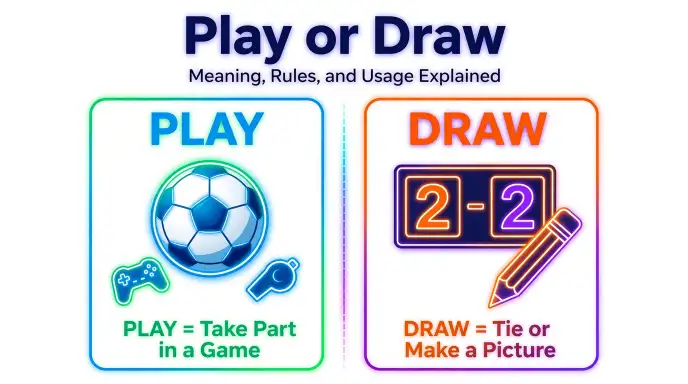
“Play or draw” usually refers to playing a game or a situation involving a draw, especially in sports. Its exact meaning depends on the context. In football, for example, a match can end in a win, a loss, or a draw.
People search for “play or draw” because they may see the phrase in sports reports, betting offers, game rules, or online discussions. They want to know if it means playing a game, choosing a draw, or describing a possible result.
The words play and draw have different meanings. “Play” can mean taking part in a game or competing against someone. “Draw” can mean making a picture, pulling something, or ending a game with equal scores. In sports, the last meaning is especially important.
Understanding the context helps you interpret the phrase correctly. This guide explains its meaning, origin, spelling, everyday use, and common mistakes so you can understand and use “play or draw” with confidence.
Play or Draw – Quick Answer
“Play or draw” describes a situation involving playing a game and possibly ending in a draw, but its exact meaning depends on the context.
- Play: Take part in a game or compete.
- Draw: Finish a game with neither side winning.
- Example: “The teams will play, and the match may end in a draw.”
In football, a draw occurs when both teams finish with the same score. Chess games can also end in a draw, meaning neither player wins. Outside sports, the word may refer to creating a picture or pulling something.
Important: “Play or draw” is not a standard spelling choice like “color or colour.” It is a phrase whose meaning depends on how people use it.
Definition and Meaning of Play or Draw
The phrase “play or draw” combines two words that have different meanings. Its exact meaning depends on where you see it.
What Does “Play” Mean?
Play means taking part in a game, sport, or activity. It can also mean using a musical instrument or acting in a role.
Examples:
- The children play football after school.
- We will play a chess match tomorrow.
- She will play the main role in the show.
What Does “Draw” Mean?
Draw has several meanings. In sports, it means a game ends without a winner. In art, it means making a picture with a pen or pencil. It can also mean pulling something toward you.
Examples:
- The football match ended in a draw.
- He likes to draw animals.
- Please draw the chair closer to the table.
What Does “Play or Draw” Mean in Football?
In football, a match can end in a win, a loss, or a draw. A draw happens when both teams finish with the same score, such as 0–0 or 2–2.
In betting markets, related terms have specific meanings. For example, “win or draw” usually means a team must win or finish level for the selection to succeed. The exact rules depend on the market.
Do not assume “play or draw” always means “win or draw.” Check the full sentence or the rules of the game to understand the intended meaning.
The Origin of Play or Draw
The words “play” and “draw” have different histories.
Play comes from Old English plegian, a word linked to playing, moving, and taking part in games. Over time, it gained wider meanings related to sport, music, acting, and recreation.
Draw comes from Old English dragan, which meant to pull or drag. Its meanings later expanded to include making pictures and describing a game that ends without a winner.
The phrase “play or draw” does not have a separate spelling history. It combines two established English words, and the meaning changes with the context.
For example, “draw” in an art class means making a picture. In a football report, it means the teams finished level.
The key difference is meaning, not spelling. Neither word has a special British or American spelling in this phrase.
British English vs American English Spelling
The words play and draw are spelled the same in British and American English. Unlike words such as “colour” and “color,” they do not have regional spelling variations.
| Usage | British English | American English |
| Play a game | Play | Play |
| Draw a picture | Draw | Draw |
| A tied football result | Draw | Draw |
| Past tense of play | Played | Played |
| Past tense of draw | Drew | Drew |
| Past participle of draw | Drawn | Drawn |
Examples in British English
- The match ended in a draw.
- The children will play outside.
- She drew a picture of her school.
Examples in American English
- The game ended in a draw.
- The children will play outside.
- She drew a picture of her school.
Both varieties use the same spelling and verb forms. The main difference may be the sporting context: in American sports, people often use “tie” where British football reports commonly use “draw.”
Which Meaning Should You Use?
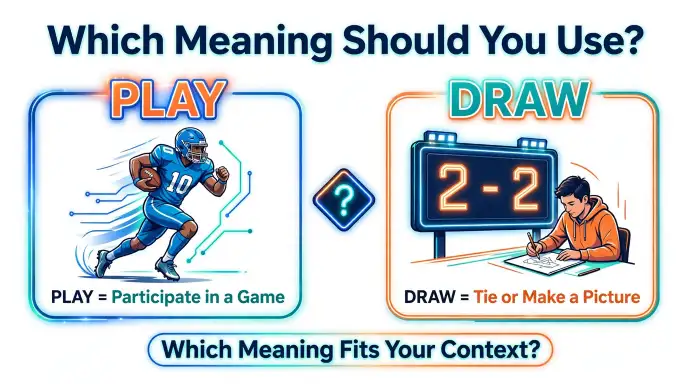
Choose the meaning that fits your audience and the situation.
For British English Readers
In British football, draw is the usual word for a match that ends with equal scores.
Example: “The match finished in a 1–1 draw.”
For American English Readers
In American English, tie is often more common when describing a game that ends with equal scores. However, “draw” is also understood and used in some sports and formal contexts.
Example: “The game ended in a 2–2 tie.”
For International Readers
Use the word that best matches the sport and the audience. If readers may not know the term, explain it.
Example: “The match ended in a draw, meaning both teams scored the same number of goals.”
For clear writing, avoid using “play or draw” without enough context. If you mean a match result, “win, lose, or draw” may express the idea more clearly.
Common Mistakes with Play or Draw
Avoid these errors to make your writing clearer.
Incorrect: The match ended in a draw tie. Correct: The match ended in a draw.
Incorrect: Yesterday, they draw the match. Correct: Yesterday, they drew the match.
Incorrect: He drawed a picture. Correct: He drew a picture.
Incorrect: The team will played tomorrow. Correct: The team will play tomorrow.
Incorrect: The match was a play. Correct: The match was a draw. (If neither team won.)
Remember: “Played” is the past tense of “play,” while “drew” is the past tense of “draw.”
Play or Draw in Everyday Examples
The words appear in sports, art, emails, news reports, and casual conversations.
In Sports News
“The teams played well, but the match ended in a draw.”
This means neither team won.
In an Email
“Are we going to play the match today, or has it been postponed?”
Here, “play” refers to taking part in the match.
On Social Media
“What a close game! I thought the match would end in a draw.”
This is a casual comment about a possible result.
In a Classroom
“Please draw a picture of your favourite animal.”
Here, “draw” means to make a picture.
In Formal Writing
“The two teams finished level, resulting in a draw.”
This is a clear way to describe a tied match.
In a Game Discussion
“We can play another round if the first game ends in a draw.”
This sentence uses both words correctly and shows how their meanings work together.
Play or Draw – Google Trends and Usage Data
People may search for “play or draw” when looking for sports results, game rules, or the meaning of a phrase. However, exact search data is needed to establish its popularity by country.
Google Trends can help compare search interest across countries and time periods. Its figures show relative interest rather than exact search counts.
To investigate this phrase, compare searches such as “play or draw,” “win or draw,” and “match draw.” Select the same time range and target countries, such as the United States and United Kingdom.
Keep these points in mind:
- Sports context: “Draw” is common in football discussions, especially in British English.
- Regional language: American readers may be more familiar with “tie” for an equal score.
- Search intent: People may want a definition, match information, or betting terminology.
- Data limits: Low search interest may not produce enough data for a reliable comparison.
Do not claim that one country searches for this exact phrase more often without checking the data.
Play vs Draw: Comparison Table
| Feature | Play | Draw |
| Main meaning | Take part in a game | Finish a game level |
| Other meaning | Perform music or act | Make a picture or pull something |
| Example | We play football. | The match ended in a draw. |
| Past tense | Played | Drew |
| Past participle | Played | Drawn |
| British spelling | Play | Draw |
| American spelling | Play | Draw |
The words are not interchangeable. Use “play” for taking part in an activity and “draw” for the intended meaning, such as an equal match result or making a picture.
Frequently Asked Questions
1. What does “play or draw” mean?
It refers to playing a game or a situation involving a draw. The exact meaning depends on the context.
2. What is a draw in football?
A draw happens when both teams finish with the same score, such as 1–1.
3. Is “play or draw” a spelling difference?
No. These are two different words with different meanings, not British and American spelling variants.
4. Is a draw the same as a tie?
In sports, both can mean that neither side wins. “Draw” is common in British football, while “tie” is common in American English.
5. What is the past tense of play?
The past tense is played. For example: “They played yesterday.”
6. What is the past tense of draw?
The past tense is drew. For example: “She drew a picture.”
7. Is “win or draw” the same as “play or draw”?
No. “Win or draw” describes two possible match results. “Play or draw” does not have one fixed meaning and needs context.
Conclusion: Understanding Play or Draw
The phrase “play or draw” can be confusing because its meaning depends on the situation. Play usually means taking part in a game or activity. Draw can mean making a picture, pulling something, or finishing a match without a winner.
In sports, a draw happens when both sides finish with the same score. For example, a football match ending 2–2 is a draw. In American English, people may use “tie” for the same result, while “draw” is common in British football.
Neither word has a different spelling in British and American English. The main difference is how people use the words in different settings.
When writing about sports, use “draw” when you mean an equal result. Use “play” when you mean taking part in a game. If you see “play or draw” in a betting market or game rule, read the full wording before deciding what it means.
By understanding the context, you can choose the right word and avoid common grammar mistakes.
Improve Your Grammar Skills!

Hi, I’m Olivia Bennett, an English grammar and spelling content writer. I enjoy exploring confusing words, spelling differences, and everyday language questions. My goal is to share clear, simple, and helpful explanations that make English easier to understand.



1 thought on “Play or Draw: Meaning, Rules, and Usage Explained”