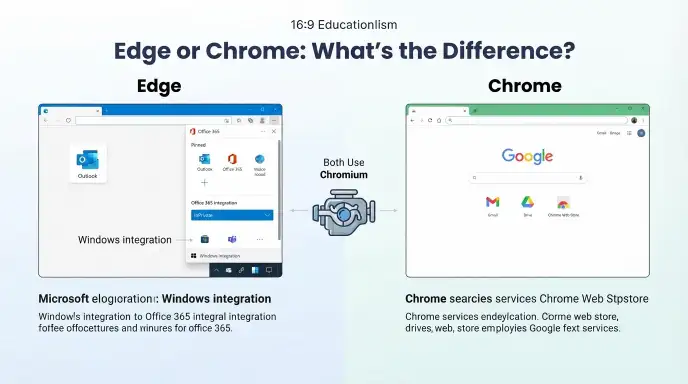
Microsoft Edge and Google Chrome are both web browsers, but Chrome is Google’s browser while Edge is Microsoft’s browser. People often search for “edge or chrome” when they want to know which browser is faster, safer, easier to use, or better for everyday browsing. The confusion is understandable because both browsers look similar and support many of the same websites and extensions.
There is also a technical reason for the similarity. Modern Edge is based on Chromium, the open source browser project that also forms the foundation of Chrome. Microsoft released the new Chromium based Edge in January 2020.
For most users, the choice depends on the device and services they use. Chrome fits naturally into the Google ecosystem, while Edge works closely with Windows and Microsoft services. Both can handle normal browsing, online shopping, email, streaming, research, and web apps.
This guide explains the difference between Edge and Chrome, their history, common mistakes, everyday usage, and current browser usage data.
Edge or Chrome: Quick Answer
Chrome is Google’s web browser, while Edge is Microsoft’s web browser. Both are modern browsers that can open websites, run web apps, save passwords, manage tabs, and support extensions.
For example:
- Chrome: Commonly used with Google Search, Gmail, Google Drive, and other Google services.
- Edge: Closely integrated with Windows and Microsoft services.
- Chrome: Uses the Chromium browser project.
- Edge: Also uses Chromium in its modern version.
Neither name is a spelling variation of the other. They are the names of two different products.
Definition and Meaning of Edge or Chrome
What Is Chrome?
Google Chrome is a web browser developed by Google. It allows users to visit websites, use online applications, watch videos, manage tabs, save passwords, and install browser extensions.
The word Chrome is a product name. In the context of web browsing, it refers specifically to Google’s browser.
Example:
I opened the website in Chrome.
What Is Edge?
Microsoft Edge is a web browser developed by Microsoft. It is designed for browsing websites and working with online services.
The word Edge is also a product name in this context. It does not mean that Edge and Chrome are different spellings of the same word.
Example:
The website works well in Microsoft Edge.
Why Do People Compare Edge and Chrome?
People often compare the two because both are Chromium based browsers and offer many similar features.
They can both:
- Open modern websites
- Support browser extensions
- Save passwords
- Manage bookmarks
- Use private browsing
- Sync information across devices
- Run web applications
- Support modern web standards
The main differences come from their companies, built in services, interfaces, account systems, and integrations.
The Origin of Edge or Chrome
Chrome and Edge have different histories.
The Origin of Chrome
In September 2008, Google launched Chrome as a new open-source web browser. The company designed it with a focus on speed, security, stability, and a simple user interface.
At the same time, the Chromium open-source project was introduced as the foundation for Chrome and future browser development.Chromium became the open source foundation used by Chrome and later by other browsers.
Chrome later became one of the most widely used browsers in the world.
The Origin of Edge
Microsoft Edge has a different history.
The original Microsoft Edge launched with Windows 10 in July 2015. It used Microsoft’s own browser technology and replaced Internet Explorer as Microsoft’s modern browser for Windows.
Microsoft later decided to rebuild Edge using Chromium. The new Chromium based Microsoft Edge was released on January 15, 2020.
This change made Edge and Chrome more closely related from a technical point of view.
Why Do Edge and Chrome Look Similar?
The biggest reason is Chromium.
Modern Edge uses the Chromium browser engine, the same open source browser project that provides the foundation for Chrome. Microsoft announced its plan to rebuild Edge on Chromium in 2019.
This means developers can often expect websites and extensions to work similarly in both browsers.
British English vs American English Spelling
“Edge” and “Chrome” are brand names, not British and American spelling variations.
There is no British spelling called Edge and an American spelling called Chrome.
| Term | Type | Meaning |
| Edge | Microsoft browser name | A web browser |
| Chrome | Google browser name | A web browser |
| Microsoft Edge | Brand/product name | Microsoft’s browser |
| Google Chrome | Brand/product name | Google’s browser |
The spelling does not change based on location.
A person in the United States writes Google Chrome, while a person in the United Kingdom also writes Google Chrome.
Likewise, the browser is called Microsoft Edge in both American and British English.
So, if you are writing about these products, always keep their official names unchanged.
Which Browser Should You Use?
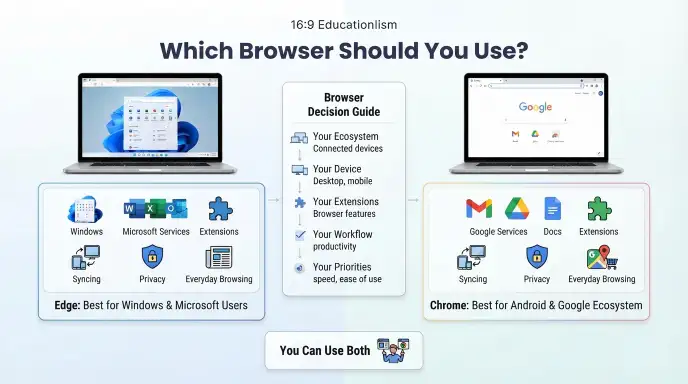
The answer depends on your needs.
If You Use Google Services
Chrome may fit naturally into a Google centered workflow.
For example, users who spend much of their time with Gmail, Google Drive, Google Docs, and other Google services may prefer Chrome because it is closely connected to the Google ecosystem.
If You Use Windows and Microsoft Services
Edge can fit naturally into a Windows and Microsoft workflow.
Users who work with Microsoft services may find Edge convenient because it is built into Windows and supports Microsoft’s ecosystem.
If You Need Common Browser Extensions
Both browsers support Chromium compatible extensions, so users have access to a large extension ecosystem.
This reduces the practical difference for many everyday users.
If You Want to Use Both
You do not have to choose only one.
Many people use Chrome for some tasks and Edge for others. For example, you might use one browser for work and another for personal browsing.
The best choice depends on your device, account ecosystem, extensions, settings, and personal workflow.
Common Mistakes with Edge or Chrome
Because the names are short and familiar, several mistakes can occur when people write about these browsers.
Mistake 1: Treating Edge and Chrome as Different Spellings
Incorrect idea:
Edge is the British version of Chrome.
Correct:
Edge and Chrome are different web browsers.
Mistake 2: Writing the Brand Name Incorrectly
Use:
Google Chrome
Not:
Google chrome
When referring to the official product, Chrome should be capitalized.
Similarly, use:
Microsoft Edge
Not:
Microsoft edge
Mistake 3: Assuming Edge Is the Old Internet Explorer
Modern Edge is not the same browser as Internet Explorer.
Microsoft’s original Edge launched in 2015, while the current Chromium based Edge was released in 2020.
Mistake 4: Assuming Chrome and Chromium Are Exactly the Same
They are closely related, but they are not identical products.
Chromium is the open source browser project. Chrome is Google’s browser built using Chromium technology.
Mistake 5: Thinking All Browser Features Are Identical
Edge and Chrome share much of their underlying technology, but their interfaces, built in features, services, settings, and integrations can differ.
Edge or Chrome in Everyday Examples
These browser names appear often in everyday technology writing.
In an Email
Please open the link in Chrome and try again.
Or:
The form works correctly in Microsoft Edge.
In Technical Support
If the page does not load, try opening it in Chrome or Edge.
In News Writing
Microsoft released a new Edge update.
Or:
Google announced a new Chrome feature.
On Social Media
Chrome keeps freezing after the latest update.
Or:
I switched to Edge for my work browser.
In Formal Writing
The website was tested in Google Chrome and Microsoft Edge.
In a Workplace Guide
Employees can access the company portal using Chrome or Edge.
These examples show that Edge and Chrome are normally used as proper product names.
Edge or Chrome: Google Trends & Usage Data
Search interest can change over time, so Google Trends should be treated as a measure of search interest rather than a direct measure of browser usage.
Current browser market share data provides a useful picture of actual browser use.
According to StatCounter’s August 2026 worldwide data, Chrome accounted for 69.39% of browser market share across all platforms, while Edge accounted for 5.36%.
Desktop usage shows a different pattern. In August 2026, Chrome had 73.28% of worldwide desktop browser share, while Edge had 10.46%.
The numbers also vary by country.
In the United States, August 2026 data showed Chrome at 54.7% and Edge at 7.37% across all platforms.
In the United Kingdom, Chrome accounted for 51.15%, while Edge accounted for 11.26%.
These figures show why people may search for “Edge or Chrome.” Both browsers are widely used, but their usage levels differ across countries and device types.
It is also important to remember that browser market share is not the same as search popularity. Market share data measures browser usage, while Google Trends measures relative search interest.
Edge vs Chrome: Quick Comparison Table
| Feature | Microsoft Edge | Google Chrome |
| Developer | Microsoft | |
| Browser engine | Chromium based | Chromium based |
| First major launch | 2015 | 2008 |
| Modern Chromium version | 2020 | Original Chromium based browser |
| Windows integration | Strong | Available |
| Google account integration | Available | Strong |
| Microsoft integration | Strong | Available |
| Extensions | Large Chromium ecosystem | Large Chromium ecosystem |
| Private browsing | Yes | Yes |
| Password management | Yes | Yes |
| Cross device syncing | Yes | Yes |
| Main product name | Microsoft Edge | Google Chrome |
Edge or Chrome: Key Differences
Although both browsers use Chromium, several practical differences remain.
1. Company Ecosystem
Chrome is part of Google’s ecosystem.
Edge is part of Microsoft’s ecosystem.
This can affect which services, accounts, and features feel more natural to you.
2. Windows Integration
Edge has a close relationship with Windows because both are Microsoft products.
This can make Edge a natural choice for users who spend most of their time in Windows and Microsoft services.
3. Google Integration
Chrome is closely connected to Google’s services.
If your daily work depends heavily on Google accounts and services, Chrome can provide a familiar workflow.
4. Similar Website Compatibility
Because modern Edge is Chromium based, many websites that work in Chrome also work in Edge.
This is one reason the two browsers can feel similar during everyday browsing.
5. Different Built In Features
The browsers can offer different built in tools, settings, privacy controls, and productivity features.
For this reason, choosing between them is not only about the browser engine.
FAQs About Edge or Chrome
1. Is Edge the same as Chrome?
No. Edge and Chrome are different browsers made by Microsoft and Google. However, modern Edge and Chrome both use Chromium technology.
2. Which is Chrome or Edge?
Chrome is made by Google, while Edge is made by Microsoft. Both are modern Chromium based browsers with similar website compatibility.
3. Is Edge based on Chrome?
Edge is not based directly on the Chrome product. Modern Edge is based on Chromium, the open source project that also forms the foundation of Chrome.
4. Is Microsoft Edge a spelling variation of Chrome?
No. Edge and Chrome are product names for two different web browsers. They are not British and American spelling variants.
5. When was Chrome launched?
Google launched Chrome in September 2008. It was introduced as a new open source browser focused on speed, security, stability, and a simple interface.
6. When was the modern Edge released?
The Chromium based Microsoft Edge was released on January 15, 2020. The original Edge had launched with Windows 10 in 2015.
7. Can I use both Edge and Chrome?
Yes. You can install and use both browsers on the same computer. Many users keep more than one browser for different tasks.
Conclusion
Edge and Chrome are two different web browsers, not two different spellings of the same word. Google Chrome belongs to Google, while Microsoft Edge belongs to Microsoft. Both support modern websites, browser extensions, password management, private browsing, and many other common features.
Chrome was launched by Google in 2008, while the original Edge arrived with Windows 10 in 2015. Microsoft later rebuilt Edge on Chromium, and the new version launched in January 2020.
For everyday users, the main difference is often the ecosystem. Chrome fits closely with Google services, while Edge has strong connections with Windows and Microsoft services. Both can be used for work, study, entertainment, research, and normal web browsing.
Current usage data also shows that Chrome has a larger worldwide browser share, while Edge has a significant desktop presence.
The simple rule is this: use Chrome when referring to Google’s browser and Edge when referring to Microsoft’s browser. They are product names, so their spelling does not change between American and British English.
Discover More About Correct Spelling!

Hi, I’m Olivia Bennett, an English grammar and spelling content writer. I enjoy exploring confusing words, spelling differences, and everyday language questions. My goal is to share clear, simple, and helpful explanations that make English easier to understand.








1 thought on “Edge or Chrome: Which Browser Should You Use?”