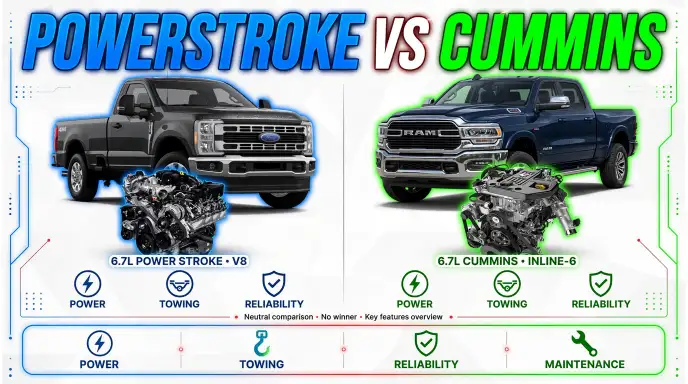
Choosing between Powerstroke or Cummins can be difficult if you want a powerful, reliable diesel truck. Both engine families have loyal fans, strong towing capabilities, and a long history in heavy-duty pickups. However, they differ in design, maintenance needs, truck applications, and the way they deliver power.
Power Stroke and Cummins are both respected diesel engine choices, but neither is automatically better for every driver. Ford uses Power Stroke engines in its Super Duty trucks, while Cummins diesel engines are widely known for their use in Ram heavy-duty pickups. Your best choice depends on the truck model, engine generation, towing needs, budget, and maintenance history.
People often compare these engines when shopping for a used diesel truck, planning to tow a heavy trailer, or deciding which truck will last longer. Some drivers prioritize low-end torque, while others care more about horsepower, repair costs, fuel economy, or ease of maintenance.
This guide compares Power Stroke and Cummins in simple terms. You will learn how they differ, where their names come from, what to consider before buying, and how to choose the right diesel engine for your needs.
Powerstroke or Cummins: The Quick Answer
Power Stroke is Ford’s diesel engine family, while Cummins is an engine manufacturer whose diesel engines power many Ram heavy-duty trucks. Cummins is especially well known for its inline-six diesel engines, while Ford’s Power Stroke lineup includes different engine designs across model years. The better option depends on the specific engine, truck, workload, and maintenance record.
Powerstroke or Cummins: Quick Answer
The choice comes down to your priorities:
- Choose Power Stroke if you prefer a Ford Super Duty truck and want its combination of diesel power, towing features, and Ford truck technology.
- Choose Cummins if you prefer a Ram 2500 or 3500 and value the inline-six engine design and its long history in heavy-duty pickups.
- Compare specific model years if you are buying used. Reliability, repair costs, and performance can vary greatly between generations.
For example, a well-maintained older Cummins may be a better buy than a poorly maintained Power Stroke. The reverse can also be true.
What Does Power Stroke or Cummins Mean?
What Is a Power Stroke Engine?
Power Stroke is Ford’s name for its diesel engine family. These engines are used in Ford Super Duty trucks and have appeared in several other Ford vehicles over the years.
Modern 6.7-liter Power Stroke engines use a V8 layout with turbocharging. Different generations have different power ratings and technical features.
Power Stroke engines are designed to handle demanding work, including towing trailers, hauling equipment, and transporting heavy loads. Their performance depends on the engine generation and the truck’s configuration.
What Is a Cummins Engine?
Cummins is the name of an independent engine manufacturer. Its diesel engines are used in many types of vehicles and equipment, including Ram heavy-duty pickups.
The familiar 5.9-liter and 6.7-liter Cummins pickup engines use an inline-six layout, with six cylinders arranged in a straight line.
Cummins engines are popular among truck owners who want strong low-speed pulling power and a diesel engine with a long service history. However, the truck’s transmission, cooling system, emissions equipment, and maintenance all affect its real-world performance.
Are Power Stroke and Cummins the Same Thing?
No. Both are diesel engine options, but they are different engine families made by different manufacturers.
Power Stroke is Ford’s engine brand. Cummins is an engine manufacturer that supplies engines for different applications, including Ram pickups. The two names are not different spellings of the same word, and they cannot be used interchangeably when identifying a truck.
The Origin of Power Stroke and Cummins
How Did the Power Stroke Name Begin?
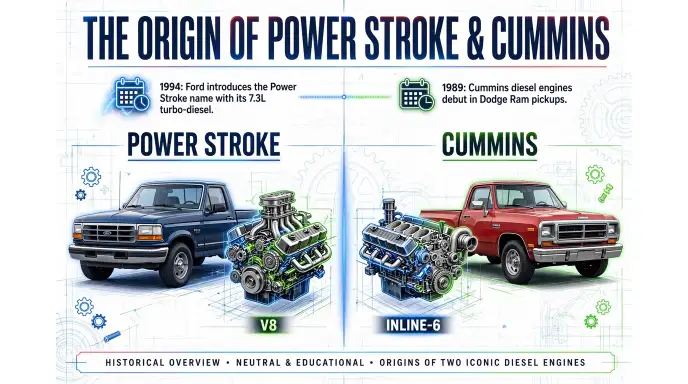
Ford’s diesel history began before the Power Stroke name became familiar. Ford introduced the Power Stroke branding with its 7.3-liter direct-injection turbo-diesel in the 1994 model year. Later generations included the 6.0-liter, 6.4-liter, and 6.7-liter engines.
Each generation brought changes in power, fuel injection, turbocharger design, and emissions control. This is why the phrase “Power Stroke reliability” does not describe one single engine experience.
A used-truck buyer should identify the exact engine and model year before judging its strengths or weaknesses.
How Did Cummins Become Popular in Pickup Trucks?
Cummins was founded in 1919 and built its reputation through diesel-engine development for a wide range of applications. Its partnership with Ram helped make the Cummins name well known among pickup owners.
The 5.9-liter inline-six became a familiar choice in Ram trucks. In 2007, the 6.7-liter engine replaced the 5.9-liter in Ram pickups, bringing greater displacement and updated technology.
Modern Cummins pickup engines have continued to evolve. Newer models use advanced fuel systems and emissions equipment, so older engines should not be treated as identical to current ones.
British English vs American English
Power Stroke and Cummins are brand names, not regional spelling alternatives. British English and American English do not use separate versions of these engine names.
| Context | Preferred form | Example |
| Ford diesel engine | Power Stroke | The truck has a 6.7-liter Power Stroke engine. |
| Informal search term | Powerstroke | He searched for Powerstroke towing reviews. |
| Cummins engine brand | Cummins | The Ram uses a Cummins diesel. |
| American truck discussion | Power Stroke or Cummins | Which engine is better for towing? |
| British or international writing | Official brand names | Compare the Power Stroke with the Cummins engine. |
Use Power Stroke in formal writing because it matches Ford’s official branding. People often type “Powerstroke” as one word in online searches, but that does not make it a different engine.
Cummins remains Cummins in both American and British English. Neither brand has a separate British spelling.
Which Version Should You Choose?
The best diesel engine depends on how you plan to use the truck. Consider these factors before choosing between Power Stroke and Cummins.
United States
Both engines are popular in the American heavy-duty pickup market. Choose a Ford Super Duty with Power Stroke if you prefer Ford’s truck platform. Choose a Ram 2500 or 3500 with Cummins if you prefer Ram’s design, features, and driving experience.
Compare the exact truck configurations rather than relying on the engine name alone.
United Kingdom
If you are buying a used or imported American pickup in the UK, check parts availability, specialist repair support, emissions requirements, and vehicle registration rules. The best engine is one you can maintain properly where you live.
Canada
Both engine families can suit towing, farm work, and cold-weather driving. Look for a truck with suitable cold-start equipment, a healthy battery, proper winter maintenance, and a service history that matches its operating conditions.
Australia
For an imported American heavy-duty pickup, consider local servicing, replacement parts, towing regulations, and the availability of suitable diesel fuel. Verify that the vehicle and its modifications comply with applicable requirements.
International, Academic, and Business Writing
For formal articles, use the correct brand names: Power Stroke and Cummins. In a technical report, identify the engine displacement, model year, and truck model. In business or fleet purchasing, compare total operating costs, warranty terms, maintenance support, and vehicle capability.
Power Stroke vs Cummins: Performance and Reliability
The engine layout, power output, maintenance history, and supporting components all affect performance. Neither brand wins every category.
1. Engine Design
Power Stroke’s modern heavy-duty pickup engine is a 6.7-liter V8 diesel. The cylinders sit in two banks, forming a V shape.
The familiar Cummins pickup engine is a 6.7-liter inline-six diesel. Its six cylinders sit in one straight row. This layout is one reason Cummins engines have a distinctive design and a strong following among diesel enthusiasts.
The layout alone does not prove that one engine is more reliable. Materials, engineering, operating temperatures, maintenance, and component design also matter.
2. Horsepower and Torque
Horsepower measures the rate at which an engine can do work. Torque measures its twisting force, which is important when moving heavy loads.
The following figures show why you must compare the actual model year and engine version.
| Specification | 2026 Ford 6.7L Power Stroke | 2026 Ford 6.7L High Output Power Stroke |
| Engine layout | V8 diesel | V8 diesel |
| Horsepower | 475 hp | 500 hp |
| Torque | 1,050 lb-ft | 1,200 lb-ft |
These figures represent Ford’s published specifications for its 2026 Super Duty diesel options. They are not a direct comparison with Cummins because equivalent Ram specifications and configurations must also be considered.
For towing, do not judge a truck by torque alone. The transmission, axle ratio, cooling system, brakes, suspension, tires, and rated towing limits all affect what it can safely pull.
3. Reliability and Engine Life
Many owners report long service from both engine families, but there is no universal mileage figure that guarantees either one will last longer.
A truck’s history can matter more than its badge. Regular oil changes, proper fuel filtration, correct coolant, timely repairs, and sensible towing practices can help protect an engine.
When buying used, check:
- Complete maintenance records.
- Signs of coolant or oil leaks.
- Cold-start behavior and unusual smoke.
- Turbocharger and fuel-system condition.
- Diagnostic trouble codes.
- Emissions-system condition.
- Evidence of heavy tuning or modifications.
A professional diesel inspection is worthwhile before spending money on an older truck.
4. Maintenance and Repair Costs
Neither engine is guaranteed to be cheaper to maintain. Costs depend on the model year, engine design, parts prices, labor rates, and the type of repair.
Modern diesel engines also use emissions equipment that can add complexity and repair costs. A truck’s diesel particulate filter, exhaust after-treatment components, and related systems should be checked as part of a pre-purchase inspection.
Older engines may have fewer modern emissions components, but age and wear can bring their own problems. Do not assume that an older truck will always be cheaper to own.
5. Fuel Economy
Fuel economy varies with truck weight, gearing, tires, driving speed, trailer weight, terrain, and maintenance. A heavy truck towing a large trailer will usually use more fuel than the same truck traveling unloaded.
Do not assume Cummins always delivers better mileage or that Power Stroke always uses more fuel. Compare real-world records for the same type of truck and workload.
For a fair comparison, use similar routes, loads, speeds, and driving conditions. Also consider the cost of diesel fuel and the annual distance you expect to travel.
6. Towing and Heavy Work
Both engine families are designed for demanding work, but towing capacity is a truck specification, not just an engine specification.
For example, certain properly equipped 2026 Ford Super Duty configurations offer a maximum available gooseneck towing capacity of 40,000 pounds. That figure does not apply to every Super Duty truck, and it should not be compared with a Ram’s maximum without matching the relevant configurations.
Before buying, check the manufacturer’s towing guide and the truck’s own ratings. Pay attention to payload, tongue or pin weight, gross combined weight rating, and the trailer’s loaded weight.
Common Mistakes When Comparing Power Stroke and Cummins
These are some common errors that can lead to a poor buying decision.
| Incorrect assumption | Better approach | Why it matters |
| Every Cummins is more reliable than every Power Stroke. | Compare exact generations and service records. | Reliability varies by engine and condition. |
| More torque always means better towing. | Check the full truck’s towing ratings. | The chassis and other components also set limits. |
| All 6.7-liter diesels are alike. | Identify the manufacturer and model year. | Displacement alone does not identify an engine. |
| The cheapest used truck is the best deal. | Calculate likely repairs and maintenance. | A low purchase price can hide expensive problems. |
| One brand always gets better fuel economy. | Compare similar trucks under similar conditions. | Driving and load have a major effect on consumption. |
Memory tip: Compare the complete truck, not just the engine badge.
Everyday Examples
Here are examples of how to discuss the two engine families in different situations.
- Daily conversation: “I’m comparing Power Stroke and Cummins before buying a diesel truck.”
- Email: “Could you send me the maintenance records for the Cummins-powered Ram?”
- Business writing: “The fleet team will compare Power Stroke and Cummins trucks based on operating costs and towing requirements.”
- News headline: “Power Stroke vs Cummins: What Heavy-Duty Truck Buyers Should Know”
- Blog: “This guide compares engine design, performance, maintenance, and reliability.”
- Social media: “Would you choose a Ford Power Stroke or a Ram Cummins for towing?”
- Academic or technical writing: “The report evaluates the performance and service requirements of two heavy-duty diesel engine families.”
These examples use the names correctly and show how the comparison fits different contexts.
Google Trends and Modern Usage
Searches for “Powerstroke or Cummins” often come from people comparing used trucks, researching diesel reliability, choosing a towing vehicle, or joining discussions about Ford and Ram pickups.
The wording is common in online communities because buyers want a simple answer to a complex decision. However, the phrase covers many engine generations, so search results may discuss very different trucks.
There is no single popularity figure in this article that establishes which engine is searched more often. Exact Google Trends results depend on the selected time period, location, search category, and terms being compared. A current comparison should be checked directly in Google Trends rather than estimated.
For the most useful research, compare terms such as:
- Power Stroke vs Cummins
- 6.7 Power Stroke vs 6.7 Cummins
- Cummins vs Power Stroke reliability
- Best diesel engine for towing
- Power Stroke vs Cummins maintenance costs
Be sure to compare similar model years whenever possible. A search about an older 5.9-liter Cummins is not equivalent to one about a newer 6.7-liter Power Stroke.
Power Stroke vs Cummins: Quick Comparison Table
| Feature | Power Stroke | Cummins |
| Manufacturer or brand | Ford diesel engine family | Diesel engine manufacturer |
| Common heavy-duty pickup | Ford Super Duty | Ram 2500 and 3500 |
| Modern pickup engine layout | 6.7L V8 | 6.7L inline-six |
| Towing capability | Depends on truck configuration | Depends on truck configuration |
| Reliability | Depends on generation and care | Depends on generation and care |
| Repair costs | Vary by model and repair | Vary by model and repair |
| Best choice | Drivers who prefer Ford trucks | Drivers who prefer Ram trucks |
Key Takeaways
- Power Stroke is Ford’s diesel engine family, while Cummins is an engine manufacturer.
- Modern heavy-duty Power Stroke pickups use a 6.7-liter V8 diesel.
- The familiar 6.7-liter Cummins pickup engine uses an inline-six layout.
- Both engine families can deliver strong towing performance.
- Reliability depends on the specific generation, maintenance, and operating conditions.
- Fuel economy and repair costs vary with the truck, its condition, and how it is used.
- Always compare official towing and payload ratings before hauling heavy loads.
- A thorough inspection is especially important when buying a used diesel truck.
Frequently Asked Questions
1. Is Power Stroke or Cummins more reliable?
Neither brand is always more reliable. Both have engines with strong reputations, as well as generations that require careful inspection. Maintenance, operating conditions, previous repairs, and engine design all matter. If you are buying used, compare the exact model year and engine version, review service records, and arrange a professional inspection before deciding.
2. Is Cummins better than Power Stroke for towing?
Both can be excellent towing engines. The better choice depends on the truck’s rated towing capacity, payload, transmission, axle ratio, and intended workload. Check the manufacturer’s towing guide for the exact model and configuration. Do not choose based on torque figures alone, because the engine is only one part of a safe towing setup.
3. Does Cummins last longer than Power Stroke?
There is no universal mileage limit that proves one brand lasts longer. Both engine families can provide many years of service with proper care. An engine that receives regular maintenance and avoids overheating may outlast a neglected engine from either brand. Check service history and current condition instead of relying on brand reputation alone.
4. Which diesel engine has more horsepower?
The answer depends on the engine version and model year. For example, Ford’s 2026 Super Duty offers a standard-output 6.7-liter Power Stroke rated at 475 horsepower and a high-output version rated at 500 horsepower. To compare it fairly with Cummins, use the official specifications for the matching Ram model year and configuration.
5. Is Power Stroke a Ford engine?
Yes. Power Stroke is Ford’s diesel engine brand. Its engines have appeared in several generations of Ford trucks, including the Super Duty lineup. The 7.3-liter, 6.0-liter, 6.4-liter, and 6.7-liter versions differ in design and technology. When researching reliability, identify the particular engine rather than treating every Power Stroke as the same.
6. Is Cummins only used in Ram trucks?
No. Cummins manufactures diesel engines for a range of applications, including commercial vehicles, industrial equipment, and other machinery. Its pickup-truck engines are especially associated with Ram heavy-duty pickups.
7. Which engine is cheaper to maintain, Power Stroke or Cummins?
Neither is consistently cheaper across all generations. Repair costs depend on parts, labor, engine condition, fuel-system design, turbochargers, emissions equipment, and the type of failure.
8. Which engine is better for a daily driver?
Either can work as a daily driver if you need a heavy-duty truck. However, diesel pickups can be expensive to run if most journeys are short or the truck rarely carries heavy loads. Consider purchase cost, fuel use, maintenance, parking, and your actual workload.
9. Is the 6.7 Power Stroke better than the 6.7 Cummins?
Neither is automatically better. Both engines have different layouts, engineering choices, and power ratings that change with model year. Compare the exact Ford and Ram trucks you are considering, including their transmission, towing ratings, maintenance requirements, and service history.
Conclusion
Power Stroke and Cummins are two leading names in the heavy-duty diesel truck market, but they serve different truck platforms. Power Stroke is Ford’s diesel engine family, while Cummins is a manufacturer known for its inline-six pickup engines and many other diesel applications.
Neither is the clear winner in every situation. Both can provide strong pulling power, but reliability, fuel economy, maintenance costs, and towing ability depend on the exact engine generation and truck configuration.
If you prefer a Ford Super Duty, a Power Stroke may be the natural choice. If you prefer a Ram 2500 or 3500, Cummins is worth considering. When buying used, focus on maintenance records, mechanical condition, known issues for the specific model year, and the availability of qualified repair support.
For heavy towing, check the manufacturer’s ratings rather than relying on horsepower or torque alone. If you drive mainly around town, consider if a heavy-duty diesel is worth the added ownership costs.
The best choice is not simply Power Stroke or Cummins. It is the well-maintained truck that fits your workload, budget, and long-term needs. Share your thoughts with other diesel enthusiasts and explore more engine comparisons before making your final decision.
Learn more grammar!

I’m Ethan Carter, a grammar-focused writer and English language enthusiast at SpellGrammar. I enjoy explaining confusing words, spelling differences, and grammar rules in clear, simple language. My goal is to help readers write with greater accuracy and confidence in everyday and professional English.








1 thought on “Powerstroke or Cummins: Which Diesel Engine Is Better?”